BJP says no to Mayawati's request on SC/ST Bill passage

September 5, 2012

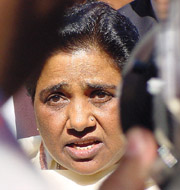
Mayawathi

New Delhi, September 5: Rejecting BSP chief Mayawati's request to allow Parliament to pass reservation in promotion Bill, BJP today decided it will continue to force adjournment of both the Houses on coal block allocation issue.

BJP parliamentary party floor leader held a meeting here under the chairmanship of L K Advani to discuss the party strategy in the Rajya Sabha when the reservation in promotion of SC/ST employees is introduced and discussed for passage tomorrow.

Party sources said BJP will not allow the House to function and press for its three demands--Prime Minister Manmohan Singh's resignation, cancellation of 142 coal block allocations and a fair and impartial probe.

Party leaders said it has been decided that BJP will not accede to Mayawati's request that the House to be allowed to function for a short duration to pass the Constitutional amendement needed for the proposed legislation.

BJP is in principle supporting the Bill but feels the government is bringing this legislation to divert attention from the coal block issue. Mayawati met the Leader of the Opposition Sushma Swaraj and her Rajya Sabha counterpart Arun jaitley today afternoon and requested them to help in passage of the Bill which was cleared by union cabinet in the morning.

SP is likely to disrupt the introduction of the Bill in the Upper House as it wants concessions for OBC also to be included in the Bill.

Meanwhile, BJP issued a whip to all its MPs to be present in both the Houses tomorrow, party sources said.


Comments

Add new comment

  • Coastaldigest.com reserves the right to delete or block any comments.
  • Coastaldigset.com is not responsible for its readers’ comments.
  • Comments that are abusive, incendiary or irrelevant are strictly prohibited.
  • Please use a genuine email ID and provide your name to avoid reject.
Agencies
July 12,2020

Jaipur/New Delhi, Jul 12: The crisis in Rajasthan Congress has deepened with state Chief Minister Ashok Gehlot and his deputy Sachin Pilot at loggerheads.

While Gehlot is blaming BJP for trying to destabilise the state government by poaching MLAs, Pilot is camping in Delhi to speak to the party leadership regarding the political turmoil in the state.

According to sources, Pilot has sought an appointment with party's interim president Sonia Gandhi but time for the meeting has not yet been given by her. Although Pilot met another party leader to apprise him about the situation in the state and spelled out his grievance.

As of now, many MLAs, who are believed to be in the Pilot camp, are also in Delhi to meet the party leadership. According to sources, the deputy chief minister has the support of nearly 30 Congress MLAs along with many independent legislators.

It is important to note that the controversy broke out in Rajasthan after Special Operation Group (SOG) sent a notice to Sachin Pilot to record his statement in the case registered by SOG in the alleged poaching of Congress MLAs in the state. The clash between Gehlot and Pilot is also over the post of PCC Chief as Gehlot Camp wants that 'One Leader One Post' formula to be implemented in Rajasthan. Currently, Sachin Pilot is heading the PCC besides holding the Deputy CM post.

Sources close to Sachin Pilot have informed that the young leader is upset with the notice issued to him. He believes it is aimed to record his phone calls and keep him under surveillance. Many of Pilot's supporters feel indignation and told Pilot that they cannot work with Ashok Gehlot. Also, Pilot is unlikely to attend the meeting called by Gehlot today, according to sources.

While the top leadership of the party is keeping mum, sources say it is keeping a watch on the development. General Secretary KC Venugopal has taken up the matter of the rift with the party's top brass with them not happy about it.

Rajasthan AICC Incharge Avinash Pandey told media persons: "Everything is under control. Few MLAs had issues and after discussion, they have returned back to Jaipur and others are also in touch. BJP's attempt of destabilising the government will not be successful in Rajasthan and government is stable."

Gehlot also held a meeting with ministers last night in Jaipur.  According to Gehlot camp, the top leadership is apprised of the development of the poaching attempt in the state. Amid Political Crisis Rajasthan CM Ashok Gehlot called a meeting of Ministers and all Cong MLAs tonight at his residence.

The Rajasthan crisis has alerted the other senior leaders of the party who have opined that the Madhya Pradesh incident should not get repeated in Rajasthan.

Former Union Minister and Rajya Sabha MP Kapil Sibbal tweeted, "Worried for our party. Will we wake up only after the horses have bolted from our stables?"

Comments

Add new comment

  • Coastaldigest.com reserves the right to delete or block any comments.
  • Coastaldigset.com is not responsible for its readers’ comments.
  • Comments that are abusive, incendiary or irrelevant are strictly prohibited.
  • Please use a genuine email ID and provide your name to avoid reject.
coastaldigest.com news network
June 17,2020

Prime Minister Narendra Modi, who had maintained silence on Chinese aggression and massacre of Indian in eastern Ladakh, now issued a statement saying ‘India wants peace’. He added that India is capable of giving a befitting reply if provoked. 

The prime minister started his meeting with chief ministers on the Covid-19 with a two-minute silence as a tribute to the 20 soldiers who were killed in action in Galwan Valley this week. As he spoke, it became clear that the message was aimed not just at reassuring the nation but also delivering a sharp message to Beijing.

“I would like to assure the nation that the sacrifice of our jawans will not be in vain. For us, the unity and sovereignty of the country is the most important,” PM Modi said. Home minister Amit Shah and defence minister Rajnath Singh were also present in the meeting.

Over twenty Indian soldiers were killed in the violent face-off which took place in Eastern Ladakh on Monday. The troops fought each other with fists and rocks. After the clash, the two sides “disengaged” from the area where the fighting happened, the Indian army statement said. A news agency quoting sources said four Indian soldiers are in critical condition after the face-off.

Defence minister Rajnath Singh mourned the death of 20 Indian soldiers. “The loss of soldiers in Galwan is deeply disturbing and painful. Our soldiers displayed exemplary courage and valour in the line of duty and sacrificed their lives in the highest traditions of the Indian Army,” he said in a statement.

“The Nation will never forget their bravery and sacrifice. My heart goes out to the families of the fallen soldiers. The nation stand shoulder to shoulder with them in this difficult hour. We are proud of the bravery and courage of India’s bravehearts,” the minister further said in the statement posted on Twitter.

These are the first Indian casualties in a border skirmish with PLA since October 1975 when Chinese troops ambushed an Indian patrol in Arunachal Pradesh’s Tulung La sector and shot four soldiers dead.

Comments

Add new comment

  • Coastaldigest.com reserves the right to delete or block any comments.
  • Coastaldigset.com is not responsible for its readers’ comments.
  • Comments that are abusive, incendiary or irrelevant are strictly prohibited.
  • Please use a genuine email ID and provide your name to avoid reject.
News Network
January 13,2020

Jan 13: For the first time in years, the government of India’s Prime Minister Narendra Modi is playing defense. Protests have sprung up across the country against an amendment to India’s laws — which came into effect on Friday — that makes it easier for members of some religions to become citizens of India. The government claims this is simply an attempt to protect religious minorities in the Muslim-majority countries that border India; but protesters see it as the first step toward a formal repudiation of India’s constitutionally guaranteed secularism — and one that must be resisted.

Modi was re-elected prime minister last year with an enhanced majority; his hold over the country’s politics is absolute. The formal opposition is weak, discredited and disorganized. Yet, somehow, the anti-Citizenship Act protests have taken hold. No political party is behind them; they are generally arranged by student unions, neighborhood associations and the like.

Yet this aspect of their character is precisely what will worry Modi and his right-hand man, Home Minister Amit Shah. They know how to mock and delegitimize opposition parties with ruthless efficiency. Yet creating a narrative that paints large, flag-waving crowds as traitors is not quite that easy.

For that is how these protests look: large groups of young people, many carrying witty signs and the national flag. They meet and read the preamble to India’s Constitution, into which the promise of secularism was written in the 1970’s.

They carry photographs of the Constitution’s drafter, the Columbia University-trained economist and lawyer B. R. Ambedkar. These are not the mobs the government wanted. They hoped for angry Muslims rampaging through the streets of India’s cities, whom they could point to and say: “See? We must protect you from them.” But, in spite of sometimes brutal repression, the protests have largely been nonviolent.

One, in Shaheen Bagh in a Muslim-dominated sector of New Delhi, began simply as a set of local women in a square, armed with hot tea and blankets against the chill Delhi winter. It has now become the focal point of a very different sort of resistance than what the government expected. Nothing could cure the delusions of India’s Hindu middle class, trained to see India’s Muslims as dangerous threats, as effectively as a group of otherwise clearly apolitical women sipping sweet tea and sharing their fears and food with anyone who will listen.

Modi was re-elected less than a year ago; what could have changed in India since then? Not much, I suspect, in most places that voted for him and his party — particularly the vast rural hinterland of northern India. But urban India was also possibly never quite as content as electoral results suggested. India’s growth dipped below 5% in recent quarters; demand has crashed, and uncertainty about the future is widespread. Worse, the government’s response to the protests was clearly ill-judged. University campuses were attacked, in one case by the police and later by masked men almost certainly connected to the ruling party.

Protesters were harassed and detained with little cause. The courts seemed uninterested. And, slowly, anger began to grow on social media — not just on Twitter, but also on Instagram, previously the preserve of pretty bowls of salad. Instagram is the one social medium over which Modi’s party does not have a stranglehold; and it is where these protests, with their photogenic signs and flags, have found a natural home. As a result, people across urban India who would never previously have gone to a demonstration or a political rally have been slowly politicized.

India is, in fact, becoming more like a normal democracy. “Normal,” that is, for the 2020’s. Liberal democracies across the world are politically divided, often between more liberal urban centers and coasts, and angrier, “left-behind” hinterlands. Modi’s political secret was that he was that rare populist who could unite both the hopeful cities and the resentful countryside. Yet this once magic formula seems to have become ineffective. Five of India’s six largest cities are not ruled by Modi’s Bharatiya Janata Party in any case — the financial hub of Mumbai changed hands recently. The BJP has set its sights on winning state elections in Delhi in a few weeks. Which way the capital’s voters will go is uncertain. But that itself is revealing — last year, Modi swept all seven parliamentary seats in Delhi.

In the end, the Citizenship Amendment Act is now law, the BJP might manage to win Delhi, and the protests might die down as the days get unmanageably hot and state repression increases. But urban India has put Modi on notice. His days of being India’s unifier are over: From now on, like all the other populists, he will have to keep one eye on the streets of his country’s cities.


Comments

Add new comment

  • Coastaldigest.com reserves the right to delete or block any comments.
  • Coastaldigset.com is not responsible for its readers’ comments.
  • Comments that are abusive, incendiary or irrelevant are strictly prohibited.
  • Please use a genuine email ID and provide your name to avoid reject.