



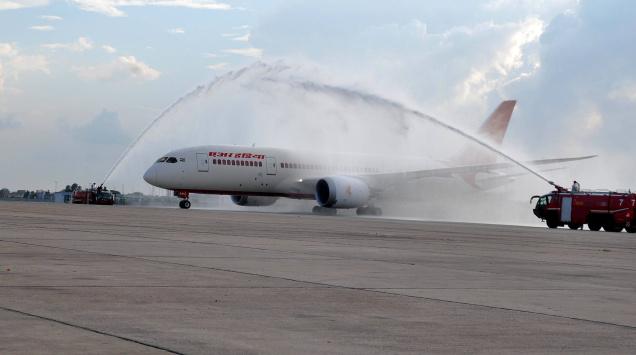
AI gets its first Dreamliner

September 8, 2012

air_copy


New Delhi, September 8: The advanced Boeing 787 Dreamliner of Air India touched down at Delhi's IGI Airport today, ending an over four-year wait of the struggling national carrier to add this next-generation airplane in its fleet.

The plane, painted in red and yellow livery of Air India, landed at the main runway of the airport at 1705 hours and was given water-cannon salute as it taxied to the bay. After parking, a small religious ceremony was conducted to welcome the aircraft in the presence of Air India CMD Rohit Nandan and senior Civil Aviation Ministry and airline officials.

The Dreamliner took 15 hours of flying time from Boeing's Charleston factory in South Carolina in the US to Delhi, plus a 90-minute stopover at Frankfurt for re-fuelling, the commander of the aircraft, Capt A S Soman, told PTI.

"It was a very smooth flight. It has a very quite cabin and there is much less fatigue (for the pilot). It is both a pilot and passenger friendly airplane," he said. Air India, which ordered 27 Dreamliners six years ago, would get two more of these planes in the next few weeks. A total of eight of them would arrive by March next year, including five by December, while the national carrier would get six more in the 2012-13 fiscal.

The aircraft would ultimately become the mainstay of Air India's global operations and is key to its turnaround plan. For Air India, the plane has been configured to have 256 seats -- 18 full-flat Business Class seats and 238 in Economy. It features a host of sophisticated technologies, including mood-lighting inside the cabin and large LCD display screens for in-flight entertainment.

For the next two months, Air India would use the B-787s to operate on select sectors like Delhi-Dubai, Delhi-Kolkata, Delhi-Bangalore and Delhi-Amritsar for the crew to practice more landings and take-offs. So far, a total 65 pilots have been trained to fly this plane.

The mid-size plane has four variants, with the longest -range one capable of flying over 15,000 kms non-stop. By December, Air India would introduce these aircraft on new long-haul sectors like Melbourne and Sydney, apart from the older ones like Japan, Middleast and several European destinations.

A top official of its manufacturer Boeing recently described the aircraft as "the fundamentally right aircraft for Air India's turnaround plan". The plane, made of carbon composite material, is light- weight and is considered less of a fuel guzzler. Boeing claims the plane consumes 20 per cent less fuel compared with the similar-sized B-767s, thereby lowering flying costs.

The first batch was supposed to be delivered in September 2008 but design and production issues at Boeing delayed deliveries. According to Boeing, the aircraft was ready for delivery in May but it got delayed over finalisation of compensation agreement between Air India and the aircraft manufacturer. The agreement deals with the compensation to be given by the US aircraft major for almost four-year delay in deliveries.

Air India was the world's second carrier to have placed orders for this aircraft. Delays in clearing of the agreement and in the plane's deliveries to Air India, made it the fifth airline to get it.

Theairlines which have inducted and are already operating this aircraft are Japan's All Nippon Airways, Japan Airlines, Ethiopian Airways and Lan Airlines of Chile.

Comments

Add new comment

  • Coastaldigest.com reserves the right to delete or block any comments.
  • Coastaldigset.com is not responsible for its readers’ comments.
  • Comments that are abusive, incendiary or irrelevant are strictly prohibited.
  • Please use a genuine email ID and provide your name to avoid reject.
News Network
June 13,2020

New Delhi, Jun 13: About 56 per cent of children were found to have no access to smartphones which have emerged as essential tools for online learning during the coronavirus-induced lockdown, according to a new study that surveyed 42,831 students at various school levels.

The study ''Scenario amidst COVID 19 - Onground Situations and Possible Solutions'' was conducted by child rights NGO Smile Foundation with an aim of analysing the access to technology.

The findings of the study showed that 43.99 per cent of surveyed children have access to smartphones and another 43.99 per cent of students have access to basic phones while 12.02 per cent do not have access to either smartphones or basic phones.

A total of 56.01 per cent children were found to have no access to smartphones, the study said.

"Concerning television, it was noted that while 68.99 per cent have access to TV, a major chunk of 31.01 per cent does not. Hence suggesting that using smartphone interventions for enhancing learning outcomes is not the only solution," it said.

At the primary level of education (class 1 to 5) 19,576 children were surveyed while at upper primary level (class 6 to 8) 12,277 children were surveyed. At secondary level of education (class 9 to 10) 5,537 children were surveyed and at higher secondary level (class 11 to 12) 3,216 children were surveyed.

The survey based on which the study was conducted used two approaches - over the telephone wherein the NGO reached out to the children whose database it already had -- students enrolled in various education centres of the NGO -- and second was through community mobilization wherein community workers went door to door to get answers.

The survey was conducted in 23 states, including Delhi, Gujarat, Maharashtra, Karnataka, Tamil Nadu, West Bengal, Andhra Pradesh, Telangana, Uttar Pradesh, Haryana, over a period of 12 days from April 16 to April 28.

The lockdown induced by the COVID-19 pandemic in March prompted schools and colleges to move to the virtual world for teaching and learning activities. However, many experts say the digital divide in the country may turn online classes into an operational nightmare.

As per official statistics, there are over 35 crore students in the country. However, it is not clear as to how many of them have access to digital devices and Internet.

Santanu Mishra, co-founder and executive trustee, Smile Foundation, said the findings clearly show that the digital divide is a real challenge, and multiple approaches need to be implemented to cater to all across the nation.

"As an exercise before we start any programme, we do a baseline study to understand the on-ground challenges so that our programmes can bring in real work and real change. With the onset of the pandemic, following indefinite school closures, it is more important than ever to understand the situation and how can we ensure that children are given quality education. Through this, we understand that customized modules need to be built in accordance with the channel of communication," he said.  

Comments

Add new comment

  • Coastaldigest.com reserves the right to delete or block any comments.
  • Coastaldigset.com is not responsible for its readers’ comments.
  • Comments that are abusive, incendiary or irrelevant are strictly prohibited.
  • Please use a genuine email ID and provide your name to avoid reject.
News Network
March 16,2020

Mar 16: A fourth batch of 53 Indians returned to India from Iran on Monday, taking the total number of people evacuated from the coronavirus-hit country to 389.

This comes a day after over 230 Indians were brought back from Iran to New Delhi and quarantined at the Indian Army Wellness Centre in Jaisalmer, the third batch to be evacuated from that country.

"Fourth batch of 53 Indians - 52 students and a teacher - has arrived from Tehran and Shiraz, Iran. With this, a total of 389 Indians have returned to India from Iran. Thank the efforts of the team @India_in_Iran and Iranian authorities," Jaishankar tweeted.

The Indians came in a Mahan Air flight that landed at the Delhi airport at around 3 am, officials said, adding that they were later taken to Jaisalmer in an Air India flight for being quarantined.

The first batch of 58 Indian pilgrims were brought back from Iran last Tuesday and the second group of 44 Indian pilgrim arrived from there on Friday.

Iran is one of the worst-affected countries by the coronavirus outbreak and the government has been working to bring back Indians stranded there. Over 700 people have died from the disease in Iran and nearly 14,000 cases have been detected.

Jaishankar had told Rajya Sabha last week that the government was focusing on evacuating Indians stranded in Iran and Italy as these countries are facing an "extreme situation".

Comments

Add new comment

  • Coastaldigest.com reserves the right to delete or block any comments.
  • Coastaldigset.com is not responsible for its readers’ comments.
  • Comments that are abusive, incendiary or irrelevant are strictly prohibited.
  • Please use a genuine email ID and provide your name to avoid reject.
Agencies
May 30,2020

New Delhi, May 30: The COVID-19 pandemic has left the Indian private healthcare sector in acute financial distress, a new survey said on Friday adding that the healthcare facilities in the country have witnessed at least 80 per cent fall in average revenue.

Post the lockdown from March 24, Indian hospitals have seen a large impact, especially among small and medium-sized hospitals, which are now facing existential challenges.

The survey by healthcare industry body NATHEALTH was conducted in 251 healthcare facilities across nine states and 69 cities to assess the impact of COVID-19 on the domestic healthcare industry.

The findings showed that 90 per cent of the surveyed healthcare facilities are facing financial challenges with 21 per cent facilities facing an existential threat.

"There is a need for a stimulus package to revive the Indian healthcare industry which will be crucial to provide much-needed relief to the healthcare sector which is the frontline defence in this fight against COVID-19," said Dr Sudarshan Ballal, President NATHEALTH.

According to the survey, hospitals in tier 1 and tier 2 cities are experiencing a 78 per cent reduction in OPD footfalls, and a drop of 79 per cent in in-patient admissions.

The study found that 90 per cent of organisations require some form of financial assistance.

The findings indicated that even after the lockdown lift, the situation will remain difficult for the hospitals and nursing homes as patients will hesitate from visiting hospitals.

Comments

Add new comment

  • Coastaldigest.com reserves the right to delete or block any comments.
  • Coastaldigset.com is not responsible for its readers’ comments.
  • Comments that are abusive, incendiary or irrelevant are strictly prohibited.
  • Please use a genuine email ID and provide your name to avoid reject.