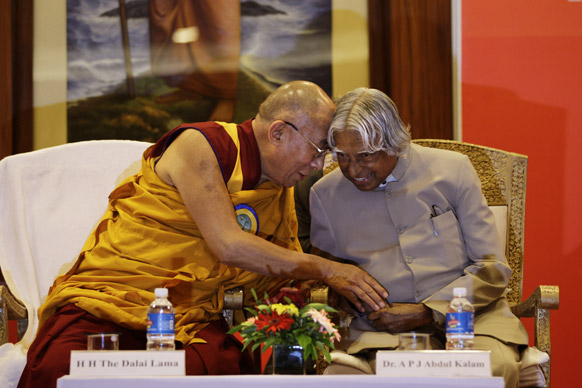
Sad that Indians are corrupt, says Dalai Lama

September 12, 2012
Dalai_Lama

New Delhi, September 12: Tibetan spiritual leader the Dalai Lama today said it was a contradiction that Indians were indulging in "unethical" practises like corruption despite being religious-minded.

Indians are "highly religious-minded" and it is very sad that corruption is prevalent in this country, he said while denouncing the menace. "I recently went to Ladakh and someone told me for example if government gives them Rs 100, only Rs 20 reach them. Rest 80 per cent disappears. This is very sad. Indians are religious-minded people and they fear god," he said at a function at the Ramakrishna Mission here.

When poverty remains a major issue in the country, corruption is not acceptable and everyone should think on this count, he said.

"It is a big contradiction. On one hand they pray in the morning and through the day they do corruption. This is not done. When you deny god and deny spirituality then at least one can understand," he said.


Comments

Add new comment

  • Coastaldigest.com reserves the right to delete or block any comments.
  • Coastaldigset.com is not responsible for its readers’ comments.
  • Comments that are abusive, incendiary or irrelevant are strictly prohibited.
  • Please use a genuine email ID and provide your name to avoid reject.
Agencies
July 30,2020

New Delhi, Jul 30: Preparing for a long haul in the Eastern Ladakh sector in extreme winters, the Indian Army has an edge over the Chinese as it has deployed 35,000 troops there who have already done tenures in high altitude and cold conditions.

The Indian troops deployed there are mentally prepared for tackling the weather and terrain.
In contrast, the Chinese troops deployed along the Line of Actual Control (LAC) are not used to these conditions as they have been brought from mainland China and are not accustomed to high altitude extreme cold weather conditions.

"We are preparing to provide extreme cold weather portable cabins for around 35,000 troops that have been deployed in the Eastern Ladakh sector," government sources said.

"Our soldiers deployed there have already done a tenure or two in Siachen, Eastern Ladakh or Northeast and they are physically and mentally prepared for a longer deployment there," they said.

The Chinese soldiers deployed on the Indian front include mainly conscripts who join the PLA for a period of 2-3 years and then return to their normal lives, sources said.

Indian and Chinese troops are engaged in a standoff situation all along the LAC in Eastern Ladakh from sub-sector north with both sides having deployed around 40,000 troops against each other over there.

The two sides have disengaged at three friction points including Patrolling Point 14, PP-15 and PP-17 and PP-17A.

At PP-17 and 17A, the Chinese have now maintained a small element of close to 50 troops and the remaining elements have gone back into their permanent locations.

The sources said the Army is also not much bothered about the Chinese build-up along the LAC as it has got more than two additional divisions from outside Ladakh sector.

India Army has more troops than what the Chinese have brought there, they said.

For the winter deployment, the Army already has a sizeable stock of clothes and habitat for troops as the Indian army deploys troops at the world's highest battlefield Siachen glacier and is prepared.

For additional requirements, the force is in the process of placing orders for additional tents and shelters from indigenous as well as foreign vendors.

The time for summer stocking is on and we are going to get the additional cabins and tents by that time, the sources.

Months of June, July, and August are considered to be the best time for stocking winter rations and ammunition. The snowfall is expected to start soon in the Eastern Ladakh area where the temperature is already low.

Prime Minister Narendra Modi's government has given financial powers of Rs 500 crore per procurement to the defence forces to address any type of shortages of weapons, ammunition, and habitat.


Comments

Add new comment

  • Coastaldigest.com reserves the right to delete or block any comments.
  • Coastaldigset.com is not responsible for its readers’ comments.
  • Comments that are abusive, incendiary or irrelevant are strictly prohibited.
  • Please use a genuine email ID and provide your name to avoid reject.
News Network
July 1,2020

Jul 1: Gold prices in India hit an all-time high on Wednesday, tracking a global rally, as surging coronavirus cases in many countries raised the metal's safe-haven appeal.

Local gold futures hit an all-time high of Rs 48,871 ($646.66) per 10 grams in early trade, taking their gains to 25% in 2020 so far. The contract had gained nearly 25% in 2019.

However, this dampened the retail demand for gold in India, the world's second-largest consumer of the precious metal.

"Retail demand is negligible. Buyers are postponing purchases anticipating a correction in prices," said a Mumbai-based bank dealer with a bullion importing bank.

In thin trade, dealers were offering a discount of up to $22 an ounce over official domestic prices on Wednesday afternoon, up from the last week's $18. The domestic price includes a 12.5% import tax and 3% sales tax.

The country's gold imports in May plunged 99% from a year earlier as international air travel was banned and jewellery shops were closed amid a nationwide lockdown to curb the spread of coronavirus.

In overseas market, spot gold firmed near an eight-year peak on Wednesday, as a spike in coronavirus cases in the United and States and many other countries has cast a shadow on hopes for a quicker global economic recovery, driving inflows into safe-haven assets.

According to a latest Reuters tally, the coronavirus has infected more than 10.48 million people worldwide so far.

Comments

Add new comment

  • Coastaldigest.com reserves the right to delete or block any comments.
  • Coastaldigset.com is not responsible for its readers’ comments.
  • Comments that are abusive, incendiary or irrelevant are strictly prohibited.
  • Please use a genuine email ID and provide your name to avoid reject.
Agencies
June 30,2020

Seventy-seven per cent children below five years of age in Jammu and Kashmir were not able to access basic healthcare services like immunisation during the lockdown imposed to curb the spread of COVID-19, CRY said on Monday citing a study.

The 'Rapid Online Perception Study about the Effects of COVID-19 on Children' was conducted during the first and second phases of the lockdown based on responses of parents and primary caregivers from all across the country, including Jammu and Kashmir, the NGO said in a statement.

It said a total of 387 respondents from Jammu and Kashmir participated in the study.

"Seventy-seven per cent children of age 0-5 years were not able to access basic healthcare services such as immunisation during lockdown - necessarily imposed to curb the spread of COVID-19 pandemic in Jammu and Kashmir," Child Rights and You (CRY) said.

It said as immunisation programmes witnessed a major setback during the lockdown across the country, the results of the survey across 23 states and Union Territories found nearly 50 per cent of parents with children below five years of age unable to access immunisation services.

"Worryingly, the figure was considerably high in Jammu and Kashmir with 77.14 per cent children below five years unable to get immunisation services," it added.

According to the study, in Jammu and Kashmir, nearly 35 per cent of the respondents said their children did not receive medical help during the lockdown, resulting in difficulties to cope with their children's illnesses and health hazards.

The study also talks about more systemic arrangements and logistical preparedness to ensure that children with no or compromised digital reach are not deprived from their Right to Education.

With online classes introduced as a substitute of schools during the lockdown, access to education for children remained a major issue of concern, as many of them, especially the ones from marginalised and financially poorer backgrounds found it difficult without smartphones and internet access.

The survey's findings revealed that nationally only 41 per cent households with children of school-going age could access online classes on a regular basis.

"Almost 90 per cent parents and primary caregivers reported that the lockdown has increased the screen time of their child to great or some extent. About half of the households recorded an increase of children's exposure to online activities during lockdown," it said.

The NGO said around 76 per cent parents agreed that they could keep a watch of their children's online activity to some extent.

Comments

Add new comment

  • Coastaldigest.com reserves the right to delete or block any comments.
  • Coastaldigset.com is not responsible for its readers’ comments.
  • Comments that are abusive, incendiary or irrelevant are strictly prohibited.
  • Please use a genuine email ID and provide your name to avoid reject.