


Diesel price hike: Govt under fire from allies, Opposition, aam aadmi

September 13, 2012

Mamatha

New Delhi, September 14: The government has finally bitten the bullet on fuel price hike raising the price of diesel by Rs 5 per litre and limiting the usage of LPG to six cylinders per household. Sources say the Sonia Gandhi-led Cabinet Committee on Political Affairs was against it, but were finally convinced by Prime Minister Manmohan Singh to end policy paralysis and bring in big ticket reforms.

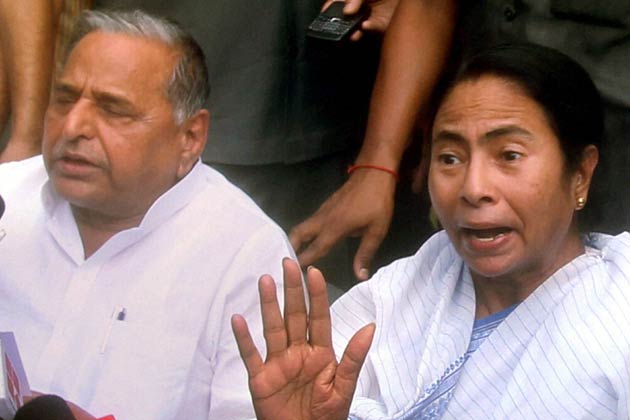
But the the government now finds itself under fire from not just the Opposition, but its own allies as well as the 'aam aadmi'. Trinamool Congress chief and West Bengal Chief Minister Mamata Banerjee was the first to react. She will take out a rally on Saturday in Kolkata, demanding a rollback.

Speaking to IBN18 Editor-in-Chief Rajdeep Sardesai, Mamata said, "It wasn't discussed with the UPA allies. I have a great respect for UPA because we know that the government must continue, there should be stability. But at the same time if the deisel price is increased, it will affect the farmers, it will effect the common people and it is very difficult as people cannot survive with this."

She said that the matter was quite serious and her party would not tolerate things that affect people, adding that the government must withdraw the hike.

Key UPA ally DMK, too, has condemned the hike. Party supremo Karunanidhi said, "Already the prices of essential commodities are so high. This hike would further affect the poor and the middle class and increase inflation."

Opposing the diesel price hike, UPA's close ally NCP also demanded a rollback saying the decision will further burden the common man.

"The Centre should consider rollback in diesel price and should not put a cap on subsidised LPG especially given the high price of essential goods thereby affecting the common man," NCP spokesperson Nawab Malik said.

Terming the hike in diesel price as an anti-people step by Congress-led UPA government, the Samajwadi Party announced that it would hold a sit-in against the move across the state.

"The move to hike diesel price is anti-people and will increase prices. Samajwadi Party opposes the move and will hold sit-in across the state to protest the hike," SP spokesman Rajendra Chaudhary told PTI.

BJP leader Yashwant Sinha said, "Diesel increase will have a cascading effect on the economy as a whole. Prices are already not under control, so this is going to contribute to overall inflation and create mayhem in the economy."

CPI National Secretary D Raja termed the decisions as "retrogade and anti-people". "It will have an adverse effect on the prices of essential commodities which are already high. It will further increase hardship of common people. Government should not go ahead," he said.

The 'aam aadmi' was the worst affected. "This decision is going to adversly affect a hard working common man like me. It's getting difficult to drive a car these days," said a consumer in Delhi.

Another consumer in Mumbai said, "The increase in the price of diesel will affect the poor like us the most. As a result of this inflation will increase."
hike

Earlier post:

Diesel price hiked by Rs 5/litre; petrol, kerosene spared

New Delhi, September 13(PTI): The government today decided to hike diesel prices by Rs 5 per litre effective midnight tonight, but left petrol, kerosene and LPG rates untouched.


The Cabinet Committee on Political Affairs, headed by Prime Minister Manmohan Singh, this evening decided to raise diesel prices by Rs 5 per litre, excluding VAT (value-added tax).


It also decided to restrict supply of subsidised cooking gas to six cylinders per household in a year.


Diesel in Delhi costs Rs 41.32 a litre and after this hike, it will cost Rs 46.95, after considering 12.5 per cent VAT on the hike.


Petrol needed a hike of Rs 6 per litre but the government offset that by reducing excise duty by Rs 5.50 per litre from existing rate of Rs 14.78 per litre.

Comments

Add new comment

  • Coastaldigest.com reserves the right to delete or block any comments.
  • Coastaldigset.com is not responsible for its readers’ comments.
  • Comments that are abusive, incendiary or irrelevant are strictly prohibited.
  • Please use a genuine email ID and provide your name to avoid reject.
News Network
February 9,2020

Panaji, Feb 9: Archbishop of Goa and Daman, Rev Filipe Neri Ferrao, has urged the central government to "immediately and unconditionally revoke the Citizenship Amendment Act" and stop quashing the "right to dissent".

He also appealed to the government not to implement the proposed countrywide National Register of Citizens (NRC) and the National Population Register (NPR).

Diocesan Centre for Social Communications Media, a wing of the Goa Church, in a statement on Saturday said, "The Archbishop and the Catholic community of Goa would like to appeal to the government to listen to the voice of millions in India, to stop quashing the right to dissent and, above all, to immediately and unconditionally revoke the CAA and desist from implementing the NRC and the NPR."

The CAA, NRC and NPR are "divisive and discriminatory" and will certainly have a "negative and damaging effect" on a multi-cultural democracy like ours, the church said.

There is serious concern that NRC and NPR will result in "direct victimisation of the underprivileged classes, particularly Dalits, adivasis, migrant labourers, nomadic communities and the countless undocumented people who, after having been recognised as worthy citizens and voters for more than 70 years, will suddenly run the risk of becoming stateless and candidates for detention camps," it said.

There has been widespread discontent and open protests throughout the country and even abroad against the CAA, NRC and NPR, which are "forecasting a systematic erosion of values, principles and rights" that have been guaranteed to all citizens in the Constitution, the release said.

Eminent citizens, including top intellectuals and legal luminaries, have taken a studied and unequivocal stand against the CAA, NRC and NPR, it noted.

Goa also witnessed several protests, which transcended the confines of religious and caste affiliation and brought people from all walks of life together on one united platform, said the statement.

It said Christians in India have always been a peace-loving community and deeply committed to the ideals of justice, liberty, equality and fraternity, enshrined in the Constitution.

"We have always taken great pride that our beloved country is a secular, sovereign, socialist, pluralistic and democratic republic," the church said.

The very fact that CAA uses religion goes against the secular fabric of the country, it said. "It goes against the spirit and heritage of our land which, since times immemorial, has been a welcoming home to

all, founded on the belief that the whole world is one big family," the church said.

"We pray for our beloved country, that good sense, justice and peace prevail in the hearts and minds of all," it added.

Comments

Add new comment

  • Coastaldigest.com reserves the right to delete or block any comments.
  • Coastaldigset.com is not responsible for its readers’ comments.
  • Comments that are abusive, incendiary or irrelevant are strictly prohibited.
  • Please use a genuine email ID and provide your name to avoid reject.
Agencies
August 4,2020

New Delhi, Aug 4: India witnessed a single-day spike of 52,050 COVID-19 cases as the total cases in the country reached 18,55,746, the Union Ministry of Health and Family Welfare said on Tuesday.

803 COVID-19 related deaths were reported in the last 24 hours. The total cases include 5,86,298 active cases, 12,30,510 cured/discharged/migrated and 38,938 deaths, the Health Ministry added.

Maharashtra continues to be the worst-affected state as it has a total of 1,47,324 active cases and 15,842 deaths. A total of 4,50,196 coronavirus cases have been recorded in the state up to Monday, according to Union Ministry of Health.

Tamil Nadu reported 5,609 new COVID-19 cases and 109 deaths on Monday, taking total cases to 2,63,222 including 2,02,283 discharges and 4,241 deaths, the state Health Department said.

The total cases in Delhi have risen to 1,38,482 including 1,24,254 recovered/discharged/migrated cases and 4,021 deaths, according to the Ministry of Health.

Meanwhile, India recorded the highest single-day testing by conducting over 6.6 lakh tests to diagnose COVID-19 in the last 24 hours.
"In its fight against COVID-19, India scales a new high of 6,61,715 tests in the last 24 hours," said the Health Ministry in a tweet.

A total of 2,08,64,206 samples for COVID-19 have been tested across the country so far, said the Health Ministry.

Comments

Add new comment

  • Coastaldigest.com reserves the right to delete or block any comments.
  • Coastaldigset.com is not responsible for its readers’ comments.
  • Comments that are abusive, incendiary or irrelevant are strictly prohibited.
  • Please use a genuine email ID and provide your name to avoid reject.
Agencies
June 29,2020

From March through May, around 1 crore migrant workers fled India’s megacities, afraid to be unemployed, hungry and far from family during the world’s biggest anti-Covid-19 lockdown.

Now, as Asia’s third-largest economy slowly reopens, the effects of that massive relocation are rippling across the country. Urban industries don’t have enough workers to get back to capacity, and rural states worry that without the flow of remittances from the city, already poor families will be even worse off -- and a bigger strain on state coffers.

Meanwhile, migrant workers aren’t expected to return to the cities as long as the virus is spreading and work is uncertain. States are rolling out stimulus programs, but India’s economy is hurtling for its first contraction in more than 40 years, and without enough jobs, a volatile political climate gets more so.

“This will be a huge economic shock, especially for households of short-term, cyclical migrants, who tend to come from vulnerable, poor and low-caste and tribal backgrounds,” said Varun Aggarwal, a founder of India Migration Now, a research and advocacy group based in Mumbai.

In the first 15 days of India’s lockdown, domestic remittances dropped by 90%, according to Rishi Gupta, chief executive officer of Mumbai-based Fino Paytech Ltd., which operates the country’s biggest payments bank.

By the end of May, remittances were back to around 1750 rupees ($23), about half the pre-Covid average. Gupta’s not sure how soon it’ll fully recover. “Migrants are in no hurry to come back,” Gupta said. “They’re saying that they’re not thinking of going back at all.”

If workers stay in their home states long term, policymakers will have more than remittances to worry about. If consumption falls and the new surplus of labor drives wages down, Agarwal said, “there will also be a second-order shock to the local economy. Overall, not looking good.”

India announced a $277 billion stimulus package in May and followed it up with a $7 billion program aimed at creating jobs for 125 days for migrants in villages across 116 districts. Separately, local authorities are also looking for solutions.

Officials in Bihar have identified 2,500 acres of land that could be made available to investors, said Sushil Modi, deputy chief minister of Bihar, a state in east India. “We can use this crisis as an opportunity to speed up reforms,” he said.

The investors haven’t materialised yet, and in the meanwhile, state governments are relying on the national cash-for-work program that guarantees 100 days worth of wages per household.

Skilled workers don’t want to do manual labor offered through the program, and even if they did, says Amitabh Kundu of RIS, many think of it as beneath their station. “There will be an increase in social tensions,” he predicts. “Caste may again start playing a role. It’s absolute chaos.”

For skilled workers, initiatives vary:

* Uttar Pradesh, which received 3.2 million people, is compiling lists of skilled workers who need employment and trying to place them with local manufacturing and real estate industry associations. So far, the government says, it’s placed 300,000 people with construction and real estate firms.

* Bihar has placed returners in state-run infrastructure projects and hired others to stitch uniforms and make furniture for government-run schools, even as they waited in quarantine centres, said Pratyay Amrit, head of the state’s disaster management department.

* The eastern state of Odisha announced an urban wage employment program aimed at putting as many as 450,000 day labourers to work through September. Some 25,000 people have been employed, so far, under the scheme, G. Mathivathanan, principal secretary for housing and urban development said.

Attracting Investments

It’s not clear any of this will be enough to make a dent, says Ravi Srivastava, professor at New Delhi-based Institute of Human Development, adding that the states don’t have much of a track record on economic development.

“It was the failure of these states to improve governance and put development plans in place that led to the out-migration in the first place,” he said.

But officials and workers’ rights advocates see opportunity. Uttar Pradesh has established liaisons to encourage companies from the US, Japan and South Korea to establish manufacturing in the state. There and in Madhya Pradesh and Rajasthan, the government has made labour laws more friendly to employers, making it easier to hire and fire workers.

Modi, the minister from Bihar, said the migration may also give workers--historically a disenfranchised group--new power, particularly as urban centres struggle. “The way industries treated workers during the lockdown -- didn’t pay them, the living conditions were poor -- now these industries will realize the value of this force,” Modi said.

“In the days to come, labour will emerge as a force that can’t be ignored anymore,” he added. “That’s the new normal. We will work out how to ensure dignity, rights to our people who are going to work in other states.”

Bihar is due for elections by November, a vote that could be an early test of the mass migration’s political consequences. The state is currently governed by a coalition that includes Prime Minister Narendra Modi’s Bharatiya Janata Party. Amitabh Kundu, a fellow at the Research and Information System for Developing Countries, a New Delhi-based government think-tank, said migrant workers are likely to be angry voters.

“Chief ministers are telling these migrants that they will not have to go back for work,” he said. “But their capacity to do something miraculous in the next four to five months is doubtful. If they can retain even one-fourth of the migrants, I would call it a success.”

Comments

Add new comment

  • Coastaldigest.com reserves the right to delete or block any comments.
  • Coastaldigset.com is not responsible for its readers’ comments.
  • Comments that are abusive, incendiary or irrelevant are strictly prohibited.
  • Please use a genuine email ID and provide your name to avoid reject.