


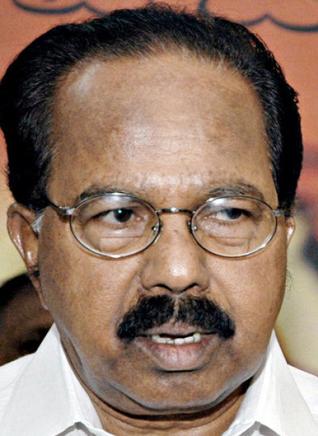
De-allocated coal blocks should be given to power projects: Moily

September 14, 2012

Moily

New Delhi, September 14: Coal blocks that are deallocated by the government after review of their status should be given to the upcoming power projects to meet the capacity addition target of 85,000 MW in the 12th Five Year Plan, Power Minister Veerappa Moily said on Friday.

“Yes, definitely. We are going to seek that (the de-allocated coal blocks),” Mr Moily told reporters here after releasing a report “Green Energy Corridors“.

He added, “We are always placing our priority because you know coal (which) is provided...that will contribute more to the power sector. That kind of capacity building (85,000 MW in 12th Plan) is in the offing,” he said.

On Thursday, the Coal Ministry had decided to deallocate 4 coal blocks — Bramhadih Block in Jharkhand, allocated to Castron Mining Ltd in 1996; Chinora and Warora (southern part) blocks in Maharashtra, given to Fieldmining and Ispat Ltd in 2003; Lalgarh (North) block in Jharkhand allotted to DOMCO Smokeless Fuels Pvt Ltd in 2005.

The decision to de-allocate the blocks was taken after recommendation by an Inter-Ministerial Group (IMG), headed by Additional Secretary (Coal) Zohra Chatterji.

The government decision came shortly after IMG’s recommendation to do so following the group’s evaluation of the performance of each of the cases considering factors like approval of mining plan, grant of environment clearance, status of forest clearance and land acquisition.

The IMG also recommended deduction of Bank Guarantee (BG) in case of Marki Mangli-II, III and IV Blocks in Maharashtra allocated to Shri Virangana Steels Ltd.

IMG had last week reviewed the status of 29 coal blocks allocated to private firms and it is likely to submit the final report on it next week.

“We can definitely produce 25,000 MW by the end of this financial year provided that other things are tied up because the capacity has been created. There are also capacities which have not been utilised... It is available around you, only thing is that a decision has to be taken,” Mr Moily said.

The Power Minister also said that he is meeting Finance Minister P Chidambaram later in the day “to ensure there is no blockade to capacity utilisation and also on creating new capacity for the power sector”.

The meeting will be attended by representatives of ministries of coal and environment and forests as well, he added.


Comments

Add new comment

  • Coastaldigest.com reserves the right to delete or block any comments.
  • Coastaldigset.com is not responsible for its readers’ comments.
  • Comments that are abusive, incendiary or irrelevant are strictly prohibited.
  • Please use a genuine email ID and provide your name to avoid reject.
News Network
June 9,2020

Jun 9: Prime Minister Narendra Modi wants all 1.3 billion Indians to be “vocal for local” — meaning, to not just use domestically made products but also to promote them. As an overseas citizen living in Hong Kong, I’m doing my bit by very vocally demanding Indian mangoes on every trip to the grocery. But half the summer is gone, and not a single slice so far.

My loss is due to India’s COVID-19 lockdown, which has severely pinched logistics, a perennial challenge in the huge, infrastructure-starved country. But more worrying than the disruption is the fruity political response to it. Rather than being a wake-up call for fixing supply chains, the pandemic seems to be putting India on an isolationist course. Why?

Granted that the liberal view that trade is good and autarky bad isn’t exactly fashionable anywhere right now. What makes India’s lurch troublesome is that the pace and direction of economic nationalism may be set by domestic business interests. The Indian liberals, many of whom are Western-trained academics, authors and — at least until a few years ago — policy makers, want a more competitive economy. They will be powerless to prevent the slide.

Modi’s call for a self-reliant India has been echoed by Home Minister Amit Shah, the cabinet’s unofficial No. 2, in a television interview. If Indians don’t buy foreign-made goods, the economy will see a jump, he said. The strategy — although it’s too nebulous yet to call it that — has a geopolitical element. A military standoff with China is under way, apparently triggered by India’s completion of a road and bridge near the common border in the tense Himalayan region of Ladakh. It’s very expensive to fight even a limited war there. With India’s economy flattened by COVID, New Delhi may be looking for ways to restore the status quo and send Beijing a signal.

Economic boycotts, such as Chinese consumers’ rejection of Japanese goods over territorial disputes in the East China Sea, are well understood as statecraft. In these times, it’s not even necessary to name an enemy. An undercurrent of popular anger against China, the source of both the virus and India’s biggest bilateral trade deficit, is supposed to do the job. But is it ever that easy?

A hastily introduced policy to stock only local goods in police and paramilitary canteens became a farcical exercise after the list of banned items ended up including products by the local units of Colgate-Palmolive Co., Nestle SA, and Unilever NV, which have had significant Indian operations for between 60 and 90 years, as well as Dabur India Ltd., a New Delhi-based maker of Ayurveda brands. The since-withdrawn list demonstrates the practical difficulty of bureaucrats trying to find things in a globalized world that are 100% indigenous.

Free-trade champions fret that the prime minister, whom they saw as being on their side six years ago, is acting against their advice to dismantle statist controls on land, labor and capital to help make the country more competitive. Engage with the world more, not less, they caution. But Modi also has to satisfy the Rashtriya Swayamsevak Sangh, the umbrella Hindu organisation that gets him votes. Its backbone of small traders, builders and businessmen — the RSS admits only men — was losing patience with the anemic economy even before the pandemic. Now, they’re in deep trouble, because India’s broken financial system won’t deliver even state-guaranteed loans to them.

The U.S.-China tensions — over trade, intellectual property, COVID responsibility and Hong Kong’s autonomy — offer a perfect backdrop. A dire domestic economy and trouble at the border provide the foreground. Big business will dial economic nationalism up and down to hit a trifecta of goals: Block competition from the People's Republic; make Western rivals fall in line and do joint ventures; and tap deep overseas capital markets. The first goal is being achieved with newly placed restrictions on investment from any country that shares a land border with India. The second aim is to be realized by corporate lobbying to influence India's whimsical economic policies. As for the third objective, with the regulatory environment becoming tougher for U.S.-listed Chinese companies like Alibaba Group Holding Ltd., an opportunity may open up for Indian firms.

All this may bring India Shenzhen-style enclaves of manufacturing and trade, but it will concentrate economic power in fewer hands, something that worries liberals. They’re moved by the suffering of India’s low-wage workers, who have borne the brunt of the COVID shutdown. But when their vision of a more just society and fairer income distribution prompts them to make common cause with the ideological Left, they’re quickly repelled by the Marxist voodoo that all cash, property, bonds and real estate held by citizens or within the nation “must be treated as national resources available during this crisis.” Who will invest in a country that does that instead of just printing money?

At the same time, when liberals look to the business class, they see a sudden swelling of support for ideas like a universal basic income. They wonder if this isn’t a ploy by industry to outsource part of the cost of labor to the taxpayer. Slogans like Modi’s vocal-for-local stir the pot and thicken the confusion. The value-conscious Indian consumer couldn’t give two hoots for calls to buy Indian, but large firms will know how to exploit economic nationalism. One day soon, I’ll get my mangoes — from them.

Comments

Add new comment

  • Coastaldigest.com reserves the right to delete or block any comments.
  • Coastaldigset.com is not responsible for its readers’ comments.
  • Comments that are abusive, incendiary or irrelevant are strictly prohibited.
  • Please use a genuine email ID and provide your name to avoid reject.
Agencies
March 3,2020

Kashmir, Mar 3: Four days after the National Investigation Agency made a major breakthrough in the Pulwama terror attack case over a year after the bombing, arresting one person who had sheltered the suicide bomber Adil Ahmad Dar, the NIA on Tuesday arrested two more people in the case - a father-daughter duo - who had also provided shelter to the bomber, officials said.

The NIA also claimed that the video of the suicide bomber was also recorded at their residence and released by the Jaish-e-Mohammad (JeM) terror group from Pakistan after the attack. An NIA spokesperson in Delhi said: "Two more persons have been arrested by the agency in the Pulwama terror attack case and they have been identified as Insha Jan, 23, and her father Tariq Ahmed Shah, 50, who works as a tipper driver."

The official said that the father-daughter duo have been arrested from Hakripora area in Pulwama for their involvement in the attack. The two were arrested on early Tuesday morning after senior officials of the NIA raided their house on Monday night.

A senior NIA official related to the probe told IANS: "The video of Dar, who attacked the CRPF convoy, was recorded at the home of the duo. And the same video was released soon after the Pulwama terror attack by the JeM terrorists from a Pakistani IP address."

He said, "The video was shared by them to their handlers in Pakistan."

The spokesperson further claimed that during the probe Tariq Ahmed Shah disclosed that his house in Hakripora area was used by Dar, Mohammad Umar Farooq, a Pakistani terrorist and IED maker, Kamran - another Pakistani terrorist (both were later killed in encounters with security forces), Sameer Ahmed Dar, a Jaish-e-Mohammad terrorist from Pulwama and Mohammad Ismail aka Ibrahim, a Pakistani terrorist.

The spokesperson said that Shah facilitated all the terrorists at his house for sheltering and for planning of the heinous attack on the CRPF convoy. He said Jan, daughter of Shah, facilitated the terrorists at their home and provided food and other logistics during their stay on more than 15 occasions for two to four days each time, in their house during the year 2018-2019.

"Initial interrogation has revealed that Jan was in constant touch with Farooq and was in communication with him over telephone and other social media applications," the spokesperson said. The fresh arrests of the two accused brings the total number of arrests in the case to three.

The arrests were made on the revelations of Shakir Bashir Magrey, who was arrested by the anti-terror probe agency on February 28. According to senior NIA officials, more arrests will be made in the coming days. Magrey, a resident of Hajibal, Kakapora in Pulwama district of Jammu & Kashmir, is an overground worker (OGW) of the Pakistan-based Jaish-e-Mohammad (JeM).

According to agency sources, Magrey allegedly provided shelter and other logistical assistance to the Pulwama suicide bomber. He was sent to 15 days' NIA custody by a special NIA court in Jammu & Kashmir on Friday. During interrogation, Magrey revealed that he had harboured Dar and Pakistan-based terrorist Mohammad Umar Farooq in his house from late 2018 till the attack in February 2019 and assisted them in the preparation of the Improvised Explosive Device (IED). His shop is located near Lethpora bridge, and as advised by Mohammad Umar, he started conducting reconnaissance of the movement of CRPF convoys on Jammu-Srinagar Highway in January 2019, and informed Mohammad Umar and Adil Ahmad Dar about it.

Magrey was also involved in modifying the Maruti Eeco car and fitting the IED into it in early February, 2019 and was introduced to Adil Ahmad Dar in mid-2018 by Mohammad Umar and he became a full-time OGW of JeM.

"During his initial interrogation, he disclosed that on several occasions, he collected and delivered arms, ammunition, cash and explosive material to JeM terrorists, including those involved in the Pulwama attack," the agency had said on February 28.

"During investigation, the make, model and number of the car used in the attack was quickly ascertained by NIA to be a Maruti Eeco through forensic examination of the tiny remnants of the car which were found at the spot during extended searches," the agency stated.

"This has been corroborated by accused Shakir Bashir Magrey. The explosives used in the attack were determined to be ammonium nitrate, nitro-glycerin and RDX, through forensic investigation," it said.

Comments

Add new comment

  • Coastaldigest.com reserves the right to delete or block any comments.
  • Coastaldigset.com is not responsible for its readers’ comments.
  • Comments that are abusive, incendiary or irrelevant are strictly prohibited.
  • Please use a genuine email ID and provide your name to avoid reject.
News Network
January 22,2020

Jan 22: India's ranking in the latest global Democracy Index has dropped 10 places to the 51st spot out of 167 owing to violent protests and threats to civil liberties challenging freedoms across the country.

Prime Minister Narendra Modi's government has been criticized by rights groups and western governments after shutting off the internet and mobile phone networks and detaining opposition politicians in Kashmir.

Modi’s government has also responded harshly to ongoing protests against a controversial, religion-based citizenship law. Muslims have said their neighborhoods have been targeted, while the central government has attempted to ban protests and urged TV news channels not to broadcast “anti-national” content. Some leaders in Modi’s ruling party called for “revenge” against protesters. India’s score in 2019 was its worst ranking since the EIU’s records began in 2006, and has fallen gradually since Modi was elected in 2014.

The Economist Intelligence Unit’s 2019 Democracy Index, which provides an annual comparative analysis of political systems across 165 countries and two territories, said the past year was the bleakest for democracies since the research firm began compiling the list in 2006.

“The 2019 result is even worse than that recorded in 2010, in the wake of the global economic and financial crisis,” the research group said in releasing the report on Wednesday.

The average global score slipped to 5.44 out of a possible 10 -- from 5.48 in 2018 -- driven mainly by “sharp regressions” in Latin America, Sub-Saharan Africa, the Middle East and North Africa. Apart from coup-prone Thailand, which improved its score after holding an election last year, there were also notable declines in Asia after a tumultuous period of protests and new measures restricting freedom across the region’s democracies.

Asia Declines

Hong Kong, meanwhile, fell three places to rank 75th out of 167 as more than seven months of violent and disruptive protests rocked the Asian financial hub. An aggressive police response early in the unrest, when protests were mostly peaceful, led to a “marked decline in confidence in government -- the main factor behind the decline in the territory’s score in our 2019 index,” the group said.

In Singapore, which ranked alongside Hong Kong at 75th, a new “fake news” law led to a deteriorating score on civil liberties.

“The government claims that the law was enacted simply to prevent the dissemination of false news, but it threatens freedom of expression in Singapore, as it can be used to curtail political debate and silence critics of the government,” EIU analysts said.

China’s score fell to just 2.26 in the EIU’s ranking, placing it near the bottom of the list at 153, as discrimination against minorities, repression and surveillance of the population intensified. Still, in China “the majority of the population is unconvinced that democracy would benefit the economy, and support for democratic ideals is absent,” the EIU said.

Comments

Add new comment

  • Coastaldigest.com reserves the right to delete or block any comments.
  • Coastaldigset.com is not responsible for its readers’ comments.
  • Comments that are abusive, incendiary or irrelevant are strictly prohibited.
  • Please use a genuine email ID and provide your name to avoid reject.