


Weak rupee makes gold smuggling, bets attractive

September 15, 2012

New Delhi, September 15: When 26-year-old Abdul Salam from Dubai was arrested at Mumbai airport last month with 156 gold chains concealed in his shoes, he was trying to land an irresistible windfall. Gold prices are rising faster in India than overseas. And this has brought back a profit opportunity, legal, not-quite-legal and illegal.

Gold arbitrage is promising punters as much as 12% annual return on investment. For some, it's almost Haji Mastan time again. But here's a difference - the infamous gold smuggler arbitraged on government ban on gold imports, today's shadier punters rely on the rupee's weakness against the dollar and the impact a weak rupee has on local gold prices.

There has been a 10-fold increase in the number of gold smuggling cases in recent months. Between April and June this year, authorities impounded gold worth 940 crore in some 200 cases of smuggling, up 272% over the same period last year, finance ministry data shows.

Smugglers make money if they can successfully avoid paying duties - 4% customs duty and other taxes, which add 5%-plus to the landed cost of gold.

Arbitraging on gold in less risky ways is possible - but complicated. The incentives, for all kinds of punters, is however simple to understand.

Take this price comparison. On September 10, 2011, the spot London price was $1,857/ounce. The price on MCX in Mumbai was 28,152/10 gms. On September 10, 2012, the spot London price was $1,736. The price on MCX was 32,035. In other words, while gold overseas dropped 6.5% in last one year, gold on MCX has risen almost 14%.

Why? Last September, the dollar was trading at 46.48. Now, the exchange rate is 55.36. It's this near- 20% depreciation of the rupee that has pushed up local gold prices.

The thumb rule is that every one rupee rise or fall in the exchange rate leads to a movement of 500-550 per 10 gm in the same direction on MCX. Since the rupee is expected to further weaken against the dollar as companies scramble to pay back overseas loans in the next couple of months, gold's faster rise in India is virtually guaranteed for the rest of the year.

"Normally international gold prices rise on the back of a weakening dollar. Currently, while the dollar's weakness continues to push up gold, the dollar has strengthened against the rupee. That is why Indian prices are higher than the world market. It is a pure currency play," says analyst Thiagarajan Gnanasekar at CommTrendz Research and Fund Management.

How does a canny investor - assuming he's not keen on smuggling - take advantage of this currency play?

When gold lands legally in India, it attracts taxes that add up to more than 5% (4% customs duty and local taxes). After paying that duty, there's no real possibility of arbitrage. That's why NRIs, allowed to legally import 1 kg gold per head, can't play the local market.

Theoretically, an Indian investor can buy a gold contract on New York Mercantile Exchange's Comex division, hedge the rupee against the dollar, and sell an equivalent contract on the MCX, says Ashok Mittal, CEO, Emkay Commotrade, a brokerage.

This can be a high risk strategy. You have to pay some cash upfront as margin money in both MCX and Comex along with the brokerage fees. There is the cost of hedging the rupee against the dollar.
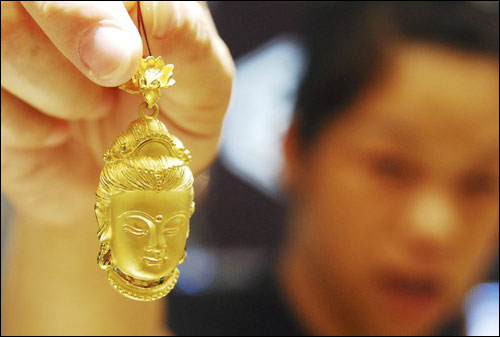

gold


Comments

Add new comment

  • Coastaldigest.com reserves the right to delete or block any comments.
  • Coastaldigset.com is not responsible for its readers’ comments.
  • Comments that are abusive, incendiary or irrelevant are strictly prohibited.
  • Please use a genuine email ID and provide your name to avoid reject.
News Network
June 9,2020

New Delhi, Jun 9: Petrol price on Tuesday was hiked by 54 paise per litre and diesel by 58 paise a litre - the third straight daily increase in rates after oil PSUs ended an 82-day hiatus in rate revision.

Petrol price in Delhi was hiked to Rs 73.00 per litre from 72.46, while diesel rates were increased to Rs 71.17 a litre from Rs 70.59, according to a price notification of state oil marketing companies.

This is the third daily increase in rates in a row. Oil companies had on Sunday restarted revising prices in line with costs, after ending an 82-day hiatus.

Prices were raised by 60 paise per litre each on both petrol and diesel on Sunday as well as on Monday. In all, petrol price has gone up by Rs 1.74 per litre and diesel by Rs 1.78 a litre in three days.

Oil PSUs - Indian Oil Corp (IOC), Bharat Petroleum Corp Ltd (BPCL) and Hindustan Petroleum Corp Ltd (HPCL) - had put daily price revisions on hold soon after the government on March 14, hiked excise duty on petrol and diesel by Rs 3 per litre each.

Oil companies did not pass on that excise duty hike, as well as the May 6 increase in tax on petrol by Rs 10 per litre and Rs 13 a litre hike on diesel by setting them off against the decline in retail prices that should have effected to reflect international oil rates falling to two-decade low.

International rates have since rebounded and oil companies having exhausted all the margin are now passing on the increase to customers, an industry official said.

Comments

Add new comment

  • Coastaldigest.com reserves the right to delete or block any comments.
  • Coastaldigset.com is not responsible for its readers’ comments.
  • Comments that are abusive, incendiary or irrelevant are strictly prohibited.
  • Please use a genuine email ID and provide your name to avoid reject.
News Network
March 12,2020

New Delhi, Mar 12: The coronavirus pandemic could deal a crippling blow to the Indian travel and tourism industry, specially with the government suspending all visas, with the economic impact being assessed to run into thousands of crores of rupees. According to industry chamber CII, this is the one of the worst crises ever to hit the Indian tourism industry impacting all its geographical segments - inbound, outbound and domestic, almost all tourism verticals - leisure , adventure, heritage, MICE, cruise, corporate and niche segments.

The whole tourism value chain across hotels, travel agents, tour operations, destinations, restaurants, family entertainment venues and air, land and sea transportation have been hit.

In an impact assessment of the coronavirus pandemic, CII Tourism Committee said inbound foreign tourism of over USD 28 billion in value terms accounts for an average 60-65 per cent between October to March.

"As the news of the virus started picking up from November, the percentage of cancellations started going up in this segment exponentially and is reaching a peak of almost 80 per cent now in March in many Indian locations. The value at risk from this segment will be in multiples of tens of thousands of crores," the CII assessment report said.

With India cancelling all visas, the chamber said the impact "will be worse".

It further said,"The forward bookings for the inbound season of October 2020-March 2021 which should have started picking are all muted. These are showing highly discouraging signs with cancellations of important global travel marts which are marketplaces for contracting for the next season."

It further said there are reports of large scale forward cancellations from NRI segment from developed markets, which account for over 60 per cent during April to September inbound visits.

"Unless the progression of the virus stops, almost the entire value for the remainder of 2020 season is at risk," the report added.

ANAROCK Property Consultants Chairman Anuj Puri said India's hospitality sector will definitely be impacted by the announcement of a global pandemic, and the mounting numbers of confirmed coronavirus cases in the country.

"The cancellation of visas for foreigners as well as the strong advice issued to Indians to refrain from unnecessary travel will have a marked effect. This is the most unsettling healthcare crisis in recent times and hotel bookings will go south," he added.

On Indians being advised to refrain from unnecessary travel, as per the CII report almost 28 million plus Indians are estimated to have travelled outside in 2019 and there were almost 1.8 billion domestic tourist footfalls.

The holiday season of Indians -- those travelling within the country and outside -- is heavy in April-July, October and December.

"The December holiday season of 2019 took an estimated hit of almost 40-50 per cent, the holiday season of April to July 2020 is likely to take a humongous hit which could be as high as 80-100 per cent, unless there is positive news of the progression of virus decreasing," the CII assessment report said.

There are advanced cancellations and highly reduced forward booking pipelines for the holiday season. Only corporates are flying and that too only on highly essential same day travel. Most of the MNCs are advising work from home, stifling travel, it added.

On suspension of visas, MakeMyTrip Group CEO Rajesh Magow told ,"The period between February till the end of March is typically a lean period because of exam season but we are seeing a demand slowdown for the upcoming summer holiday season especially for international travel. The situation remains dynamic making it hard to quantify the actual impact on our business and industry at large."

He further said,"The decision by the government will have an impact on inbound and outbound international travel. So far there are no restrictions or advisories issued for domestic travel."

VFS Global Regional Group COO - South Asia, Middle East and North Africa, Americas Vinay Malhotra said,"While it is too early to comment on the impact of coronavirus on visa application trends, so far, our visa application processes in India continue on schedule as per the mandates of our client governments."

He also said the company is exploring steps to assuage concerns of people about visiting busy public areas due to the nature of the virus by considering discounted rates on courier return services for visa customers who want to avoid returning to the visa centres to pick up their passports.

Besides, he said,"We are also contemplating lower fees for our Visa at your doorstep service, for those customers who are requesting an alternative to visiting the centres to submit visa applications."

Comments

Add new comment

  • Coastaldigest.com reserves the right to delete or block any comments.
  • Coastaldigset.com is not responsible for its readers’ comments.
  • Comments that are abusive, incendiary or irrelevant are strictly prohibited.
  • Please use a genuine email ID and provide your name to avoid reject.
News Network
May 30,2020

May 30: A Delhi court on Saturday granted interim bail for 10 days to former municipal councillor from the Congress Ishrat Jahan, who has been booked under the stringent Unlawful Activities (Prevention) Act, to get married.

She has been booked under the anti-terror law in a case related to communal violence in northeast Delhi in February.

Additional Sessions Judge Dharmender Rana granted the interim relief from June 10 to June 19 to Jahan on furnishing two sureties of Rs 1 lakh.

The court directed her not to tamper with any evidence or influence the witnesses in the case.

According to the interim bail plea, filed through advocates S K Sharma and Lalit Valeecha, Jahan's marriage was fixed in 2018 for June 12, 2020.

The plea further said that Jahan would not tamper with any evidence or influence the witnesses if granted bail.

The petition, also filed through advocates Tushar Anand and Manu Prabhakar, claimed that Jahan has been falsely implicated in the case.

It alleged that upon bare perusal of the contents of the FIR, no incident of violence can be attributed to her and the wild and baseless allegations made against her were not only irresponsible and false, but also caused serious harm to her reputation.

Jahan, who is also an advocate, was only a supporter of ongoing peaceful protests and it was one of the fundamental rights of the citizens to protest and register their dissent against any unreasonable measure of the government, the plea said.

Besides Jahan, Jamia Millia Islamia University students Asif Iqbal Tanha, Gulfisha Khatoon, Jamia Coordination Committee members Safoora Zargar, Meeran Haider, president of Jamia Alumni Association Shifa-Ur-Rehman, suspended AAP councillor Tahir Hussain, activist Khalid Safi, JNU student Natasha Narwal and former student leader Umar Khalid have also been booked under the anti-terror law in the case.

The police had claimed in the FIR that Khalid and his associates had instigated people to start riots in the area and it was a "premeditated conspiracy".

Communal clashes had broken out in northeast Delhi on February 24 after violence between citizenship law supporters and protesters spiralled out of control, leaving at least 53 people dead and around 200 injured.

Comments

Add new comment

  • Coastaldigest.com reserves the right to delete or block any comments.
  • Coastaldigset.com is not responsible for its readers’ comments.
  • Comments that are abusive, incendiary or irrelevant are strictly prohibited.
  • Please use a genuine email ID and provide your name to avoid reject.