



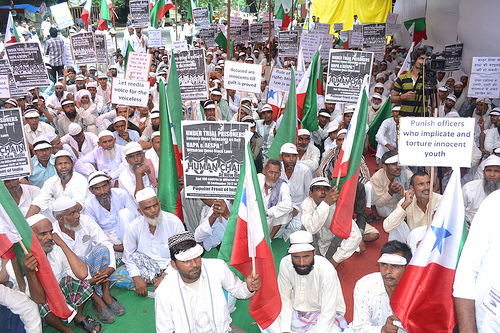
Human chain erected in Delhi to demand release of innocents on bail

[email protected] (TCN News )
September 16, 2012
Human_Chain_eracted


New Delhi, September 16: Hundreds of people on Saturday made a human chain at Jantar Mantar in New Delhi demanding release of under-trial innocent Adivasis, Dalits and Muslims on bail. Popular Front of India had organized the program at the end of its month-long nationwide campaign “Bail Is The Rule; Release The Innocents From Jail” (15th August 2012 -- 15th September 2012).

The human chain started at 11.00 am and lasted for 30 minutes and the participants took oath in the leadership of Popular Front of India Chairman EM Abdur Rahman. “We, the citizens of India, who have joined hands to form this Human Chain, declare our commitment to the democratic and secular values enshrined in the constitution of our country and protected in our legal system. We believe every citizen should be treated innocent unless and until he is found guilty by due process of law. No accused individual should be kept in jail We strongly believe that bail is the rule and jail is an exception. We call up on the government to release the under- trial prisoners of the country on bail. We all pledge to strive together to prevent illegal arrests, to free under trial prisoners, to provide compensation to victims and to withdraw UAPA amendments and all black laws,” they said.

The participants also raised slogans demanding release of innocent Adivasis, Dalits and Muslims on bail. Many family members of victims such as Shozain Kazmi (Son of Ahmed Kazmi), Shakeel Siddiqui (brother of Qateel Siddique) and many others participated in the human chain.

Followed by the human chain a public meeting was held at the place in which various leaders including PFI Chairman EM Abdur Rahman, Human rights activists such as Arundhati Roy, Rona Wilson, SAR Geelani, Dr. Sai Baba, Dr Basheer (IUML), Prof P Koya (NCHRO), Moulana Shahul Baqavi (All India Imams Council), Hafiz Mansoor Ali Khan (SDPI), Zafarul Islam Khan(AIMMM), Kavitha Krishnan (CPI-ML), Aneesus Zaman (Campus Front), Omar Khalid (DSU) and various leaders/activist addressed the public.

Following the meeting a nationwide signature campaign was inaugurated by Human rights activist Arundhati Roy demanding the release of innocents.

Addressing the public, Arundathi Roy said: “thousands of innocent Adivasis in many states of India have been arrested who don’t have a piece of bread to eat. And after the demolition of Babri masjid picking up of Muslim youth began in big scale. I demand that all these innocent political prisoners to be released on bail immediately.”



Comments

Add new comment

  • Coastaldigest.com reserves the right to delete or block any comments.
  • Coastaldigset.com is not responsible for its readers’ comments.
  • Comments that are abusive, incendiary or irrelevant are strictly prohibited.
  • Please use a genuine email ID and provide your name to avoid reject.
News Network
July 23,2020

New Delhi, Jul 23: Riding high on foreign investors buying stakes in Jio Platforms, Reliance Industries Ltd Chairman Mukesh Ambani became the world’s fifth-richest person Wednesday, edging past American investor Warren Buffett on the real-time ranking of billionaires by Forbes. With an estimated wealth of $75 billion, Ambani is only next to Facebook co-founder and CEO Mark Zuckerberg, whose wealth is pegged at $89 billion.

Buffet had slipped down the rankings after donating more than $37 billion of Berkshire Hathaway Inc. stock since 2006 to charity. Berkshire Hathaway’s stock performance has also underwhelmed recently.

Amazon founder and CEO Jeff Bezos still sits at top in the richest list, with a net worth of $185.8 billion. He is followed by Microsoft co-founder Bill Gates with net worth of $113.1 billion and luxury group LVMH Moet Hennessy Louis Vuitton’s chief Bernard Arnault, with a net worth of $112 billion. Facebook CEO Mark Zuckerberg is at the fourth position in the Forbes list.

Shares of Ambani’s conglomerate have more than doubled since a low in March as its digital unit got more than $15 billion in investments from companies including Facebook Inc, Silver Lake, Intel, and most recently, Google. The US tech giant has committed a capital infusion of Rs 33,737 crore for a 7.7 per cent stake on Jio Platforms.

The total investment from financial and strategic investors into Jio Platforms stands at Rs 1,52,056 crore. RIL has raised a total of Rs 2,12,809 crore through a rights issue, the combined investments in Jio Platforms and investment by BP.

During the Reliance AGM last week, Ambani had said RIL has made its net-debt free ahead of a March 2021 target due to recent investments. Ambani said Jio has designed and developed a complete 5G solution that’s ready for launch as soon as spectrum is made available next year.

Jio and Google have also entered into a commercial agreement to jointly develop an entry-level affordable smartphone with optimisations to the Android operating system and the Play Store, Ambani said.

RILs market value jumped to Rs 12.7 lakh crore or $170 billion on Monday, making it the 51st most valued company in the world. Between April 1 and July 13, RIL has gained $81 billion in market capitalisation and has climbed 47 places from being the 98th most valued company on April 1 to 51st most value company now.

The share price of RIL has risen by 120 per cent over the last four months for Rs 883 per share on March 23, 2020 to Rs 1,939 on Monday. Since April 22, when Facebook Inc announced an investment of Rs 43,574 crore in Jio Platforms for 9.99 per cent equity stake, Jio Platforms has announced investments by 12 other investors. The total investment by these 13 investors over the last 12-weeks amounted to Rs 118,318 crore.

Comments

Add new comment

  • Coastaldigest.com reserves the right to delete or block any comments.
  • Coastaldigset.com is not responsible for its readers’ comments.
  • Comments that are abusive, incendiary or irrelevant are strictly prohibited.
  • Please use a genuine email ID and provide your name to avoid reject.
News Network
February 9,2020

Mumbai, Feb 9: Given the slow progress on the ongoing Rs 38,000-crore capacity expansion at the four largest metro airports, and also the surging traffic, the snaky queues will continue at least till 2023, warns a report.

The four largest airports -- New Delhi, Mumbai, Bengaluru and Hyderabad -- handle more than half of the traffic and are operating at 130 per cent of their installed capacity. These airports are under a record Rs 38,000-crore capex but the capacity will not come up before end-2023, says a Crisil report.

“With the dip in traffic growth largely behind, we expect congestion at the top four airports of New Delhi, Mumbai, Bengaluru and Hyderabad, which handle more than half of the load, to continue till about FY23,” says the report.

Already these airports are operating at over 130 percent of installed capacity, and the ongoing healthy traffic growth this operating rate is expected to rise further in the next 12 months.

“Operationalising of capacities in the following two fiscals will bring down utilisation levels albeit still high at over 90 per cent by fiscal 2023 and that is despite an unprecedented Rs 38,000 crore capex being undertaken by the operators of these airports over five fiscals 2020-24,” says the report.

Despite this unprecedented capex that is debt-funded, ratings are likely to be stable given the strong cash flows expected due to healthy traffic growth, low project risks associated with the capex and improving regulatory environment, notes the report.

“Capacity at these four airports will increase a cumulative 65 per cent to 228 million annually (from 138 million now) by fiscal 2023. However, traffic is expected to grow strong at up to 10 per cent per annum over the same period. Since additional capacities will become operational in phases only by fiscal 2023, high passenger growth will add to congestion till then,” warn the report.

High utilisation will ride on pent-up demand (accumulated in 2019 as traffic was impacted with the grounding of Jet Airways) and one-off issues with new aircraft of certain airlines.

Further impetus will also come from improving connectivity to lower-tier cities and reducing fare difference between air and rail. Increasing footfalls at airports provide a leg-up to non-aero streams such as advertising, rentals, food and beverage and parking, which comprise around half of the revenue of airports already.

These are expected to grow strongly at over 10-12 per cent, also supported by higher monetisation avenue coming along with current capex. The other half of revenue (aero revenue) is an entitlement approved by the regulator, providing a pre-determined, fixed return over the asset base and a pass-through of costs.

Aero revenue is also expected to get a bump up during fiscals 2022-24, when a new tariff order for airports is likely. Overall aggregate cash flows are likely to double by fiscal 2024 and provide a healthy cushion against servicing of debt contracted for capex, the report concludes.

Comments

Add new comment

  • Coastaldigest.com reserves the right to delete or block any comments.
  • Coastaldigset.com is not responsible for its readers’ comments.
  • Comments that are abusive, incendiary or irrelevant are strictly prohibited.
  • Please use a genuine email ID and provide your name to avoid reject.
Agencies
August 3,2020

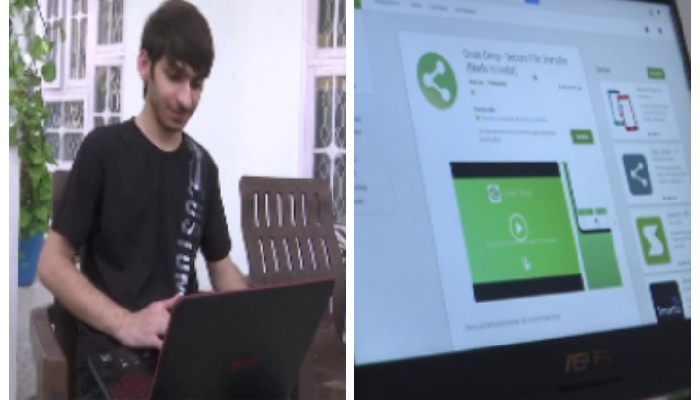
Rajouri, Aug 3: Ashfaq Mehmood Choudhary, a 17-year-old boy from Chattyear of Jammu and Kashmir's Rajouri district, has developed a file-sharing app 'Dodo Drop' which would enable users to share audios, videos, images, and texts between two devices without Internet access.

While speaking to media persons, Ashfaq Mehmood said that the 'Dodo Drop' application is an alternative to the Chinese 'SHAREit' app. "The Indian government has banned several Chinese apps due to data breaching, and among those apps was SHAREit which was used for sharing files.

Users faced a lot of problems due to the ban, and so I decided to make this file-sharing app. With 'Dodo Drop', users can share audios, videos, images, and even texts," he said.

Ashfaq said that it took him four weeks to develop the application, and it was launched on August 1 this year. The 'Dodo Drop' application has a transfer rate of up to 480 mbps, which is faster than the SHAREit app and is "quite easy" to use.

"Users can transfer data comprising photos, videos, audios, apps, texts, etc. between two devices with no Internet access. The transfers are fully encrypted and secure," he added.

"Our Prime Minister has always asserted the need for decreasing the dependency on foreign products and apps and to focus on the development of India-based apps. I tried to be part of the initiative of 'Aatmanirbhar Bharat' by developing an India-based file-sharing app. I want to develop global-standard apps for India," he added.

"We support and cooperate with him. He generates his own income by working on some projects and utilises it. We will continue to support him," said Parvez Ahmed Choudhary, Ashfaq's father.

In July, the Ministry of Electronics and Information Technology (MEITY) banned 47 apps, which were variants and cloned copies of the 59 apps banned earlier in June. These banned clones included SHAREit Lite, Tiktok Lite, Helo Lite, BIGO LIVE Lite, and VFY Lite.

The 59 apps had been banned by the Centre in June in view of the information available that they were engaged in activities which were "prejudicial to sovereignty and integrity and defence" of the country.

Almost all the apps banned had some preferential Chinese interest and the majority had parent Chinese companies.

The ban came amid border tensions with China in the Eastern Ladakh region.

Comments

Add new comment

  • Coastaldigest.com reserves the right to delete or block any comments.
  • Coastaldigset.com is not responsible for its readers’ comments.
  • Comments that are abusive, incendiary or irrelevant are strictly prohibited.
  • Please use a genuine email ID and provide your name to avoid reject.