


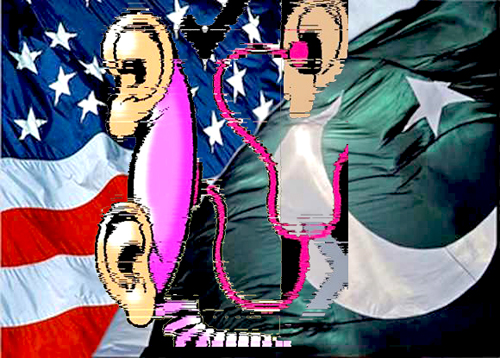
RAW tapped senior US official's phone, 'heard’ US-Pak move on J&K

September 17, 2012
US_PAK

London, September 17: In his memoirs 'Diplomatic Channels', Kris Srinivasan, 17 years after he demitted office as foreign secretary, reveals that India's external intelligence agency, RAW, snooped on a telephone conversation between a reputedly pro-Pakistan US assistant secretary of state for South Asia, Robin Raphel, and then US ambassador in Islamabad, which confirmed that the US would not back a draft resolution against India on Kashmir moved by Pakistan at the United Nations, and therefore it would fail to proceed any further.

The book, to be launched in London soon, recounts that Pakistan had provisionally introduced the resolution at the UN general assembly's first committee in September 1994. To counter this, the ministry of external affairs, led by Srinivasan, approached then Prime Minister P V Narasimha Rao to instigate the release of Kashmiri dissidents, initiate the process of elections in Jammu & Kashmir, and pave the way for a return of Red Cross to the state.

Thereafter, meeting his counterpart in the US administration Peter Tarnoff, Srinivasan argued "a negative vote against India at the UN would only stimulate militant activity and render futile the democratic steps the Indian government was trying to take".

India soon came to know of the frustration of Raphel — "which we came to hear from a phone intercept," says Srinivasan. She informed her colleague, the US ambassador, that she had pressed for an affirmative vote for the Pakistan resolution, but had been blocked by the "higher-ups".

RAW successfully tapped Raphel's call, despite this being from Washington to Islamabad, and apparently forwarded a tape and transcript to Srinivasan.

Interestingly, as a decoy, India had moved a draft resolution in the UN first committee on the desirability of complete elimination of nuclear weapons — based on various previous public pronouncements by the US, Russia and China — within a fixed time-frame, which had, in fact, found co-sponsors. This alarmed the Americans, who were pressing for a resolution favouring a Comprehensive Test Ban Treaty. They promptly despatched a senior arms control expert to Delhi to ask India to desist.

South Block withdrew the draft, conveying to Washington that it would reciprocally expect the same attitude when it came to India's concerns. The world's superpower, it would appear, was check-mated. Earlier in 1994, Pakistan had provisionally moved a resolution against India on Kashmir at the UN Commission for Human Rights. This, too, had to be withdrawn after strenuous lobbying by the MEA, for which Atal Bihari Vajpayee and Salman Khurshid earned plaudits.

The book is uncomplimentary about some politicians. About Shankar Dayal Sharma, he says, "He had a mumbling, indistinct manner of speech, causing his scarcely comprehending foreign visitors much bewilderment." On K R Narayanan: "He was a humdrum professional diplomat with leftist inclinations...".


Comments

Add new comment

  • Coastaldigest.com reserves the right to delete or block any comments.
  • Coastaldigset.com is not responsible for its readers’ comments.
  • Comments that are abusive, incendiary or irrelevant are strictly prohibited.
  • Please use a genuine email ID and provide your name to avoid reject.
Agencies
February 23,2020

Rajghat, Feb 23: The maternal uncle of Dr Kafeel Khan, who was recently arrested for allegedly making inflammatory statements during anti-CAA protests, was shot dead in front of his house at Bankatichak in Rajghat area, police said on Sunday.

Dr Nusratullah Warsi aka Dada (55), a property dealer, was shot dead on Saturday night at about 10:45 pm and an FIR against two people was filed in this connection on a written complaint of his family members.

According to police, it appears to be a case of murder due to monetary and property dispute and they are searching for both the accused.

Dr Kafeel Khan, suspended doctor of Gorakhpur BRD Medical College, was last month arrested under charges of giving a provocative speech during a protest against the CAA and NRC at Aligarh Muslim University and was later charged with the National Security Act.

Warsi on Saturday evening had gone to his lawyer Siraj Tariq's house, a few metres away from his own house, and was returning home on foot when a man shot him in his head, killing him on the spot.

"On the written complaint of family members, case of murder against one Imammuddin and Anil Sonkar has been registered and police has initiated probe and is searching for both the accused. Police met the women in their house and is interrogating them," Circle Officer VP Singh said.

Prima facie it appears to be a case of property and money dispute, he said, adding, three teams have been constituted to investigate the case and soon the accused will be caught.

Dr Kafeel Khan had last month raised apprehension in a Mumbai court about being killed in an "encounter" by the Uttar Pradesh police after claiming that he had been "falsely" implicated in the case by them.

The paediatrician had come to the limelight in 2017 when a controversy broke out after the death of over 60 children in less than a week at the BRD Medical College in Gorakhpur in Uttar Pradesh, where he was posted.

Comments

Add new comment

  • Coastaldigest.com reserves the right to delete or block any comments.
  • Coastaldigset.com is not responsible for its readers’ comments.
  • Comments that are abusive, incendiary or irrelevant are strictly prohibited.
  • Please use a genuine email ID and provide your name to avoid reject.
News Network
January 23,2020

Mumbai, Jan 23: Rashmi Sahijwala never expected to start working at the age of 59, let alone join India’s gig economy—now she is part of an army of housewives turning their homes into “cloud kitchens” to feed time-starved millennials.

Asia’s third-largest economy is battling a slowdown so sharp it is creating a drag on global growth, the International Monetary Fund said Monday, but there are some bright spots.

The gig economy, aided by cheap mobile data and abundant labour, has flourished in India, opening up new markets across the vast nation.

Although Indian women have long battled for access to education and employment opportunities, the biggest hurdle for many is convincing conservative families to let them leave home.

But new apps like Curryful, Homefoodi, and Nanighar are tapping the skills of housewives to slice, dice and prepare meals for hungry urbanites from the comfort of their homes.

The so-called cloud kitchens—restaurants that have no physical presence and a delivery-only model—are rising in popularity as there is a boom in food delivery apps such as Swiggy and Zomato.

“We want to be the Uber of home-cooked food,” said Ben Mathew, who launched Curryful in 2018, convinced that housewives were a huge untapped resource.

His company—which employs five people for the app’s daily operations—works with 52 women and three men, and the 31-year-old web entrepreneur hopes to get one million female chefs on-board by 2022.

“We usually train them in processes of sanitisation, cooking, prep time and packaging... and then launch them on the platform,” Mathew told news agency.

One of the first housewives to join Curryful in November 2018 shortly after its launch, Sahijwala was initially apprehensive, despite having four decades of experience in the kitchen.

But backed by her children, including her son who gave her regular feedback about her proposed dishes, she took the plunge.

Since then, she’s undergone a crash course in how to run a business, from creating weekly menus to buying supplies from wholesale markets to cut costs.

The learning curve was steep and Sahijwala switched from cooking everything from scratch to preparing curries and batters for breads in advance to save time and limit leftovers.

She even bought a massive freezer to store fruits and vegetables despite her husband’s reservations about the cost.

“I told him that I am a professional now,” she told news agency.

‘Internet restaurants’

Kallol Banerjee, co-founder of Rebel Foods which runs 301 cloud kitchens backing up 2,200 “internet restaurants”, was among the first entrepreneurs to embrace the concept in 2012.

“We could do more brands from one kitchen and cater to different customer requirements at multiple price points,” Banerjee told AFP.

The chefs buy the ingredients, supply the cookware and pay the utility bills.

The apps—which make their money through charging commission, such as more than 18 percent per order for Curryful—offer training and supply the chefs with containers and bags to pack the food in.

Curryful chef Chand Vyas, 55, spent years trying to set up a lunch delivery business but finally gave up after failing to compete with dabbawalas, Mumbai’s famously efficient food porters.

Today Vyas works seven hours a day, five days a week in her kitchen, serving up a bevy of Indian vegetarian staples, from street food favourites to lentils and rice according to the app’s weekly set menus.

“I don’t understand marketing or how to run a business but I know how to cook. So, the current partnership helps me focus on just that while Curryful takes care of the rest,” Vyas told AFP.

She pockets up to $150 (Rs 10,000 approx) a month after accounting for the commissions and costs, but hopes to earn more as the orders increase.

In contrast, a chef at a bricks-and-mortar restaurant takes home a monthly wage of between $300 (Rs 20,000 approx) and $1,000 (Rs 70,000) approx for working six days a week.

With India’s cloud kitchen sector expected to reach $1.05 billion by 2023, according to data platform Inc42, other companies are also keen to get a slice of the action.

Swiggy, for example, has invested 2.5 billion rupees ($35.3 million) in opening 1,000 cloud kitchens across the nation.

Back in her Mumbai kitchen, Sahijwala is elated to have embarked on a career at an age when her contemporaries are eyeing retirement.

Over the past year, she has seen her profit grow to $200 (Rs 15,000 approx) a month, but more importantly, she said, “My passion has finally found an outlet.

“I am just glad life has given me this chance.”

Comments

Add new comment

  • Coastaldigest.com reserves the right to delete or block any comments.
  • Coastaldigset.com is not responsible for its readers’ comments.
  • Comments that are abusive, incendiary or irrelevant are strictly prohibited.
  • Please use a genuine email ID and provide your name to avoid reject.
Agencies
May 5,2020

Jammu and Kashmir, May 5: Awarding the prestigious Pulitzer Prize to three Indian photographers, the Pulitzer Board at Columbia University claimed that it was for their work in Kashmir as "India revoked its independence".

The award to Channi Anand, Mukhtar Khan and Dar Yasin in the feature photography category for their pictures for the Associated Press was announced on Monday.

The prizes, considered the most prestigious for US journalism, are associated with the university's Graduate School of Journalism where the judging is done and is announced, although this year it was done remotely.

Besides a certificate, the prizes carry a cash award of $15,000, except the public service category for which a gold medal is awarded.

The public service prize went to The Anchorage Daily News for a series that dealt with policing in Alaska state.

In making the award to the three, the Board said on its website that it was "for striking images of life in the contested territory of Kashmir as India revoked its independence, executed through a communications blackout".

Besides making the false claim about "independence" of Kashmir being "revoked", the board that includes several leading journalists did not explain how their photographs could have reached the AP within hours of the incidents recorded "through a communication blackout".

India's Central government only revoked Article 370 of the Constitution that gave Jammu and Kashmir a special status and it was not independent.

Indian journalists were allowed to operate in Kashmir, while only non-Indian journalists were barred.

The wording of the award announcement calls into question the credibility of the Pulitzer Board that gives out what are considered prestigious journalism awards.

The portfolio of pictures by the three on the Pulitzer web site included one of a masked person attacking a police vehicle and another of masked people with variants of the Kashmir flag, besides photos of mourners and protesters.

One of the finalists for the Pulitzer Prize for explanatory journalism was a reporter of Indian descent at The Los Angeles Times, Swetha Kannan, who was nominated for her work with two colleagues on the seas rising due to climate change.

Comments

Add new comment

  • Coastaldigest.com reserves the right to delete or block any comments.
  • Coastaldigset.com is not responsible for its readers’ comments.
  • Comments that are abusive, incendiary or irrelevant are strictly prohibited.
  • Please use a genuine email ID and provide your name to avoid reject.