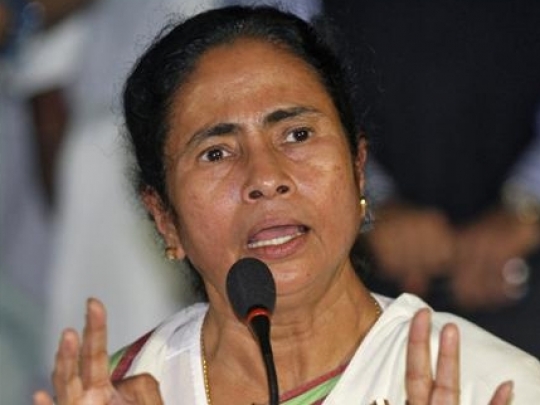
Mamata Banerjee exits UPA, PM asks ministers to stand their course

September 19, 2012

mamatha_benergee

New Delhi, September 19: Congress president Sonia Gandhi will meet top leaders of her party this morning to discuss the crisis triggered by Mamata Banerjee's withdrawal of support to the UPA government. The Congress' core group meeting is scheduled for 10 am and will be attended by Prime Minister Manmohan Singh, Defence Minister AK Antony and Finance Minister Chidambaram.

Yesterday, Ms Banerjee pulled out of the UPA coalition, in which her party was the second-largest member. The west Bengal Chief Minister said her six ministers will resign on Friday at 3 pm in protest against a menu of new reforms introduced by the government last week, including raising diesel prices, restricting the supply of subsidised cooking gas to six cylinders per household, and opening up India's huge retail sector to foreign super-chains like Wal-Mart. Ms Banerjee described those decisions as "a disaster for the poor" and said her party had been shown minimal respect by the UPA.

Sources in the Congress say that party president Sonia Gandhi will now try to negotiate a compromise - while there will be no reversal of the retail reforms, the government may agree to a partial rollback in diesel prices, along with increasing the cap on LPG cylinders from six to nine per year.

The Prime Minister has, according to sources, driven home the point that he is committed to the reforms needed to jumpstart the economy; he allegedly told senior ministers that their government "must stay the course" and that it has "an unfinished agenda" for the economy for which it will allow "like-minded people" to help.

With the support of Mulayam Singh Yadav and Mayawati, the UPA still has more than 300 MPs on its side. It needs 272 to stay in power. But the government will now be more vulnerable to demands from those partners, who are both opposed to FDI in retail.

Before it decided to implement 51% Foreign Direct Investment or FDI in retail, the government had calculated its political risks. Ms Banerjee has 19 Lok Sabha MPs. Mulayam Singh Yadav and his Samajwadi Party, who provide external support to the UPA, have 22. Ms Mayawati and her Bahujan Samaj Party (BSP) have another 21. So though the UPA is in a minority without the Trinamool Congress, it can be propped up by Mr Yadav and Ms Mayawati.

Mr Yadav landed in Delhi on Tuesday night and plans to meet with the Left and other parties to gauge their reaction to the UPA's new position. "Don't take us for granted," warned his party's Ram Gopal Yadav after Ms Banerjee's announcement. "We will not join the government. Any party that does so will be wiped out in 2014," he said, adding that his party will decide its next move after an all-India bandh or strike on Thursday to protest against the Centre and its decisions on FDI and the new diesel prices. In the South, the DMK, another member of the UPA, has decided to participate in that bandh. Party chief M Karunanidhi, whose 18 MPs are part of coalition at the Centre, will make a statement, after a party meeting today, on where the DMK stands in the new political landscape.

The Congress is now said to be counting on Mayawati's Bahujan Samaj Party and some Independents to keep it in a majority in the Lok Sabha. Sources in Mayawati's party say she will decide on her relationship with the UPA at a meeting of her party on October 10. The BSP has voiced demands very similar to Mamata Banerjee's - a rollback in diesel prices and on the new norms for LPG. It also wants the government to withdraw the decision on FDI in retail. But unlike Ms Banerjee or Mr Yadav, who are riding recent electoral successes and would not mind mid-term elections to extend their gains, Ms Mayawati is still smarting from her defeat in Uttar Pradesh this year and she will not want early polls since she is unlikely to make too many gains.

Comments

Add new comment

  • Coastaldigest.com reserves the right to delete or block any comments.
  • Coastaldigset.com is not responsible for its readers’ comments.
  • Comments that are abusive, incendiary or irrelevant are strictly prohibited.
  • Please use a genuine email ID and provide your name to avoid reject.
coastaldigest.com news network
July 27,2020

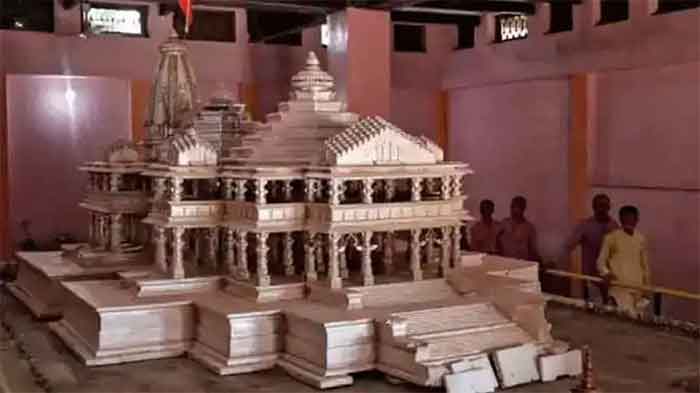
Ayodhya, Jul 27: With days to go for the August 5 "bhoomi pujan" ceremony of the Ram temple in Ayodhya, the mosques adjacent to the demolished Babri Masjid premises are spreading the message of a peaceful coexistence of Hindus and Muslims.

There are eight mosques and two mausoleums located close to the 70-acre Babri Masjid premises mandated by the Supreme Court for a temple of Sri Ram.

Azaan and namaaz are offered in the mosques and the annual "Urs" is held at the mausoleums without any objection from the local Hindus.

The eight mosques located near the upcoming Ram temple premises are Masjid Dorahikuan, Masjid Mali Mandir ke Bagal, Masjid Kaziyana Achchan ke Bagal, Masjid Imambara, Masjid Riyaz ke Bagal, Masjid Badar Paanjitola, Masjid Madaar Shah and Masjid Tehribazar Jogiyon ki.

The two mausoleums are Khanqaahe Muzaffariya and Imambara.

"It is the greatness of Ayodhya that the mosques surrounding the Ram temple are giving a strong message of communal harmony to the rest of the world," Haji Asad Ahmad, the corporator of the Ram Kot ward, said. The Ram temple area is situated in Ahmad's ward.

"Muslims take out the 'juloos' of Barawafaat that goes through the periphery of Ram Janmabhoomi. All religious functions and rituals of Muslims are respected by their fellow citizens," the corporator said.

Asked for a comment on the presence of mosques near the upcoming Ram temple premises, the chief priest of the temple, Acharya Satyendra Das, said, "We had a dispute only with the structure that was connected to the name of (Mughal emperor) Babur. We have never had any issue with the other mosques and mausoleums in Ayodhya. This is a town where Hindus and Muslims live in peace."

"Muslims offer namaaz, we perform our puja. The mosques around us will strengthen Ayodhya's communal harmony and peace will prevail," he added.

Both Hindus and Muslims have accepted the Supreme Court verdict over Ram Janmabhoomi, Das said, adding, "We have no dispute with each other."

Sayyad Akhlaq Ahmad Latifi, the "sajjada nasheen" and "pir" of the 500-year-old Khanqaahe Muzaffariya mausoleum, said Muslims in Ayodhya are performing all religious practices freely.

"We offer prayers five times a day in the mosque at Khanqaah and hold the yearly 'Urs'," he added.

"What a scene would it be -- a grand Ram temple surrounded by small mosques and mausoleums and everyone offering prayers according to their beliefs. That will be representative of the true culture of India," Mahant Yugal Kishore Sharan Shastri, the chief priest of the Sarayu Kunj temple adjacent to the Ram Janmabhoomi premises, said.

Reacting to the presence of mosques and mausoleums near the Ram Janmabhoomi premises, Triloki Nath Pandey, the decree holder of the land as the "first friend of Ram Lalla" as mandated by the Supreme Court, said, "We do not have any objection to either those mosques or any other mosques. We will not trigger a dispute regarding any structure, Ayodhya must live in peace and communal harmony."

Mahant Raju Das, the priest of the Hanumangarhi temple, said, "The presence of the mosques tells the story of Ayodhya's communal harmony. A Ram mandir will be built and there will be no objection to the mosques or religious practices of Muslims."

Comments

Add new comment

  • Coastaldigest.com reserves the right to delete or block any comments.
  • Coastaldigset.com is not responsible for its readers’ comments.
  • Comments that are abusive, incendiary or irrelevant are strictly prohibited.
  • Please use a genuine email ID and provide your name to avoid reject.
News Network
April 6,2020

New Delhi, Apr 6: With an increase of 490 cases in the last 12 hours, the total number of COVID-19 positive cases in India climbed to 4067, said Ministry of Health and Family Welfare on Monday.

As many as 109 deaths have been reported across the country due to the deadly disease.
There are 3666 active cases in the country while 292 people have been cured/discharged/migrated.

Maharashtra has reported the highest number of COVID-19 cases so far, standing at 690, followed by Tamil Nadu and Delhi with 571 and 503 cases respectively. 

Comments

Add new comment

  • Coastaldigest.com reserves the right to delete or block any comments.
  • Coastaldigset.com is not responsible for its readers’ comments.
  • Comments that are abusive, incendiary or irrelevant are strictly prohibited.
  • Please use a genuine email ID and provide your name to avoid reject.
Agencies
July 30,2020

Mumbai, Jul 30: Counterfeiting incidents have increased 24 per cent in the country in 2019 over the previous year, creating an over Rs 1 lakh crore hole in the economy, according to a report.

The report also said counterfeiters are having a free run due to the pandemic-driven disruptions to organised supply chains and the resultant spike in consumer demand.

According to the report by ASPA, a self-regulated industry body of anti-counterfeiting and traceability solutions providers, counterfeiting has risen steadily in the last few years, and exploiting the pandemic as a cover for their activities.

Between February and April 2020, over 150 incidents of counterfeiting cases were reported, mostly about fake PPE kits, sanitisers and masks taking advantage of the high demand for these products, it noted.

"There was a 24 per cent increase in counterfeiting in 2019 over 2018, leading to the loss of more than Rs 1 lakh crore to the overall economy," said Nakul Pasricha, president of Authentication Solution Providers Association.

The association works with global authorities like the International Hologram Manufacturers Association, Counterfeit Intelligence Bureau of the Interpol, and domestic industry lobbies like Ficci, he said.

Counterfeiting is a universal issue and is 3.3 per cent of global trade, according to the OECD data, impacting social and economic development across the world.

The report lists the currency, FMCG, alcohol, pharma, documents, agriculture, infrastructure, automotive, tobacco, lifestyle and apparel, as the 10 sectors impacted most by counterfeiting.

Among these, currency, alcohol and FMCG continue to be the top three sectors with the highest counterfeiting in the last two years. The FMCG sector is most vulnerable, as counterfeit incidents rose 63 per cent between 2018 (79) and 2019 when the reported cases jumped to 129.

Within the states, the fakers have a free run in Uttar Pradesh, Bihar, Rajasthan, Madhya Pradesh, Bengal, Punjab, Jharkhand, Delhi, Gujarat, and Uttarakhand, calling for urgent actions to frame anti-counterfeiting policy measures.

According to the report, UP continues to be on top followed by Bihar, Rajasthan, and together these three states represent almost 45 per cent of all counterfeiting reported in the last two years.

What is more alarming is that counterfeiting is not limited to high-end luxury items today, as common everyday items as fake cumin seeds, mustard cooking oil, ghee, hair oils, soaps, baby care vaccines and medicines are aplenty in the markets.

"There is an urgent need for building and nurturing authentication ecosystems in the country with the active involvement and active participation of all stakeholders," said Pasricha.

Comments

Add new comment

  • Coastaldigest.com reserves the right to delete or block any comments.
  • Coastaldigset.com is not responsible for its readers’ comments.
  • Comments that are abusive, incendiary or irrelevant are strictly prohibited.
  • Please use a genuine email ID and provide your name to avoid reject.