


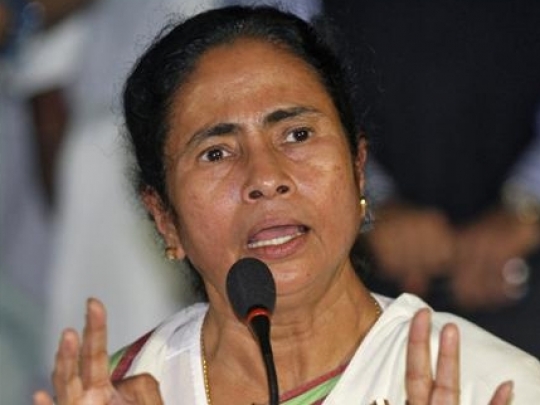
Mamata Banerjee exits UPA, PM asks ministers to stand their course

September 19, 2012

mamatha_benergee

New Delhi, September 19: Congress president Sonia Gandhi will meet top leaders of her party this morning to discuss the crisis triggered by Mamata Banerjee's withdrawal of support to the UPA government. The Congress' core group meeting is scheduled for 10 am and will be attended by Prime Minister Manmohan Singh, Defence Minister AK Antony and Finance Minister Chidambaram.

Yesterday, Ms Banerjee pulled out of the UPA coalition, in which her party was the second-largest member. The west Bengal Chief Minister said her six ministers will resign on Friday at 3 pm in protest against a menu of new reforms introduced by the government last week, including raising diesel prices, restricting the supply of subsidised cooking gas to six cylinders per household, and opening up India's huge retail sector to foreign super-chains like Wal-Mart. Ms Banerjee described those decisions as "a disaster for the poor" and said her party had been shown minimal respect by the UPA.

Sources in the Congress say that party president Sonia Gandhi will now try to negotiate a compromise - while there will be no reversal of the retail reforms, the government may agree to a partial rollback in diesel prices, along with increasing the cap on LPG cylinders from six to nine per year.

The Prime Minister has, according to sources, driven home the point that he is committed to the reforms needed to jumpstart the economy; he allegedly told senior ministers that their government "must stay the course" and that it has "an unfinished agenda" for the economy for which it will allow "like-minded people" to help.

With the support of Mulayam Singh Yadav and Mayawati, the UPA still has more than 300 MPs on its side. It needs 272 to stay in power. But the government will now be more vulnerable to demands from those partners, who are both opposed to FDI in retail.

Before it decided to implement 51% Foreign Direct Investment or FDI in retail, the government had calculated its political risks. Ms Banerjee has 19 Lok Sabha MPs. Mulayam Singh Yadav and his Samajwadi Party, who provide external support to the UPA, have 22. Ms Mayawati and her Bahujan Samaj Party (BSP) have another 21. So though the UPA is in a minority without the Trinamool Congress, it can be propped up by Mr Yadav and Ms Mayawati.

Mr Yadav landed in Delhi on Tuesday night and plans to meet with the Left and other parties to gauge their reaction to the UPA's new position. "Don't take us for granted," warned his party's Ram Gopal Yadav after Ms Banerjee's announcement. "We will not join the government. Any party that does so will be wiped out in 2014," he said, adding that his party will decide its next move after an all-India bandh or strike on Thursday to protest against the Centre and its decisions on FDI and the new diesel prices. In the South, the DMK, another member of the UPA, has decided to participate in that bandh. Party chief M Karunanidhi, whose 18 MPs are part of coalition at the Centre, will make a statement, after a party meeting today, on where the DMK stands in the new political landscape.

The Congress is now said to be counting on Mayawati's Bahujan Samaj Party and some Independents to keep it in a majority in the Lok Sabha. Sources in Mayawati's party say she will decide on her relationship with the UPA at a meeting of her party on October 10. The BSP has voiced demands very similar to Mamata Banerjee's - a rollback in diesel prices and on the new norms for LPG. It also wants the government to withdraw the decision on FDI in retail. But unlike Ms Banerjee or Mr Yadav, who are riding recent electoral successes and would not mind mid-term elections to extend their gains, Ms Mayawati is still smarting from her defeat in Uttar Pradesh this year and she will not want early polls since she is unlikely to make too many gains.

Comments

Add new comment

  • Coastaldigest.com reserves the right to delete or block any comments.
  • Coastaldigset.com is not responsible for its readers’ comments.
  • Comments that are abusive, incendiary or irrelevant are strictly prohibited.
  • Please use a genuine email ID and provide your name to avoid reject.
News Network
March 19,2020

Attari, Mar 19: At least 29 Indians, who had gone to Dubai to watch a cricket match which was called off later, on Wednesday night returned to India through the land transit route of Attari-Wagah border here.

Earlier, when they entered India after being cleared by the Pakistan Immigration Authority, they were detained at Attari border, as they were not having requisite permission on their passport to return to India through Pakistan.

According to officials, they had earlier flown to Dubai from New Delhi to watch a Pakistan League Cricket match there.

The match, however, was aborted and they decided to return India via Pakistan. They took a flight to Pakistan and after landing there, they took land route to reach Attari-Wagah border.

All were cleared by Indian immigration authority after being allowed by the Union Ministry of Home Affairs.

Amritsar Civil Surgeon Dr Prabdeep Kaur Johal said that by 9.30 PM all the Indian nationals were not handed over to the medical team for checkup.

She said if anyone of them are found with any symptoms of the virus, they would be admitted to Amritsar Government Hospital or else they would be allowed to continue their journey to Delhi or elsewhere.

Comments

Add new comment

  • Coastaldigest.com reserves the right to delete or block any comments.
  • Coastaldigset.com is not responsible for its readers’ comments.
  • Comments that are abusive, incendiary or irrelevant are strictly prohibited.
  • Please use a genuine email ID and provide your name to avoid reject.
News Network
May 9,2020

May 9: Union Home Minister Amit Shah has said the West Bengal government is not allowing trains with migrant workers to reach the state that may further create hardship for the labourers.

In a letter to West Bengal Chief Minister Mamata Banerjee, Shah said not allowing trains to reach West Bengal is "injustice" to the migrant workers from the state.

Referring to the 'Shramik Special' trains being run by the central government to facilitate transport of migrant workers from different parts of the country to various destinations, the home minister said in the letter that the Centre has facilitated more than two lakh migrants workers to reach home.

Shah said migrant workers from West Bengal are also eager to reach home and the central government is also facilitating the train services.

"But we are not getting expected support from the West Bengal. The state government of West Bengal is not allowing the trains reaching to West Bengal. This is injustice with West Bengal migrant labourers. This will create further hardship for them," Shah wrote.

Comments

Add new comment

  • Coastaldigest.com reserves the right to delete or block any comments.
  • Coastaldigset.com is not responsible for its readers’ comments.
  • Comments that are abusive, incendiary or irrelevant are strictly prohibited.
  • Please use a genuine email ID and provide your name to avoid reject.
News Network
January 24,2020

New Delhi, Jan 24: Although India's Ujjwala programme encouraged adoption of liquefied petroleum gas (LPG) for cooking among the poor, households availing the scheme have not shifted away from using highly polluting fuels like firewood, a study reveals.

The researchers, including those from the University of British Columbia (UBC) in Canada, found that additional incentives to encourage regular use of cooking gas are necessary for a complete transition to clean cooking fuel among poor rural households.

They noted that about 2.9 billion people across Asia, Africa, and Latin America burn solid fuels like firewood to meet their cooking energy needs.

This has significant negative implications for public health, the environment, and societal development, according to the researchers.

Through the Pradhan Mantri Ujjwala Yojana (PMUY), India has provided capital cost subsidies to poor women to adopt a clean-burning cooking fuel or LPG.

The researchers explained that within the first 40 months of the scheme, more than 80 million households obtained LPG stoves.

However, the full benefits of LPG adoption depend on near complete replacement of polluting fuels with LPG, according to a research-based policy brief published in the journal Nature Energy.

The scientists said this cannot be assumed solely on the basis of LPG presence in the household.

"Our research shows that Ujjwala was able to attract new consumers rapidly, but those consumers did not start using LPG on a regular basis," Abhishek Kar, a postdoc at Columbia University in the US, told PTI.

The study analysed LPG sales data for over 25,000 consumers, including PMUY beneficiaries, as well as general rural LPG consumers in Koppal district of Karnataka.

The scientists employed data covering all LPG purchases of PMUY beneficiaries through their first year in the programme.

They also assessed the general rural population's purchases during their first five years as consumers to assess the effect of experience on use.

The findings estimate that an average rural family needs to purchase five 14.2 kilogramme-cylinders annually to meet half of their cooking needs.

However, the study said just seven per cent of PMUY beneficiaries in Koppal purchased five or more cylinders annually, suggesting that the beneficiaries seldom use LPG.

The general (nonPMUY) consumers in this region use on average two times more LPG cylinders than PMUY beneficiaries, the researchers noted.

Yet, only 45 per cent of nonPMUY consumers use five or more cylinders per year -- even after several years of experience with LPG, they said.

The team assessed price and seasonal factors affecting LPG use among the general population over a three-year period.

It found that LPG consumers are sensitive to price and seasonality -- LPG cylinder refill rates are lower in the summer when agricultural activity is limited, and cash is scarce.

"There was no scheme incentives to promote use, except general LPG subsidies which is available to all, including the urban middle class," said Kar, who was a Ph.D. scholar at UBC when the research was published.

"If there is no additional income, what cost would a poor family on an already tight budget cut to pay for an extra expense on a regular basis.

"Ujjwala has started the scheme of 5 kg-cylinder in response, but the impact of that on LPG sales is still publicly unknown," he said.

These findings, the researchers noted, suggest the need for additional measures to promote regular LPG use for all rural populations.

Although the finding come from a single district in Southern India, it may also apply to other areas with similar socio-economic conditions, they said.

A more expansive evaluation of PMUY would help design targeted incentives to transform infrequent users to regular users, according to the researchers.

Comments

Add new comment

  • Coastaldigest.com reserves the right to delete or block any comments.
  • Coastaldigset.com is not responsible for its readers’ comments.
  • Comments that are abusive, incendiary or irrelevant are strictly prohibited.
  • Please use a genuine email ID and provide your name to avoid reject.