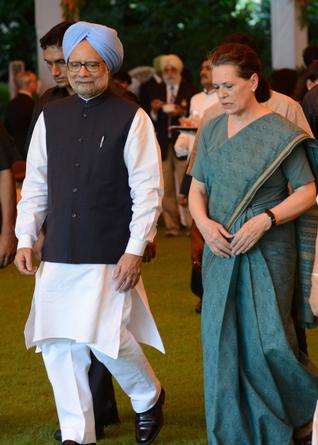
Cong core group meets after Mamata decides to quit

September 19, 2012

sonia_pm

New Delhi, September 19: A day after Trinamool Congress decided to withdraw support to UPA, the Congress top brass was on Wednesday huddled in a meeting with party president Sonia Gandhi and Prime Minister Manmohan Singh deliberating over the strategy ahead.

The meeting of the Congress core group chaired by Ms. Gandhi at the Prime Minister’s residence deliberated at length on the political scenario after Mamata Banerjee’s announcement of withdrawing support to the government.

Minutes before the core group meeting began, the Prime Minister held confabulation with Deputy Chairman of Planning Commission Montek Singh Ahluwalia.

There have been indications from the party earlier that they should be “ready to bite the bullet” as reforms are necessary at this juncture.

Trinamool Congress on Tuesday decided to withdraw its ministers from the Union government and its support.

The second biggest constituent of the UPA with 19 members in Lok Sabha said the party could reconsider its stand if the government rolls back its decisions on FDI, raised the cap on subsidised LPG from six to 12 cylinders besides reducing diesel hike from Rs 5 by Rs 3 or Rs 4.

“We are withdrawing our support... Our ministers will go to Delhi, meet the Prime Minister and tender their resignations at 3 PM on Friday,” the TMC chief and West Bengal Chief Minister had said.

Immediately after the Trinamool’s announcement on Tuesday, Mr. Digvijay Singh said on twitter, “FDI decision was taken in national interest fulling knowing its political fallout and I hope the government will stand firm as it did on the nuclear deal.”

If the Trinamool Congress goes ahead with its decision to withdraw support, the UPA will be reduced to 251, 21 short of the majority mark of 272 in the 545-member Lok Sabha. However, with the support of outside allies -- Samajwadi Party (22), BSP (21) and some others -- the government is still comfortably placed with the support of over 300 members.

Comments

Add new comment

  • Coastaldigest.com reserves the right to delete or block any comments.
  • Coastaldigset.com is not responsible for its readers’ comments.
  • Comments that are abusive, incendiary or irrelevant are strictly prohibited.
  • Please use a genuine email ID and provide your name to avoid reject.
News Network
April 9,2020

Patna, Apr 9: In a horrifying incident, a migrant woman was sexually abused in a Gaya hospital where she was kept in an isolation ward. Three days later, she died due to excessive bleeding.

The matter came to light on Tuesday when her mother-in-law informed the authorities concerned about the shocking incident.

The 25-year-old victim had returned to Bihar’s Gaya district from Ludhiana (in Punjab) along with her husband on March 25. Before returning to her in-laws’ place, she had undergone abortion at Ludhiana just when she was two months pregnant.

On reaching Gaya, she complained of excessive bleeding. Her husband admitted her to Anugrah Narain Magadh Medical College and Hospital (ANMMCH) on March 27 where she was kept in the emergency ward.

Later, on April 1, on being suspected to be coronavirus patient, she was kept in an isolation ward. Her family members alleged that it was in this isolation ward where a doctor attending to her overnight outraged her modesty for two successive nights on April 2 and 3.

“The following day, she was discharged from the hospital after her coronavirus test report was found to be negative. However, after returning home, she remained aloof and struck by fear. On questioning, she revealed how a doctor had sexually abused her in the isolation ward. On April 6, she passed away due to excessive bleeding,” said her mother-in-law.

On receiving the information, the local police asked the mother-in-law to come to the hospital on Tuesday and identify the doctor (about whom the victim had given a description). However, the accused was not identified.

“Prima facie, the matter is serious. We are verifying the allegations. We will dig out the CCTV footage in the hospital and take strict action after identifying the culprit,” said Dr VK Prasad, the hospital superintendent.

Meanwhile, the Gaya police have arrested two people who posed as doctors and entered the isolation ward using doctors’ kits. One of the apprehended people works in a private.

Comments

Add new comment

  • Coastaldigest.com reserves the right to delete or block any comments.
  • Coastaldigset.com is not responsible for its readers’ comments.
  • Comments that are abusive, incendiary or irrelevant are strictly prohibited.
  • Please use a genuine email ID and provide your name to avoid reject.
Agencies
May 27,2020

New Delhi, May 27: India’s fourth recession since Independence, first since liberalisation, and perhaps the worst to date is here, according to rating agency, Crisil.

CRISIL sees the Indian economy shrinking 5 per cent in fiscal 2021 (on-year), because of the Covid-19 pandemic. The first quarter will suffer a staggering 25 per cent contraction.

About 10 per cent of gross domestic product (GDP) in real terms could be permanently lost. "So going back to the growth rates seen before the pandemic is unlikely in the next three fiscals", Crisil said.

Crisil has revised its earlier forecast downwards. "Earlier, on April 28, we had slashed our prediction to 1.8 per cent growth from 3.5 per cent growth. Things have only gone downhill since", it said.

While we expect non-agricultural GDP to contract 6 per cent, agriculture could cushion the blow by growing at 2.5 per cent.

In the past 69 years, India has seen a recession only thrice as per available data in fiscals 1958, 1966 and 1980. The reason was the same each time a monsoon shock that hit agriculture, then a sizeable part of the economy.

"The recession staring at us today is different," it added. For one, agriculture could soften the blow this time by growing near its trend rate, assuming a normal monsoon. Two, the pandemic-induced lockdowns have affected most non-agriculture sectors. And three, the global disruption has upended whatever opportunities India had on the exports front.

Economic conditions have slid precipitously since the April-end forecast of 1.8 per cent GDP growth for fiscal 2021 (baseline), Crisil said.

On the lockdown extension, it said that the government has extended the lockdown four times to deal with the rising number of cases, curtailing economic activity severely (lockdown 4.0 is ending on May 31).

The first quarter of this fiscal will be the worst affected. June is unlikely to see major relaxations as the Covid-19 affliction curve is yet to flatten in India.

"Not only will the first quarter be a washout for the non-agricultural economy, services such as education, and travel and tourism among others, could continue to see a big hit in the quarters to come. Jobs and incomes will see extended losses as these sectors are large employers," Crisil said.

CRISIL also foresees economic activity in states with high Covid-19 cases to suffer prolonged disruption as restrictions could continue longer.

A rough estimate based on a sample of eight states, which contribute over half of India's GDP, shows that their 'red zones' (as per lockdown 3.0) contributed 42 per cent to the state GDP on average regardless of the share of such red zones.

On average, the orange zones contribute 46 per cent, while the green zones where activity is allowed to be close to normal contribute only 12 per cent to state GDP.

The economic costs are higher than earlier expectations, according to Crisil. The economic costs now beginning to show up in the hard numbers are far worse than initial expectations.

Industrial production for March fell by over 16%. The purchasing managers indices for the manufacturing and services sectors were at 27.4 and 5.4, respectively, in April, implying extraordinary contraction. That compares with 51.8 and 49.3, respectively, in March.

Exports contracted 60.3 per cent in April, and new telecom subscribers declined 35 per cent, while railway freight movement plunged 35 per cent on-year.

"Indeed, given one of the most stringent lockdowns in the world, April could well be the worst performing month for India this fiscal," it said.

Added to that is the economic package without enough muscle. The government recently announced a Rs 20.9 lakh crore economic relief package to support the economy. The package has some short-term measures to cushion the economy, but sets its sights majorly on reforms, most of which will have payoffs only over the medium term.

"We estimate the fiscal cost of this package at 1.2 per cent of GDP, which is lower than what we had assumed in our earlier estimate (when we foresaw a growth in GDP)," it said.

"We believe a catch-up to the pre-crisis trend level of GDP growth will not be possible in the next three fiscals despite policy support. Under the base case, we estimate a 10 per cent permanent loss to real GDP (from the decadal-trend level), assuming average growth of about 7 per cent between fiscals 2022 and 2024," Crisil said.

Interestingly, after the Global Financial Crisis (GFC), a sharp growth spurt helped catch up with the trend within two years. GDP grew 8.2 per cent on average in the two fiscals following the GFC. Massive fiscal spending, monetary easing and swift global recovery played a role in a V-shaped recovery.

To catch-up would require average GDP growth to surge to 11 per cent over the next three fiscals, something that has never happened before.

The research said that successive lockdowns have a non-linear and multiplicative effect on the economy a two-month lockdown will be more than twice as debilitating as a one-month imposition, as buffers keep eroding.

Partial relaxations continue to be a hindrance to supply chains, transportation and logistics. Hence, unless the entire supply chain is unlocked, the impact of improved economic activity will be subdued.

Therefore, despite the stringency of lockdown easing a tad in the third and the fourth phases, their negative impact on GDP is expected to massively outweigh the benefits from mild fiscal support and low crude oil prices, especially in the April-June quarter. "Consequently, we expect the current quarter's GDP to shrink 25 per cent on-year," it said.

Counting lockdown 4.0, Indians have had 68 days of confinement. S&P Global estimates that one month of lockdown shaves 3 per cent off annual GDP on average across Asia-Pacific.

Since India's lockdown has been the most stringent in Asia, the impact on economic growth will be correspondingly larger.

Google's Community Mobility Reports show a sharp fall in movement of people to places of recreation, retail shops, public transport and workplace travel. While data for May shows some improvement in India, mobility trends are much below the average or baseline, and lower compared with countries such as the US, South Korea, Brazil and Indonesia.


Comments

Add new comment

  • Coastaldigest.com reserves the right to delete or block any comments.
  • Coastaldigset.com is not responsible for its readers’ comments.
  • Comments that are abusive, incendiary or irrelevant are strictly prohibited.
  • Please use a genuine email ID and provide your name to avoid reject.
Agencies
May 14,2020

Mumbai, May 14: The Shiv Sena on Thursday raised questions over the Centre's Rs 20 lakh crore stimulus package announced to revive the COVID-hit economy, and asked if India is not a "self-reliant" country at present.

An editorial in Sena mouthpiece 'Saamana' wondered how Rs 20 lakh crore will be raised, and opined that an environment needs to be created where industrialists, trade and business sectors are encouraged to invest.

On the path of new self-reliance, India cannot afford industrialists running away, and for that "political institutions like the ED and CBI need to be put in lockdown for some time," it said.

Prime Minister Narendra Modi on Tuesday announced new financial incentives on top of the previously announced packages for a combined stimulus of Rs 20 lakh crore, saying the COVID-19 crisis has provided India an opportunity to become self-reliant and emerge as the best in the world.

The Sena said the country is being told that the package will be beneficial for MSMEs (micro, small and medium enterprises), poor labourers, farmers and the tax-paying middle class.

"The package (as per the Centre) will reach 130 crore Indians and the country will become self-reliant. Does this mean India is not a self-reliant country at present?" the Marathi daily asked.

It is good that PPE kits and N95 masks are now being manufactured in India, it said.

"Any country progresses ahead while learning from crisis and through struggle. Before Independence, not even a needle was manufactured in India but in 60 years, India became self-reliant in science, technology, agro business, defence, manufacturing and atomic science," it said.

An institution like the Indian Council of Medical Research (ICMR), which is helping in the manufacturing of PPE kits, is part of the self-reliant India, it noted.

Wondering how Rs 20 lakh crore, as announced in the central package, will be raised, the Sena said an "environment needs to be created where industrialists, trade and business sectors will be encouraged to invest".

"India, on path of new self-reliance, cannot afford industrialists running away, and for that political institutions like the Enforcement Directorate (ED) and the Central Bureau of Investigation (CBI) need to be put in lockdown for some time," the paper said.

Despite announcing the 'lockdown-4' and the economic package, why its impact has not been reflected in the share market? it asked.

"Investors are in a dilemma. The prime minister and chief ministers must show them trust and support," it said.

"Earlier it was Pandit Nehru and now it is Modi. If (former prime minister) Rajiv Gandhi had not laid the foundation of a digital India, there wouldn't be video conference of PM, CMs and bureaucracy in times of coronavirus," the Uddhav Thackeray-led party said.

It agreed with Modi that coronavirus will stay for long, and lives need not revolve around it.

"We need to get back on our feet again," the Sena said.

Comments

Add new comment

  • Coastaldigest.com reserves the right to delete or block any comments.
  • Coastaldigset.com is not responsible for its readers’ comments.
  • Comments that are abusive, incendiary or irrelevant are strictly prohibited.
  • Please use a genuine email ID and provide your name to avoid reject.