


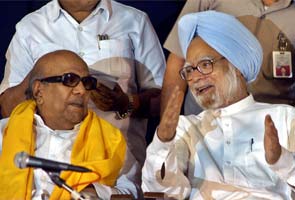
Won't pull out of UPA, say DMK sources, but will take part in bandh

September 20, 2012
Wont_pull

Chennai, September 20: After Mamata Banerjee's dramatic exit, the Congress is left without its biggest ally in the coalition it leads at the centre, but another big partner, the DMK, has made a welcome reassurance.

(After Mamata pullout, Congress gauges room for compromise: Top 10 facts)

Sources in the Southern party, which has 18 Lok Sabha MPs, say that the DMK has decided "not to embarrass the UPA" and that its course will not be affected by Ms Banerjee's pull-out last night, which has converted the UPA to a minority. The party, will however, participate in a bandh or strike called tomorrow to protest against the centre's new reforms.

Ms Banerjee said she could not remain part of the government after its decision last week to increase diesel prices, cap the amount of subsidized cooking gas available to households, and open up the retail market to foreign super-chains. (Who is Mamata Banerjee?)

Sources said this morning that a section of the DMK is in favour of following Ms Banerjee's lead and quitting the UPA, but was over-ruled. There are a few reasons why it would be politically expedient for the DMK to distance itself from the Congress now - a massive coal scam has over-shadowed the Congress, deepening the perception that it is a party infected with corruption. Like Ms Banerjee, any party that opts out of the UPA now can claim that it is doing so in the interest of the aam admi or common man, who will allegedly be hit hard by the government's new big-ticket reforms.

(Poll: Should the government give in to Mamata Banerjee?)

Tomorrow's strike against those new policies has won the support of parties ranging from the Left to the BJP, and crucially, Mulayam Singh Yadav, whose Samajwadi Party is now key for the government's survival. (Mulayam keeps UPA on tight leash, verdict on support tomorrow)

The DMK has in the recent past threatened twice to abandon the UPA. The first flashpoint was before the state elections in Tamil Nadu last year, which the DMK and Congress fought jointly. The DMK said it was not being given enough seats. Congress president Sonia Gandhi intervened to strike a compromise. However, the partnership was decimated in the polls. The DMK also flexed its muscle to pressure the Prime Minister to commit India's support to a UN resolution that asked Sri Lanka to investigate allegations of vast human rights violations against the island's minority Tamils in the final months of the civil war that ended in May 2009.

The DMK's allegiance to the government is also guided by the fact that two of its senior leaders, including the party president's daughter, are being tried for corruption in the telecom scam. The case is being investigated by the CBI, which, opposition parties, is often used by the ruling party to settle political scores or offer protection.


Comments

Add new comment

  • Coastaldigest.com reserves the right to delete or block any comments.
  • Coastaldigset.com is not responsible for its readers’ comments.
  • Comments that are abusive, incendiary or irrelevant are strictly prohibited.
  • Please use a genuine email ID and provide your name to avoid reject.
News Network
June 26,2020

New Delhi, Jun 26: With the highest single-day spike of 17,296 COVID-19 cases reported in the last 24 hours, India's COVID-19 count reached 4,90,401 on Friday, said the Union Ministry of Health and Family Welfare (MoHFW).

The country also saw 407 deaths in the last 24 hours, which pushed the death toll to 15,301.

The total number of cases includes 1,89,463 active cases, 2,85,637cured/discharged/migrated cases, as per the MoHFW.

According to the Indian Council of Medical Research (ICMR), the total number of samples tested up to June 25 is 77,76,228; the number of samples tested on 25 June is 2,15,446.

Maharashtra remains the worst-affected state in the country with 1,47,741 cases. The active cases in the state are 63,357. The number of people cured or discharged stands at 77,453 while the death toll is at 6,931.

Delhi has so far reported 73,780 cases. The active cases in the national capital stood at 26,586. While the cured and discharged numbers stood at 44,765. The death toll in the city is 2,429.

Tamil Nadu has so far reported 70,977. With active cases at 30,067 and the number of cured or discharged at 39,999, while the death toll stood at 911.

Comments

Add new comment

  • Coastaldigest.com reserves the right to delete or block any comments.
  • Coastaldigset.com is not responsible for its readers’ comments.
  • Comments that are abusive, incendiary or irrelevant are strictly prohibited.
  • Please use a genuine email ID and provide your name to avoid reject.
News Network
June 19,2020

New Delhi, Jun 19: Petrol price on Friday was hiked by 56 paise per litre and diesel by 63 paise a litre, taking the cumulative increase in rates to Rs 7.11 and Rs 7.67 per litre respectively in less than two weeks.

Petrol price in Delhi was hiked to Rs 78.37 per litre from Rs 77.81, while diesel rates were increased to Rs 77.06 a litre from Rs 76.43, according to a price notification of state oil marketing companies.

Rates have been increased across the country and vary from state to state depending on the incidence of local sales tax or VAT.

This is the 13th daily increase in rates in a row since oil companies on June 7 restarted revising prices in line with costs, after ending an 82-day hiatus in rate revision.

In 13 hikes, petrol price has gone up by Rs 7.11 per litre and diesel by Rs 7.67 a litre.

The freeze in rates was imposed in mid-March soon after the government hiked excise duty on petrol and diesel to shore up additional finances.

Oil PSUs Indian Oil Corp (IOC), Bharat Petroleum Corp Ltd (BPCL) and Hindustan Petroleum Corp Ltd (HPCL) instead of passing on the excise duty hikes to customers adjusted them against the fall in the retail rates that was warranted because of fall in international oil prices to two decade low.

International oil prices have since rebounded and oil firms are now adjusting retail rates in line with them.

Comments

Add new comment

  • Coastaldigest.com reserves the right to delete or block any comments.
  • Coastaldigset.com is not responsible for its readers’ comments.
  • Comments that are abusive, incendiary or irrelevant are strictly prohibited.
  • Please use a genuine email ID and provide your name to avoid reject.
News Network
January 31,2020

New Delhi, Jan 31: Chief Economic Adviser K V Subramanian on Friday said India's GDP is expected to grow at 6-6.5 per cent next fiscal as the economic slowdown has bottomed out.

As per the first advance estimates released by the National Statistical Organisation (NSO), the country's economic growth is likely to hit an 11-year low of 5 per cent in the current fiscal ending March 2020.

The Economic Survey 2019-20, prepared by a team lead by Subramanian, has projected the GDP to expand in the range of 6-6.5 per cent during 2020-21.

The Indian economy has hit the bottom and it will see an uptick from here, he said in a media briefing post the Economic Survey.

Amidst a weak environment for global manufacturing, trade and demand, the Indian economy slowed down with GDP growth moderating to 4.8 per cent in the first half of 2019-20, lower than 6.2 per cent in H2 of 2018-19.

Based on NSO's first advance estimates of GDP growth for 2019-20 at 5 per cent, an uptick in GDP growth is expected in the second half of the fiscal, it said.

According to it, the uptick in second half of 2019-20 would be mainly due to ten positive factors like picking up of Nifty India Consumption Index for the first time this year, an upbeat secondary market, higher FDI flows, build-up of demand pressure, positive outlook for rural consumption, rebound of industrial activity, steady improvement in manufacturing, growth in merchandise exports, higher build-up of foreign exchange reserves and positive growth rate of GST revenue collection.

The survey also emphasised that merger of public sector banks may increase the financial strength of the merged entities, lower the risk aversion and result in lowering of lending rates.

Further, as the implementation of GST further settles down, the increased unification of the domestic market may reduce business costs and facilitate fresh investment.

Reforms in land and labour market may further reduce business costs, said the survey, presented a day before Sitharaman's Union Budget 2020-21.

Comments

Add new comment

  • Coastaldigest.com reserves the right to delete or block any comments.
  • Coastaldigset.com is not responsible for its readers’ comments.
  • Comments that are abusive, incendiary or irrelevant are strictly prohibited.
  • Please use a genuine email ID and provide your name to avoid reject.