


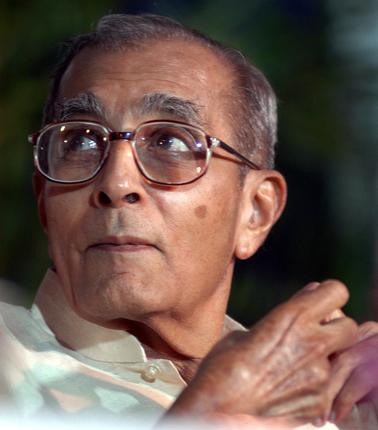
G. Kasturi, moderniser of The Hindu, passes away

[email protected] (The Hindu)
September 21, 2012
G._KasturiChennai, September 21: We record with profound regret and grief the passing of G. Kasturi, former Editor of The Hindu and former Managing Director of Kasturi and Sons Limited, the proprietors of The Hindu Group publications. He presided over, and led from the front, the newspaper’s rapid expansion and innovative modernisation and growth on the editorial-technology-logistics fronts through the 1960s and on to the cusp of the 1990s.

The end came peacefully at 2 a.m. on Friday, September 21, at his home on Kasturi Ranga Road here. Alert and active till almost the very end, he was surrounded by loved ones. He was 87.

He is survived by his wife Kamala Kasturi, sons K. Balaji and K. Venugopal, daughter Lakshmi Srinath, five granddaughters and two great grandchildren. Mr. Balaji, Mr. Venugopal and Ms. Srinath, are whole-time Directors of Kasturi and Sons Limited.

The news was received with a sense of disbelief and anguish at The Hindu’s offices in Chennai as well as in other centres.

Son of Kasturi Gopalan, who was the second of S. Kasturiranga Iyengar’s two sons, Mr. Kasturi was Editor of The Hindu from September 1965 to January 1991 — for more than 25 years. It was the longest tenure for an Editor of the newspaper, which, as on September 20, 2012, is 134 years old. (Kasturi Srinivasan was the Editor from 1934 to 1959).

Born on December 17, 1924, he had his school and college education in Madras. After acquiring an M.A. degree from Madras University creditably, he joined the organisation in 1944. In 1959, he was designated Joint Editor.

The Hindu was his life, says N. Ram

In a tribute, N. Ram, former Editor-in-Chief of The Hindu and other group publications and Director of Kasturi & Sons Limited, said:

“My uncle, Shri G. Kasturi was a major figure in the post-independence history of Indian journalism and the newspaper industry. Along with his uncle, Shri Kasturi Srinivasan, under whom he trained as a newspaperman, he was the longest serving Editor of The Hindu. Earlier and more clearly and determinedly than most of his media contemporaries and fellow Editors, he saw the need for the newspaper industry and journalism to embrace new and state-of-the-art technology and adapt it to our conditions while preserving the core values of journalism. Many a leap in newspaper technology – offset printing, facsimile transmission of whole newspaper pages, photocomposition, full-page pagination, colour scanning – found its first Indian champion in my uncle, who was always hands-on, side by side with the technical experts. He was enthusiastic about internet journalism and digital technology and almost till the end was regularly on his iMac working on page design and photographs and savouring the best of international newspaper websites. He believed that Indian newspapers had to raise their game in terms of production values and must not take their readers for granted. Significantly, he lived to see the 134th anniversary of the founding of The Hindu on September 20 and passed away a couple of hours into September 21. The Hindu was his life.”


Comments

Add new comment

  • Coastaldigest.com reserves the right to delete or block any comments.
  • Coastaldigset.com is not responsible for its readers’ comments.
  • Comments that are abusive, incendiary or irrelevant are strictly prohibited.
  • Please use a genuine email ID and provide your name to avoid reject.
Agencies
February 16,2020

New Delhi, Feb 16: Despite the fact that Aam Aadmi Party (AAP) managed to clean sweep in the recently-concluded 2020 Delhi Assembly polls with eight women candidates winning, Chief Minister Arvind Kejriwal's new cabinet does not have a single woman.

This, even as eight AAP women candidates -- Atishi Marlena, Rakhi Birla, Raj Kumari Dhillon, Preeti Tomar, Dhanwati Chandela, Parmila Tokas, Bhavna Gaur and Bandana Kumari emerged victorious in the 2020 Assembly polls.

Also, AAP's poll campaign had put the spotlight on women's issues- free bus rides for women, safety etc.

This year, AAP had fielded nine female candidates out of which only woman candidate Sarita Singh from Rohtas Nagar suffered defeat. In 2015, the party had fielded six women candidates, all of whom won the election.

Atishi Marlena, who won the election from Kalkaji, has served as a key advisor to the AAP leader Manish Sisodia primarily on education policies that transformed public school education in the capital.

Just like Marlena, incumbent MLA Rakhi Birla from Mangolpuri constituency has also failed to comeback to the Cabinet in this term even after bagging over 74,100 votes, with a margin of over 30,000 votes and 58 per cent of the vote share.

She was charged with the Cabinet Ministry of Women and Child, Social Welfare and Languages, for a few months in AAP's first term from 2013 to 2014. During this, period she came to the spotlight as she became the youngest ever cabinet minister of Delhi at the age of 26 and was even called "giant killer" for defeating four-time Congress MLA Raj Kumar Chouhan in 2013 Delhi polls.

Another candidate of AAP, Raj Kumari Dhillon swept Hari Nagar against BJP's Tajinder Pal Singh Bagga by a margin of over 20,100 votes.

Apart from these three, Preeti Tomar (Tri Nagar), Dhanwati Chandela (Rajouri Nagar), Pramila Tokas (RK Puram), Bhavna Gaur (Palam), and Bandana Kumari (Shalimar Bagh)- the other five who won for AAP- do not figure in the new cabinet.

Today at Ramlila Maidan, AAP national convenor Arvind Kejriwal was sworn-in as Chief Minister of Delhi.

Besides him, Manish Sisodia, Satyender Jain, Gopal Rai, Kailash Gehlot, Imran Hussain, and Rajendra Gautamas took oath as the ministers in Delhi.

AAP achieved a landslide victory in the Assembly elections with a clear majority of 62 seats out of 70. 

Comments

Add new comment

  • Coastaldigest.com reserves the right to delete or block any comments.
  • Coastaldigset.com is not responsible for its readers’ comments.
  • Comments that are abusive, incendiary or irrelevant are strictly prohibited.
  • Please use a genuine email ID and provide your name to avoid reject.
News Network
March 29,2020

New Delhi, Mar 29: The total confirmed coronavirus cases in India rose to 979, including 48 foreigners, according to the Ministry of Health and Family Welfare on Sunday.
There are 867 active cases of the disease as of Sunday, out of the total confirmed cases, while 87 persons have also been cured and discharged or migrated.
The number of deaths due to the infection rose to 25.
Maharashtra and Kerala, with 186 and 182 cases, have two of the highest number of positive cases in the country, with Maharashtra also recording six deaths due to the disease.
The Central government has taken many stringent measures to prevent the further spread of the disease with a 21-day nationwide lockdown being imposed.
The disease which originated from Wuhan, China has so far close to 6 lakh reported cases from around the world with more than 25 thousand deaths being reported due to it, as per World Health Organisation on March 28. 

Comments

Add new comment

  • Coastaldigest.com reserves the right to delete or block any comments.
  • Coastaldigset.com is not responsible for its readers’ comments.
  • Comments that are abusive, incendiary or irrelevant are strictly prohibited.
  • Please use a genuine email ID and provide your name to avoid reject.
News Network
June 25,2020

India has jumped past 4.5 lakh coronavirus cases and 14,476 people have succumbed to the viral infection so far. In this backdrop, speaking to IANS in an exclusive interview, AIIMS Director Randeep Guleria said India is also vulnerable to second wave of coronavirus and people should continue to follow social distancing, wearing mask and other precautions, after cases begin to decline.

He added that in order to contain the outbreak of Covid-19, a limited lockdown in hotspots, where volume of cases is very high, may be considered along with a micro-plan to prevent leakage of cases from these areas to other non-containment areas. Excerpts of the interview are below:

Q: Reports say China and South Korea are witnessing a second wave of coronavirus infection, what is this second wave, is India also vulnerable to this?

A: When cases come down significantly, people tend to drop their guard against the viral infection, and this leads to the second wave (which means a sudden increase in the number of cases). After cases begin to decline, people should continue to follow the precautions -- continue to maintain social distancing and wear masks regularly. See what happened in Singapore, it was struck by a second wave of coronavirus. Look, what happened in the 1918 pandemic, people dropped their guard and the second wave of viral infection struck back. If people do not follow social distancing then the spike in cases is apparent. We need to take these precautions at least for one year. India is also vulnerable to this second wave.

Q: If Covid-19 cases continue to rise rapidly, do you think we need another lockdown in areas where volume of cases are very high?

A: A large volume of cases is concentrated in specific areas like hotspots, and in order to maintain things in order, we may need a limited lockdown in these areas. This should be followed by a micro-plan which entails extensive testing of people and also extensive contact tracing of people who have got in touch with positive people. Need to ensure there is no leakage of cases from these areas. People from these areas should not mix with others in non-containment areas. This will aid in containing the outbreak of the virus. People who have developed symptoms should get themselves tested, especially in the containment areas.

Q: With more than 4.5 lakh cases and close to 14,500 deaths, do you think India has reached its peak and a decline in cases is prominent?

A: The cases will continue to increase for some time. The doubling time of cases has also increased. But, the cases will also begin to flatten. Though, it is difficult to give an exact time period in this viral infection, it seems, the growth in cases will flatten in the end of July or beginning of August. A decline will come to this viral infection, but it does not mean that people should drop their guard. As a measure, we need to decrease community participation and citizens should continue to follow social distancing. People should get themselves tested. All these efforts will help in preventing people from contracting this virus. These precautions will also prevent us from the second wave, and we must continue to take precautions. The virus has not gone away, it is still lurking.

Q: India has crossed the 4.5 lakh coronavirus cases so far, although our recovery rate is good, but still 10,000 to 15,000 cases are reported daily. Why do cases continue to spiral, what is the reason?

A: We have to remember a few things -- the bulk of cases are in 10 cities, nearly 70 per cent, and if we take into account cases per million population, the number is not very high, as compared with countries including countries in Europe. Many European countries put together still do not add up to the Indian population. Do not compare India to countries like Italy, Spain etc. We need to focus on hotspots, which contribute to between 70 -80 per cent of cases, and we have to identify cases in these areas at an early stage. The population density is very high in these cities. People in lower socio-economic status are highly vulnerable to the viral infection, as many live together in small spaces and there is a lot of mixing of people happening there. Look at the market places, people are not following social distancing and not wearing masks. In fact, many are in close vicinity of each other.

Comments

Add new comment

  • Coastaldigest.com reserves the right to delete or block any comments.
  • Coastaldigset.com is not responsible for its readers’ comments.
  • Comments that are abusive, incendiary or irrelevant are strictly prohibited.
  • Please use a genuine email ID and provide your name to avoid reject.