


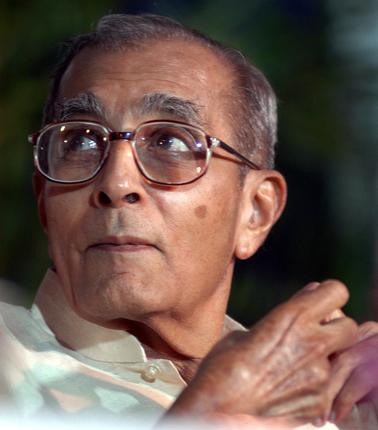
G. Kasturi, moderniser of The Hindu, passes away

[email protected] (The Hindu)
September 21, 2012
G._KasturiChennai, September 21: We record with profound regret and grief the passing of G. Kasturi, former Editor of The Hindu and former Managing Director of Kasturi and Sons Limited, the proprietors of The Hindu Group publications. He presided over, and led from the front, the newspaper’s rapid expansion and innovative modernisation and growth on the editorial-technology-logistics fronts through the 1960s and on to the cusp of the 1990s.

The end came peacefully at 2 a.m. on Friday, September 21, at his home on Kasturi Ranga Road here. Alert and active till almost the very end, he was surrounded by loved ones. He was 87.

He is survived by his wife Kamala Kasturi, sons K. Balaji and K. Venugopal, daughter Lakshmi Srinath, five granddaughters and two great grandchildren. Mr. Balaji, Mr. Venugopal and Ms. Srinath, are whole-time Directors of Kasturi and Sons Limited.

The news was received with a sense of disbelief and anguish at The Hindu’s offices in Chennai as well as in other centres.

Son of Kasturi Gopalan, who was the second of S. Kasturiranga Iyengar’s two sons, Mr. Kasturi was Editor of The Hindu from September 1965 to January 1991 — for more than 25 years. It was the longest tenure for an Editor of the newspaper, which, as on September 20, 2012, is 134 years old. (Kasturi Srinivasan was the Editor from 1934 to 1959).

Born on December 17, 1924, he had his school and college education in Madras. After acquiring an M.A. degree from Madras University creditably, he joined the organisation in 1944. In 1959, he was designated Joint Editor.

The Hindu was his life, says N. Ram

In a tribute, N. Ram, former Editor-in-Chief of The Hindu and other group publications and Director of Kasturi & Sons Limited, said:

“My uncle, Shri G. Kasturi was a major figure in the post-independence history of Indian journalism and the newspaper industry. Along with his uncle, Shri Kasturi Srinivasan, under whom he trained as a newspaperman, he was the longest serving Editor of The Hindu. Earlier and more clearly and determinedly than most of his media contemporaries and fellow Editors, he saw the need for the newspaper industry and journalism to embrace new and state-of-the-art technology and adapt it to our conditions while preserving the core values of journalism. Many a leap in newspaper technology – offset printing, facsimile transmission of whole newspaper pages, photocomposition, full-page pagination, colour scanning – found its first Indian champion in my uncle, who was always hands-on, side by side with the technical experts. He was enthusiastic about internet journalism and digital technology and almost till the end was regularly on his iMac working on page design and photographs and savouring the best of international newspaper websites. He believed that Indian newspapers had to raise their game in terms of production values and must not take their readers for granted. Significantly, he lived to see the 134th anniversary of the founding of The Hindu on September 20 and passed away a couple of hours into September 21. The Hindu was his life.”


Comments

Add new comment

  • Coastaldigest.com reserves the right to delete or block any comments.
  • Coastaldigset.com is not responsible for its readers’ comments.
  • Comments that are abusive, incendiary or irrelevant are strictly prohibited.
  • Please use a genuine email ID and provide your name to avoid reject.
News Network
April 6,2020

New Delhi, April 6: On the 40th foundation day of the Bharatiya Janata Party (BJP) today, Prime Minister Narendra Modi appealed to party workers to reaffirm the importance of social distancing, help those in need amid lockdown and enable India to overcome COVID-19.

"Greetings to all fellow BJP Karyakartas on the Sthapana Diwas of the party. Tributes to all those who have toiled hard to build the party for decades, due to which BJP has got the opportunity to serve crores of Indians across our nation's length and breadth. #BJPat40," Prime Minister Modi tweeted.

"Whenever BJP has got the opportunity to serve, the party has focused on good governance and empowering the poor. In line with the party's ethos, our Karyakartas have worked hard to bring a positive difference in the lives of many and done great social service.

We mark our party's 40th anniversary when India is battling COVID-19. I appeal to BJP Karyakartas to follow the set of guidelines from our party president JP Nadda Ji, help those in need and reaffirm the importance of social distancing. Let's make India COVID-19 free," he added.

Earlier, in a message, party President JP Nadda had asked BJP workers to hoist new party flag at all offices and at every karyakarta's house. "Maintain social distancing while hoisting," the BJP President stated.

"All BJP Karyakartas to give up one meal on our Foundation Day as a way to show solidarity with people facing hardships during the lockdown.

Provide food packets to 5+1 needy under #FeedtheNeedy program. In the next one week, put a system in place where we can provide two homemade face covers to each person at our booth. We should circulate videos of preparation and distribution of such face covers with #WearFaceCoverStaySafe," Nadda stated.

He also asked BJP Kartyakartas to encourage 40 others to donate Rs 100 each to PM-CARES Fund.

Comments

Add new comment

  • Coastaldigest.com reserves the right to delete or block any comments.
  • Coastaldigset.com is not responsible for its readers’ comments.
  • Comments that are abusive, incendiary or irrelevant are strictly prohibited.
  • Please use a genuine email ID and provide your name to avoid reject.
News Network
May 17,2020

New Delhi, May 17: Spelling out the government’s fourth tranche of initiatives towards achieving Prime Minister Narendra Modi’s vision of ‘Atmanirbhar Bharat’, Union Finance Minister Nirmala Sitharaman on Saturday announced significant structural reforms in eight sectors of the economy — coal, minerals, defense production, aviation, power distribution in Union territories, space and atomic energy.

Addressing her fourth and the second-last press conference, Sitharaman said crucial sectors such as coal production and exploration, defence production and space would see an increased participation from private entities.

Coal sector:

In the realm of coal exploration, the government has decided to liberalise the entry norms for private entities, which would mean that any interested party could bid for a coal block and sell it in the open market. The minister said that the government would do away with all the eligibility conditions at the time of bidding for a coal block, except requiring an “upfront payment with a ceiling.”

Nearly 50 coal blocks would be offered to private players immediately, revealed Sitharaman.

She further said that Rs 50,000 crore would be spent by Centre in creating ‘coal evacuation’ infrastructure, which would expedite the transport of mined product to the destination.

Defence sector:

In defence production, Sitharaman revealed that the government would raise the foreign direct investment (FDI) limit in the sector from current 49 per cent to 74 per cent. Further, the government would also work towards corporatising the ordnance factory boards. “Corporatising doesn’t amount to privatization,” added Sitharaman.

In a bid to boost indigenous production of defence products and gave an impetus to Make in India, Sitharaman said that the government was in a process of notifying a list of weapons/platforms for an import ban with year-wise timelines.

These decisions would also help in reducing huge import bills, the finance minister said.

Privatisation of electricity:

In another announcement that could have an effect on electricity charges in the union territories, Union Finance Minister Nirmala Sitharaman announced on Saturday that power departments and utilities in all the centrally administered territories would be privatised.

Sitharaman said that the proposed move would lead to better service to consumers and improvement in operational and financial efficiency in distribution.

The finance minister said that decision was guided by 'sub-optimal' utilisation of performance of power distribution and supply'.

She said that the move to that effect would provide a model for emulation by other utilities across the country, in what could be an indicator of what's in the pipeline for utilities in other states as well.

Sitharaman said that the privation reform was in line with the tariff policy reforms and would help in enhancing consumer rights, promote industry and improve the overall sustainability of the sector.

Space sector:

Sitharaman also announced the opening up of the space exploration sector for private players. Till date, the government-run Indian Space Research Organisation (ISRO) has held a monopoly on all activities concerning space exploration and satellite launches.

The Indian private sector will be a co-traveller in India's space sector journey, said Sitharaman, while announcing a series of structural reforms in eight crucial areas of the economy. The Union Finance Minister was addressing her fourth press conference in as many days, as a follow-up towards realising Prime Minister Narendra Modi's vision of 'atmanirbhar Bharat', which was spelled out in his video address on May 12.

Sitharaman said that the reforms in the space sector will provide a level-playing field for private companies in satellite launches and space-based services.

She said that the private sector would be allowed to use ISRO facilities and other assets to improve their capacities. Stating that the government would provide predictable policy and regulatory environment to private players, Sitharaman also disclosed that future projects for planetary exploration and outer space travel among others would be opened up for private entities.

Comments

Add new comment

  • Coastaldigest.com reserves the right to delete or block any comments.
  • Coastaldigset.com is not responsible for its readers’ comments.
  • Comments that are abusive, incendiary or irrelevant are strictly prohibited.
  • Please use a genuine email ID and provide your name to avoid reject.
News Network
March 7,2020

Srinagar, Mar 7: Two more accused, including a man who allegedly bought chemicals online for making improvised explosive device (IED) to be used in an attack on a convoy of the Central Reserve Police Force (CRPF) in Jammu and Kashmir's Pulwama last year, were arrested by the National Investigation Agency (NIA) on Friday, an official said.

The terror attack left 40 CRPF personnel dead in south Kashmir's Pulwama last year.

Waiz-ul-Islam, 19, from Srinagar and Mohammad Abbass Rather, 32, from Pulwama were arrested by the NIA, taking the number of those arrested in the case in the past week to five.

"During initial interrogation, Islam disclosed that he used his Amazon online shopping account to procure chemicals for making IEDs, batteries and other accessories on the directions of Pakistani Jaish-e-Mohammed (JeM) terrorists," the official said.

He said Islam personally delivered the items to the JeM terrorists after buying them online as a part of the conspiracy to carry out the attack.

"Rather is an old overground worker of the JeM. He has disclosed that he gave shelter at his home to Jaish terrorist and IED expert Mohd Umar after he came to Kashmir in April-May 2018," the official said.

Rather also sheltered other JeM terrorists - suicide bomber Adil Ahmad Dar, Sameer Ahmed Dar and Kamran, a Pakistani -- at his house before the Pulwama attack, the official said.

"He also facilitated safe shelter for the JeM terrorists, including Adil, at the house of accused Tariq Ahmed Shah and his daughter Insha Jan of Hakripora, who were arrested on March 3," the official said.

He said Islam and Rather will be produced before the NIA special court in Jammu on Saturday, while further investigation in the case continues. The NIA took over the case to probe the conspiracy behind the February 14, 2019, attack in Pulwama.

The last video of Adil, which was released by the JeM from Pakistan after the terror attack, was filmed at the home of Tariq Ahmed Shah. On February 28, the NIA achieved a major breakthrough in the case when it arrested 22-year-old Shakir Bashir Magrey, a furniture shop owner and resident of Pulwama.

Magrey had given shelter and other logistical assistance to suicide bomber Adil. He was introduced to Adil in mid-2018 by Pakistani terrorist Mohammad Umar Farooq and he became a full-time OGW of the JeM.

The explosives used in the attack were determined through forensic probe to be ammonium nitrate, nitro-glycerin and RDX. During investigation into the attack, the identity of the suicide bomber to be Adil Ahmad Dar was confirmed through DNA matching with that of his father.

The other key terrorists involved in the attack have been found to be JeM's south Kashmir divisional head Muddasir Ahmad Khan, killed in an operation by the security forces on March 11 last year; Pakistani terrorists Muhammad Umar Farooq and IED expert Kamran, both killed on March 29 last year; the owner of the car Sajjad Ahmad Bhat, a resident of Anantnag who was killed on June 16 last year, and Qari Yassir, JeM's commander for Kashmir who was killed on January 25 this year.

Comments

Add new comment

  • Coastaldigest.com reserves the right to delete or block any comments.
  • Coastaldigset.com is not responsible for its readers’ comments.
  • Comments that are abusive, incendiary or irrelevant are strictly prohibited.
  • Please use a genuine email ID and provide your name to avoid reject.