


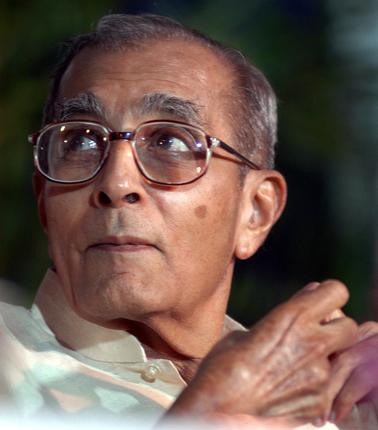
G. Kasturi, moderniser of The Hindu, passes away

[email protected] (The Hindu)
September 21, 2012
G._KasturiChennai, September 21: We record with profound regret and grief the passing of G. Kasturi, former Editor of The Hindu and former Managing Director of Kasturi and Sons Limited, the proprietors of The Hindu Group publications. He presided over, and led from the front, the newspaper’s rapid expansion and innovative modernisation and growth on the editorial-technology-logistics fronts through the 1960s and on to the cusp of the 1990s.

The end came peacefully at 2 a.m. on Friday, September 21, at his home on Kasturi Ranga Road here. Alert and active till almost the very end, he was surrounded by loved ones. He was 87.

He is survived by his wife Kamala Kasturi, sons K. Balaji and K. Venugopal, daughter Lakshmi Srinath, five granddaughters and two great grandchildren. Mr. Balaji, Mr. Venugopal and Ms. Srinath, are whole-time Directors of Kasturi and Sons Limited.

The news was received with a sense of disbelief and anguish at The Hindu’s offices in Chennai as well as in other centres.

Son of Kasturi Gopalan, who was the second of S. Kasturiranga Iyengar’s two sons, Mr. Kasturi was Editor of The Hindu from September 1965 to January 1991 — for more than 25 years. It was the longest tenure for an Editor of the newspaper, which, as on September 20, 2012, is 134 years old. (Kasturi Srinivasan was the Editor from 1934 to 1959).

Born on December 17, 1924, he had his school and college education in Madras. After acquiring an M.A. degree from Madras University creditably, he joined the organisation in 1944. In 1959, he was designated Joint Editor.

The Hindu was his life, says N. Ram

In a tribute, N. Ram, former Editor-in-Chief of The Hindu and other group publications and Director of Kasturi & Sons Limited, said:

“My uncle, Shri G. Kasturi was a major figure in the post-independence history of Indian journalism and the newspaper industry. Along with his uncle, Shri Kasturi Srinivasan, under whom he trained as a newspaperman, he was the longest serving Editor of The Hindu. Earlier and more clearly and determinedly than most of his media contemporaries and fellow Editors, he saw the need for the newspaper industry and journalism to embrace new and state-of-the-art technology and adapt it to our conditions while preserving the core values of journalism. Many a leap in newspaper technology – offset printing, facsimile transmission of whole newspaper pages, photocomposition, full-page pagination, colour scanning – found its first Indian champion in my uncle, who was always hands-on, side by side with the technical experts. He was enthusiastic about internet journalism and digital technology and almost till the end was regularly on his iMac working on page design and photographs and savouring the best of international newspaper websites. He believed that Indian newspapers had to raise their game in terms of production values and must not take their readers for granted. Significantly, he lived to see the 134th anniversary of the founding of The Hindu on September 20 and passed away a couple of hours into September 21. The Hindu was his life.”


Comments

Add new comment

  • Coastaldigest.com reserves the right to delete or block any comments.
  • Coastaldigset.com is not responsible for its readers’ comments.
  • Comments that are abusive, incendiary or irrelevant are strictly prohibited.
  • Please use a genuine email ID and provide your name to avoid reject.
News Network
January 24,2020

New Delhi, Jan 24: Although India's Ujjwala programme encouraged adoption of liquefied petroleum gas (LPG) for cooking among the poor, households availing the scheme have not shifted away from using highly polluting fuels like firewood, a study reveals.

The researchers, including those from the University of British Columbia (UBC) in Canada, found that additional incentives to encourage regular use of cooking gas are necessary for a complete transition to clean cooking fuel among poor rural households.

They noted that about 2.9 billion people across Asia, Africa, and Latin America burn solid fuels like firewood to meet their cooking energy needs.

This has significant negative implications for public health, the environment, and societal development, according to the researchers.

Through the Pradhan Mantri Ujjwala Yojana (PMUY), India has provided capital cost subsidies to poor women to adopt a clean-burning cooking fuel or LPG.

The researchers explained that within the first 40 months of the scheme, more than 80 million households obtained LPG stoves.

However, the full benefits of LPG adoption depend on near complete replacement of polluting fuels with LPG, according to a research-based policy brief published in the journal Nature Energy.

The scientists said this cannot be assumed solely on the basis of LPG presence in the household.

"Our research shows that Ujjwala was able to attract new consumers rapidly, but those consumers did not start using LPG on a regular basis," Abhishek Kar, a postdoc at Columbia University in the US, told PTI.

The study analysed LPG sales data for over 25,000 consumers, including PMUY beneficiaries, as well as general rural LPG consumers in Koppal district of Karnataka.

The scientists employed data covering all LPG purchases of PMUY beneficiaries through their first year in the programme.

They also assessed the general rural population's purchases during their first five years as consumers to assess the effect of experience on use.

The findings estimate that an average rural family needs to purchase five 14.2 kilogramme-cylinders annually to meet half of their cooking needs.

However, the study said just seven per cent of PMUY beneficiaries in Koppal purchased five or more cylinders annually, suggesting that the beneficiaries seldom use LPG.

The general (nonPMUY) consumers in this region use on average two times more LPG cylinders than PMUY beneficiaries, the researchers noted.

Yet, only 45 per cent of nonPMUY consumers use five or more cylinders per year -- even after several years of experience with LPG, they said.

The team assessed price and seasonal factors affecting LPG use among the general population over a three-year period.

It found that LPG consumers are sensitive to price and seasonality -- LPG cylinder refill rates are lower in the summer when agricultural activity is limited, and cash is scarce.

"There was no scheme incentives to promote use, except general LPG subsidies which is available to all, including the urban middle class," said Kar, who was a Ph.D. scholar at UBC when the research was published.

"If there is no additional income, what cost would a poor family on an already tight budget cut to pay for an extra expense on a regular basis.

"Ujjwala has started the scheme of 5 kg-cylinder in response, but the impact of that on LPG sales is still publicly unknown," he said.

These findings, the researchers noted, suggest the need for additional measures to promote regular LPG use for all rural populations.

Although the finding come from a single district in Southern India, it may also apply to other areas with similar socio-economic conditions, they said.

A more expansive evaluation of PMUY would help design targeted incentives to transform infrequent users to regular users, according to the researchers.

Comments

Add new comment

  • Coastaldigest.com reserves the right to delete or block any comments.
  • Coastaldigset.com is not responsible for its readers’ comments.
  • Comments that are abusive, incendiary or irrelevant are strictly prohibited.
  • Please use a genuine email ID and provide your name to avoid reject.
News Network
March 5,2020

Mar 5: The Kerala government has given its nod to a proposal aimed at encouraging students aged between 18 and 25 years to take up part-time jobs while pursuing education so as to help them gain work experience and hone their skills.

The government has decided to accept the proposal as a policy decision at the Cabinet meeting held on Wednesday, an official press release said.

The aim is to ensure that in a fiscal, 90 days of work is assured for students in government departments, local body organisations, PSUs and private companies.

This will help in developing a work culture among students.

Honorariums will be given to students by the organisations employing them part-time, the release said.

Students aged between 18 and 25 years will be permitted to become part of the scheme which will help them to gain work experience and hone their skills, the release added.

In another decision, the government decided to release Rs 26 crore from the Chief Minister's disaster relief fund for providing compensation to farmers who suffered crop loss during the 2018 floods.

Comments

Add new comment

  • Coastaldigest.com reserves the right to delete or block any comments.
  • Coastaldigset.com is not responsible for its readers’ comments.
  • Comments that are abusive, incendiary or irrelevant are strictly prohibited.
  • Please use a genuine email ID and provide your name to avoid reject.
Agencies
May 31,2020

New Delhi, May 31: The income tax department has notified forms for filing income tax returns for the financial year 2019-20.

The Central Board of Direct Taxes (CBDT) has notified Sahaj (ITR-1), Form ITR-2, Form ITR-3, Form Sugam (ITR-4), Form ITR-5, Form ITR-6, Form ITR-7 and Form ITR-V for the assessment year 2020-21.

The department has revised the I-T return forms for the financial year 2019-20 to allow assessees to avail benefits of various timeline extension granted by the government following the COVID-19 outbreak.

The government has extended various timelines under the Income Tax Act, 1961, through the Taxation and Other Laws (Relaxation of Certain Provisions) Ordinance, 2020.

Accordingly, the time for making investment or payments for claiming deduction under Chapter-VIA-B of IT Act that include Section 80C (LIC, PPF, NSC etc.), 80D (Mediclaim) and 80G (Donations) for the financial year 2019-20 had been extended to June 30, 2020.

ClearTax founder and CEO Archit Gupta said, "The new forms require a separate table to disclose tax saving investment made in the first quarter of 2020 for availing them in FY 2019-20. Taxpayers must assess their tax liability for FY 2019-20 and make sure they are maximising their Section 80C benefits if not already done so."

Comments

Add new comment

  • Coastaldigest.com reserves the right to delete or block any comments.
  • Coastaldigset.com is not responsible for its readers’ comments.
  • Comments that are abusive, incendiary or irrelevant are strictly prohibited.
  • Please use a genuine email ID and provide your name to avoid reject.