


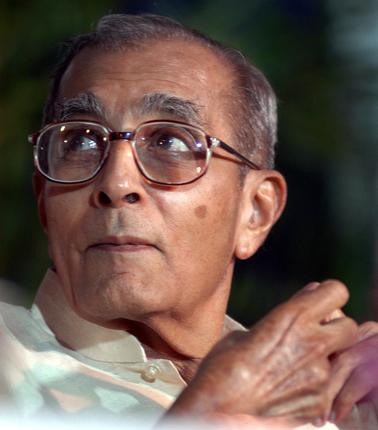
G. Kasturi, moderniser of The Hindu, passes away

[email protected] (The Hindu)
September 21, 2012
G._KasturiChennai, September 21: We record with profound regret and grief the passing of G. Kasturi, former Editor of The Hindu and former Managing Director of Kasturi and Sons Limited, the proprietors of The Hindu Group publications. He presided over, and led from the front, the newspaper’s rapid expansion and innovative modernisation and growth on the editorial-technology-logistics fronts through the 1960s and on to the cusp of the 1990s.

The end came peacefully at 2 a.m. on Friday, September 21, at his home on Kasturi Ranga Road here. Alert and active till almost the very end, he was surrounded by loved ones. He was 87.

He is survived by his wife Kamala Kasturi, sons K. Balaji and K. Venugopal, daughter Lakshmi Srinath, five granddaughters and two great grandchildren. Mr. Balaji, Mr. Venugopal and Ms. Srinath, are whole-time Directors of Kasturi and Sons Limited.

The news was received with a sense of disbelief and anguish at The Hindu’s offices in Chennai as well as in other centres.

Son of Kasturi Gopalan, who was the second of S. Kasturiranga Iyengar’s two sons, Mr. Kasturi was Editor of The Hindu from September 1965 to January 1991 — for more than 25 years. It was the longest tenure for an Editor of the newspaper, which, as on September 20, 2012, is 134 years old. (Kasturi Srinivasan was the Editor from 1934 to 1959).

Born on December 17, 1924, he had his school and college education in Madras. After acquiring an M.A. degree from Madras University creditably, he joined the organisation in 1944. In 1959, he was designated Joint Editor.

The Hindu was his life, says N. Ram

In a tribute, N. Ram, former Editor-in-Chief of The Hindu and other group publications and Director of Kasturi & Sons Limited, said:

“My uncle, Shri G. Kasturi was a major figure in the post-independence history of Indian journalism and the newspaper industry. Along with his uncle, Shri Kasturi Srinivasan, under whom he trained as a newspaperman, he was the longest serving Editor of The Hindu. Earlier and more clearly and determinedly than most of his media contemporaries and fellow Editors, he saw the need for the newspaper industry and journalism to embrace new and state-of-the-art technology and adapt it to our conditions while preserving the core values of journalism. Many a leap in newspaper technology – offset printing, facsimile transmission of whole newspaper pages, photocomposition, full-page pagination, colour scanning – found its first Indian champion in my uncle, who was always hands-on, side by side with the technical experts. He was enthusiastic about internet journalism and digital technology and almost till the end was regularly on his iMac working on page design and photographs and savouring the best of international newspaper websites. He believed that Indian newspapers had to raise their game in terms of production values and must not take their readers for granted. Significantly, he lived to see the 134th anniversary of the founding of The Hindu on September 20 and passed away a couple of hours into September 21. The Hindu was his life.”


Comments

Add new comment

  • Coastaldigest.com reserves the right to delete or block any comments.
  • Coastaldigset.com is not responsible for its readers’ comments.
  • Comments that are abusive, incendiary or irrelevant are strictly prohibited.
  • Please use a genuine email ID and provide your name to avoid reject.
News Network
February 19,2020

New Delhi, Feb 19: India will switch to the world's cleanest petrol and diesel from April 1 as it leapfrogs straight to Euro-VI emission compliant fuels from Euro-IV grades now - a feat achieved in just three years and not seen in any of the large economies around the globe.

India will join the select league of nations using petrol and diesel containing just 10 parts per million of sulphur as it looks to cut vehicular emissions that are said to be one of the reasons for the choking pollution in major cities.

Sanjiv Singh, Chairman of Indian Oil Corp (IOC) - the firm that controls roughly half of the country's fuel market, said almost all refineries began producing ultra-low sulphur BS-VI (equivalent to Euro-VI grade) petrol and diesel by the end of 2019 and oil companies have now undertaken the tedious task of replacing every drop of fuel in the country with the new one.

"We are absolutely on track for supplying BS-VI fuel from April 1. Almost all refineries have begun supplying BS-VI fuel and the same has reached storage depots across the country," he said.

From storage depots, the fuel has started travelling to petrol pumps and in the next few weeks all of them will only have BS-VI grade petrol and diesel, he said. "We are 100 per cent confident that fuel that will flow from nozzles at all the petrol pumps in the country on April 1 will be BS-VI emission compliant fuel."

India adopted Euro-III equivalent (or Bharat Stage-III) fuel with a sulphur content of 350 ppm in 2010 and then took seven years to move to BS-IV that had a sulphur content of 50 ppm. From BS-IV to BS-VI it took just three years.

"It was a conscious decision to leapfrog to BS-VI as first upgrading to BS-V and then shifting to BS-VI would have prolonged the journey to 4 to 6 years. Besides, oil refineries, as well as automobile manufacturers, would have had to make investments twice - first to producing BS-V grade fuel and engines and then BS-VI ones," he said.

State-owned oil refineries spent about Rs 35,000 crore to upgrade plants that could produce ultra-low sulphur fuel. This investment is on top of Rs 60,000 crore they spent on refinery upgrades in the previous switchovers.

BS-VI has a sulphur content of just 10 ppm and emission standards are as good as CNG.

Originally, Delhi and its adjoining towns were to have BS-VI fuel supplies by April 2019 and the rest of the country was to get same supplies from April 2020.

But oil marketing companies switched over to supply of BS-VI grade fuels in the national capital territory of Delhi on April 1, 2018.

The supply of BS-VI fuels was further extended to four contiguous districts of Rajasthan and eight of Uttar Pradesh in the National Capital Region (NCR) on April 1, 2019, together with the city of Agra.

BS-VI grade fuels were made available in 7 districts of Haryana from October 1, 2019.

Singh said the new fuel will result in a reduction in NOx in BS-VI compliant vehicles by 25 per cent in petrol cars and by 70 per cent in diesel cars.

The switchover, he said, is a tedious task as every drop of old, higher-sulphur content fuel has to be flushed out in depots, pipelines and tanks before being replaced by BS-VI.

"We are confident of disruption-free switchover to BS-VI supplies across the country," he said. "What we will be supplying is the best quality available anywhere in the world. You don't have any better fuel that is supplied in any part of the world. Perhaps our BS-VI fuel will be better than equivalent fuel in some parts of the US and Europe."

India adopted a fuel upgradation programme in the early 1990s. Low lead gasoline (petrol) was introduced in 1994 in Delhi, Mumbai, Kolkata and Chennai. On February 1, 2000, unleaded gasoline was mandated nationwide.

Similarly, BS-2000 (Euro-I equivalent, BS-1) vehicle emission norms were introduced for new vehicles from April 2000. BS-II (Euro-II equivalent) emission norms for new cars were introduced in Delhi from 2000 and extended to the other metro cities in 2001.

Benzene limits have been reduced progressively from 5 per cent in 2000 to 1 per cent nationwide. Lead content in gasoline was removed in phases and only unleaded gasoline is being produced and sold from February 1, 2000.

The octane number of gasoline signifies the improved performance of the engine. Loss in octane number due to phasing out of lead was made up by installing new facilities in the refinery and changes in refinery operation. RON (Research Octane Number) of gasoline for BS-2000 spec was increased to 88. This has over time been increased to 91.

Singh said sulphur reduction will reduce Particulate Matter (PM) emissions even in the in-use older generation diesel vehicles.

Comments

Add new comment

  • Coastaldigest.com reserves the right to delete or block any comments.
  • Coastaldigset.com is not responsible for its readers’ comments.
  • Comments that are abusive, incendiary or irrelevant are strictly prohibited.
  • Please use a genuine email ID and provide your name to avoid reject.
News Network
February 19,2020

London, Feb 19: Indian universities had a good performance year within the emerging economies of the world as a record 11 made it to the top 100 Times Higher Education's (THE) Emerging Economies University Rankings 2020.

Only China has more universities than India in the top 100 at 30 from a total of 47 countries and territories included in the analysis released in London on Tuesday evening.

A total of 56 Indian universities appear in the full ranking of a total of 533 universities across emerging economies of the world.

The Indian Institute of Science (IISc), ranked 16th, is India’s top-ranked institution followed by the Indian Institute of Technologies (IITs).

"There has long been a debate about the success of Indian universities in world rankings, and for too long they have been seen as underperforming on the global stage," notes Phil Baty, Chief Knowledge Officer for the THE.

"The Emerging Economies University Rankings 2020 suggests that real progress is being made by a number of institutions in a number of metrics across our robust methodology, and could mark an exciting turning point for Indian higher education, enabled in part by the Institutes of Eminence scheme," he said.

The Indian government’s Institutes of Eminence scheme was established in 2017 and one of its participating universities, Amrita Vishwa Vidyapeetham, has entered the top 100 for the first time, moving up a huge 51 places from joint 141st in 2019.

The other universities included in the Institutes of Eminence scheme that appear in the top 100 mark the biggest improvers in the ranking with IIT Kharagpur moving up 23 places to 32nd, IIT Delhi improving by 28 places to joint 38th and IIT Madras climbing 12 places to joint 63rd.

The Institutes of Eminence scheme provides participating universities with government funding and greater autonomy with the aim of moving them into the top 100 of the world university rankings, including Times Higher Education’s World University Ranking, over time.

The expectation is that this will be achieved through a number of changes including an increase in foreign students and staff, offering online courses and encouraging academic collaboration with other top universities around the world.

This year marks only the second time that 11 Indian institutions have held top 100 positions since the ranking began in 2014, when much fewer universities took part in the ranking globally.

Comments

Add new comment

  • Coastaldigest.com reserves the right to delete or block any comments.
  • Coastaldigset.com is not responsible for its readers’ comments.
  • Comments that are abusive, incendiary or irrelevant are strictly prohibited.
  • Please use a genuine email ID and provide your name to avoid reject.
News Network
May 22,2020

Bengaluru, May 22: Amazon.com Inc’s India unit said it would hire 50,000 temporary workers to meet a surge in online shopping in the country, where customers have been stuck indoors for two months in a lockdown to fight the coronavirus outbreak.

E-commerce firms faced massive disruption in the initial days of the lockdown in India, but a slow easing of the stringent regulations has allowed them to resume large parts of their operations.

"We want to continue helping customers all over India get everything they need so they can continue to practice social distancing," Amazon senior executive Akhil Saxena said in a statement on the company's blog. (bit.ly/2A1Wv7O)

“(The move) will also keep as many people as possible working during this pandemic while providing a safe work environment for them,” said Saxena, Amazon’s VP for customer fulfillment operations in APAC, MENA & Latam.

The temporary hires will work in Amazon’s fulfillment centers and as part of its delivery network, the company said, making the announcement at a time when various other companies in the country have been forced to cut jobs as they try to tide over the health crisis.

Amazon itself has pushed its annual global Prime Day event, traditionally a summer affair, to September, the Wall Street Journal reported on Thursday.

In India, where the Jeff Bezos-led company faces stiff competition from Walmart Inc’s Flipkart, Amazon earlier said it plans to create 1 million jobs by 2025.

The company also said on Thursday it plans to enter the food delivery business in India, pitting itself against well-established startups such as Swiggy and Zomato.

Comments

Add new comment

  • Coastaldigest.com reserves the right to delete or block any comments.
  • Coastaldigset.com is not responsible for its readers’ comments.
  • Comments that are abusive, incendiary or irrelevant are strictly prohibited.
  • Please use a genuine email ID and provide your name to avoid reject.