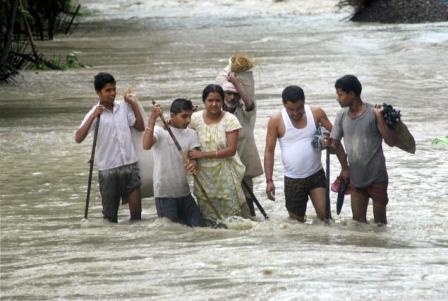
Arunachal flood situation remains grim

September 22, 2012

Arunachal_Flood

Itanagar, September 22: Flood situation in four districts of Arunachal Pradesh remained grim with major rivers and their tributaries flowing above the danger mark.

Water has entered all low lying areas of Lohit, Dibang Valley, Changlang and East Siang districts, but the death toll remained one, officials said.

In Lohit, the worst-affected district, an SOS has been sent to the state government for immediate arrangement to evacuate the marooned persons of Tezu and Namsai sub-division, Deputy Commissioner R.K. Sharma said.

Altogether 411.10 mm rainfall was recorded in the district since Friday, Mr. Sharma said adding, the sole death was reported on the night of September 20, 2012.

He said floodwaters entered Tezu town threatening the Shivajinagar locality. The Afragam, Duraliang, Danglat, Changliang and Khoraliang areas in Tezu circle were also hit.

Altogether 16 relief camps were operating in the district with 2,332 inmates. A rescue team tried to reach the spot with elephants but failed due to the torrent of water.

The district administration has also requisitioned the service of helicopter but it could not materialise due to torrential rain and bad weather condition, Mr. Sharma said.

Many villages like Mabira, Morapat, Mazgaon, Alubari, Tekelibam, Tengapani of Namsai sub-division were cut off due to flood.

BRO authorities said restoration work would take three to four more days provided weather permits.
Tezu township is reeling without power for two days as floods damaged electricity supply system at Alubari, which also supplies power to Anjaw and Lower Dibang Valley districts besides the Sadiya sub-division in Assam, Assistant Engineer A. Yirang said.

A rainfall of 836.69 mm over the past six days has lashed Dibang Valley district and the flood situation is likely to worsen if the showers do not subside in coming days, district officials said.

The increase in water level of rivers has flooded Simari, Iduli, Abali, Idili and Bolung villages.

In East Siang district, the flood situation continues to be grim with Pasighat-Pangin road and the power line remaining cut off due to rain-triggered landslides following damage of bridges and electric poles, district sources said.

The gushing waters have not only damaged the standing crops but also eroded a huge area of paddy fields causing huge losses to Pokdum, Tekang, Gobo, Poglek, Labo, field areas.

Overflowing waters of the river breached embankment at many places, threatening Borguli village.

Sources said flood waters entered Bordumsa and Diyun circles of Changlang district.

Comments

Add new comment

  • Coastaldigest.com reserves the right to delete or block any comments.
  • Coastaldigset.com is not responsible for its readers’ comments.
  • Comments that are abusive, incendiary or irrelevant are strictly prohibited.
  • Please use a genuine email ID and provide your name to avoid reject.
News Network
January 10,2020

New Delhi, Jan 10: One woman reported a rape every 15 minutes on average in India in 2018, according to government data released on Thursday, underlining its dismal reputation as one of the worst places in the world to be female.

The highly publicised gang rape and murder of a woman in a bus in New Delhi in 2012 brought tens of thousands onto the streets across India and spurred demands for action from film stars and politicians, leading to harsher punishments and new fast-track courts. But the violence has continued unabated.

Women reported almost 34,000 rapes in 2018, barely changed from the year before. Just over 85% led to charges, and 27% to convictions, according to the annual crime report released by the Ministry of Home Affairs.

Women's rights groups say crimes against women are often taken less seriously, and investigated by police lacking insensitivity.

"The country is still run by men, one (female prime minister) Indira Gandhi is not going to change things. Most judges are still men," said Lalitha Kumaramangalam, former chief of the National Commission for Women.

"There are very few forensic labs in the country, and fast-track courts have very few judges," said Kumaramangalam, a member of Prime Minister Narendra Modi's Bharatiya Janata Party (BJP).

The rape of a teenager in 2017 by former BJP state legislator Kuldeep Singh Sengar gained national attention when the accuser tried to kill herself the following year, accusing the police of inaction.

Five months before Sengar was convicted last December, the accuser's family had to be provided with security after a truck crashed into the car she was in, injuring her and killing two of her relatives.

A 2015 study by the Centre for Law & Policy Research in Bengaluru found that fast-track courts were indeed quicker, but did not handle a high volume of cases.

And a study in 2016 by Partners for Law in Development in New Delhi found that they still took an average of 8.5 months per case - more than four times the recommended period.

The government statistics understate the number of rapes as it is still considered a taboo to report rape in some parts of India and because rapes that end in the murder are counted purely as murders.

Comments

Add new comment

  • Coastaldigest.com reserves the right to delete or block any comments.
  • Coastaldigset.com is not responsible for its readers’ comments.
  • Comments that are abusive, incendiary or irrelevant are strictly prohibited.
  • Please use a genuine email ID and provide your name to avoid reject.
News Network
January 9,2020

New Delhi, Jan 9: JNU students who tried to march towards the Rashtrapati Bhavan on Thursday protesting the violence on the university campus were stopped by police and later detained.

The police also resorted to baton charge to control the mob who tried to block the traffic at Janpath. Using loudspeakers, the police also appealed to the crowd to maintain peace.

Before the students tried to proceed towards the Rashtrapati Bhavan, a delegation of JNU Students' Union and JNU Teachers' Association also met Human Resource Development (HRD) Ministry officials and demanded the removal of Vice-Chancellor M Jagadesh Kumar from his post.

Comments

Add new comment

  • Coastaldigest.com reserves the right to delete or block any comments.
  • Coastaldigset.com is not responsible for its readers’ comments.
  • Comments that are abusive, incendiary or irrelevant are strictly prohibited.
  • Please use a genuine email ID and provide your name to avoid reject.
Agencies
June 29,2020

From March through May, around 1 crore migrant workers fled India’s megacities, afraid to be unemployed, hungry and far from family during the world’s biggest anti-Covid-19 lockdown.

Now, as Asia’s third-largest economy slowly reopens, the effects of that massive relocation are rippling across the country. Urban industries don’t have enough workers to get back to capacity, and rural states worry that without the flow of remittances from the city, already poor families will be even worse off -- and a bigger strain on state coffers.

Meanwhile, migrant workers aren’t expected to return to the cities as long as the virus is spreading and work is uncertain. States are rolling out stimulus programs, but India’s economy is hurtling for its first contraction in more than 40 years, and without enough jobs, a volatile political climate gets more so.

“This will be a huge economic shock, especially for households of short-term, cyclical migrants, who tend to come from vulnerable, poor and low-caste and tribal backgrounds,” said Varun Aggarwal, a founder of India Migration Now, a research and advocacy group based in Mumbai.

In the first 15 days of India’s lockdown, domestic remittances dropped by 90%, according to Rishi Gupta, chief executive officer of Mumbai-based Fino Paytech Ltd., which operates the country’s biggest payments bank.

By the end of May, remittances were back to around 1750 rupees ($23), about half the pre-Covid average. Gupta’s not sure how soon it’ll fully recover. “Migrants are in no hurry to come back,” Gupta said. “They’re saying that they’re not thinking of going back at all.”

If workers stay in their home states long term, policymakers will have more than remittances to worry about. If consumption falls and the new surplus of labor drives wages down, Agarwal said, “there will also be a second-order shock to the local economy. Overall, not looking good.”

India announced a $277 billion stimulus package in May and followed it up with a $7 billion program aimed at creating jobs for 125 days for migrants in villages across 116 districts. Separately, local authorities are also looking for solutions.

Officials in Bihar have identified 2,500 acres of land that could be made available to investors, said Sushil Modi, deputy chief minister of Bihar, a state in east India. “We can use this crisis as an opportunity to speed up reforms,” he said.

The investors haven’t materialised yet, and in the meanwhile, state governments are relying on the national cash-for-work program that guarantees 100 days worth of wages per household.

Skilled workers don’t want to do manual labor offered through the program, and even if they did, says Amitabh Kundu of RIS, many think of it as beneath their station. “There will be an increase in social tensions,” he predicts. “Caste may again start playing a role. It’s absolute chaos.”

For skilled workers, initiatives vary:

* Uttar Pradesh, which received 3.2 million people, is compiling lists of skilled workers who need employment and trying to place them with local manufacturing and real estate industry associations. So far, the government says, it’s placed 300,000 people with construction and real estate firms.

* Bihar has placed returners in state-run infrastructure projects and hired others to stitch uniforms and make furniture for government-run schools, even as they waited in quarantine centres, said Pratyay Amrit, head of the state’s disaster management department.

* The eastern state of Odisha announced an urban wage employment program aimed at putting as many as 450,000 day labourers to work through September. Some 25,000 people have been employed, so far, under the scheme, G. Mathivathanan, principal secretary for housing and urban development said.

Attracting Investments

It’s not clear any of this will be enough to make a dent, says Ravi Srivastava, professor at New Delhi-based Institute of Human Development, adding that the states don’t have much of a track record on economic development.

“It was the failure of these states to improve governance and put development plans in place that led to the out-migration in the first place,” he said.

But officials and workers’ rights advocates see opportunity. Uttar Pradesh has established liaisons to encourage companies from the US, Japan and South Korea to establish manufacturing in the state. There and in Madhya Pradesh and Rajasthan, the government has made labour laws more friendly to employers, making it easier to hire and fire workers.

Modi, the minister from Bihar, said the migration may also give workers--historically a disenfranchised group--new power, particularly as urban centres struggle. “The way industries treated workers during the lockdown -- didn’t pay them, the living conditions were poor -- now these industries will realize the value of this force,” Modi said.

“In the days to come, labour will emerge as a force that can’t be ignored anymore,” he added. “That’s the new normal. We will work out how to ensure dignity, rights to our people who are going to work in other states.”

Bihar is due for elections by November, a vote that could be an early test of the mass migration’s political consequences. The state is currently governed by a coalition that includes Prime Minister Narendra Modi’s Bharatiya Janata Party. Amitabh Kundu, a fellow at the Research and Information System for Developing Countries, a New Delhi-based government think-tank, said migrant workers are likely to be angry voters.

“Chief ministers are telling these migrants that they will not have to go back for work,” he said. “But their capacity to do something miraculous in the next four to five months is doubtful. If they can retain even one-fourth of the migrants, I would call it a success.”


Comments

Add new comment

  • Coastaldigest.com reserves the right to delete or block any comments.
  • Coastaldigset.com is not responsible for its readers’ comments.
  • Comments that are abusive, incendiary or irrelevant are strictly prohibited.
  • Please use a genuine email ID and provide your name to avoid reject.