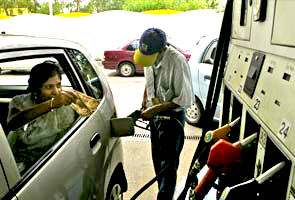
Oil companies set to reduce petrol prices

September 24, 2012

petrolpricecut

Mumbai, September 24: Consumers may get some relief as oil marketing companies (OMCs) plan to revise petrol prices downward due to falling international crude oil prices and a strengthening rupee.

The Indian basket of crude oil fell to $106.74 on September 20 from $116 five days earlier, according to data published by the oil ministry. The rupee, which hit a four-month-high of 53.47 on September 21, is expected to strengthen further due to the reform measures the government announced last week.

Usually, each dollar fall in crude oil makes petrol cheaper by 33 paise. Similarly, a strengthening rupee would lead to a 77-paisa reduction in the price of petrol. "Logically yes, petrol prices should fall.

However, we have to wait for some more time before deciding to pass on the benefit to consumers," S Varadarajan, director (finance) at BPCL, told TOI. According to him, petrol is being sold at par - no profit, no loss.

The OMCs also plan to effect frequent revisions so that the price change is reflected in paise to soften the blow for consumers and avoid any political backlash. OMCs earlier used to revise petrol prices on the 1st and 16th of every month on the basis of average international oil prices and the foreign exchange rate in the previous fortnight. However, the practice was discontinued in late July in favour of revising rates on a random date to deter petrol pump dealers from building positions.

"In US, petrol prices are revised everyday at 3 pm. In many countries, it is revised on an hourly basis. We are trying to do it more often, maybe on a bi-weekly or weekly basis, so that the revision is in paise and the consumer is not burdened with a steep hike," BPCL chairman R K Singh told TOI. He added that the government has now given OMCs a free hand on deciding the quantum and timing of a petrol price hike.

Petrol was de-controlled in 2010 but the OMCs were not allowed to revise petrol prices. So they used to seek an unofficial nod from the government to pass on a hike to consumers. This led to $1 billion in losses for the OMCs till September 15.

IOC chairman R S Butola said, "The government has taken a bold step in revising diesel price, reducing duties on petrol and capping LPG cylinders to six per household every year. Now our pump prices are at par with petrol's cost, and we'd like to be at par because the loss on petrol is not compensated by the government."

Competition Commission of India (CCI) is reportedly likely to investigate into the alleged cartel-like behavior of OMCs increasing and decreasing prices of petrol in unison. "Petrol is a decontrolled product and we can't afford to make losses on it. We are answerable to our shareholders and the federal auditor," said an HPCL board member.


Comments

Add new comment

  • Coastaldigest.com reserves the right to delete or block any comments.
  • Coastaldigset.com is not responsible for its readers’ comments.
  • Comments that are abusive, incendiary or irrelevant are strictly prohibited.
  • Please use a genuine email ID and provide your name to avoid reject.
News Network
January 18,2020

Jammu, Jan 18: Prepaid mobile connections were restored in Jammu and Kashmir on Saturday and 2G services resumed in two districts of the valley after being disconnected on August 5 last year. Voice and SMS facilities were restored for all local prepaid mobile phones across the Union territory.

Rohit Kansal, the principal secretary to the administration of Jammu and Kashmir said the order will come into effect from Saturday.

In order to consider giving mobile Internet connectivity on such SIM cards, the telecom service providers will have to verify the credentials of the subscribers, he said.

Internet service providers have been asked to provide fixed line Internet connectivity in all the 10 districts of Jammu region and two districts, Kupwara and Bandipora, in North Kashmir.

Telecom services were shut in the entire Jammu and Kashmir on August 5 when the Centre abrogated special status to the erstwhile state and also bifurcated it into two Union Territories.

However, the Supreme Court came down heavily on the UT administration last week for arbitrarily shutting down the Internet, the facility described as the fundamental right by the apex court.

Comments

Add new comment

  • Coastaldigest.com reserves the right to delete or block any comments.
  • Coastaldigset.com is not responsible for its readers’ comments.
  • Comments that are abusive, incendiary or irrelevant are strictly prohibited.
  • Please use a genuine email ID and provide your name to avoid reject.
Agencies
July 21,2020

New Delhi, Jul 21: Air India trade unions have complained to Civil Aviation Minister Hardeep Puri that the government has now turned a blind eye to the management's ethnic cleansing at lower levels through compulsory leave without pay (LWP), redundancies and wage cuts.

In a letter to Puri, the Joint Action Forum of Air India unions said, "We are deeply ashamed to say that it seems that after praising our Air Indian Corona Warriors at grand functions, respectfully, the government has now turned a blind eye to this management's ethnic cleansing of Air Indians at the lower levels, through compulsory LWP, redundancies and wage cuts."

The Joint Action Forum of Air India unions strongly opposes this Compulsory Leave without pay scheme as it is an illegal practice and is not a voluntary scheme.

"In fact the Board resolution itself empowers the Chairman and Managing Director with extraordinary powers, which seem akin to a High Court, to pack off employees on 2 years leave (extended to 5 years) at CMD's discretion or at the arbitrary whim of the Regional heads," the trade unions said.

"This said Compulsory LWP scheme violates every labour law put in place by Parliament and orders of the Supreme Court and various other courts and seeks to dispossess the lower categories workers of their legally guaranteed rights," it added.

The trade unions have pointed out that the redundancies are at the elite management cadre level and not the workers.

"We are indeed shocked that the management of Air India could prepare and formulate a scheme for compulsorily sending workers on leave without pay, which is akin to an illegal lay-off, under the garb of a Leave Without Pay, when ironically the redundancy actually lies in the upper echelons of management and not with the humble workers of Air India, who have slogged to make our Airline the treasure it is," they complained to Puri.

"It must be noted that out of 11,000 permanent employees, our management occupies almost 25% as Executive Cadre, with little or no accountability. Solely amongst the Elite Management Cadre, we have 121 top officers ranking from DGMS, GMs, EDs to Functional Directors, most of whom are either performing duplicate job functions or are indeed redundant and not to mention the retired relics serving as consultants and also the CEOs of various subsidiary companies," they added.

Trade unions said the redundancy or compulsory leave without pay scheme if any at all, has to apply only to these Executives, more so, when they do not even have protection of labour laws or Supreme Court orders.

Strangely, the topmost corporate executive cadre and the backroom Generals, have saved themselves from the axe of wage cuts, by sacrificing a piffling of a few grand, whilst the frontline warriors of flying cabin crew, engineers, ground staff have borne the biggest brunt head on, the unions said.

Comments

Add new comment

  • Coastaldigest.com reserves the right to delete or block any comments.
  • Coastaldigset.com is not responsible for its readers’ comments.
  • Comments that are abusive, incendiary or irrelevant are strictly prohibited.
  • Please use a genuine email ID and provide your name to avoid reject.
News Network
May 24,2020

New Delhi, May 24: New rules for domestic travel during the lockdown were released by the government today, including advising passengers to download the Aarogya Setu application on their mobile devices and asking states to ensure thermal screening at departure point of airports, railway stations and bus terminals. The guidelines were shared by Civil Aviation Minister Hardeep Singh Puri, who also shared new rules for international travel.

The minister had recently said that international flight operations may start by mid-June or end-July if the COVID-19 virus "behaves in a predictable manner".

"Prescribed clinical protocol will be followed in case any domestic or international traveller shows symptoms of COVID-19. States can also develop their own protocol for quarantine and isolation as per their own assessment," Mr Puri said.

The guidelines come a day before the resumption of air travel after nearly two-months hiatus following lockdown to prevent the spread of coronavirus.

The Indian Railways has also issued a list of 100 pairs of trains that it will operate from June 1, putting in operation popular trains such as Durontos, Sampark Krantis, Jan Shatabdis and Poorva Express.

Dos and Don'ts shall be provided along with tickets to travellers by agencies concerned, said the Health Ministry's guidelines for domestic travel (air/train/inter-state bus travel).

Latest guidelines on domestic & international travel have been issued by @MoHFW_INDIA.

I hope travellers strictly follow these self-regulatory norms & strengthen India's hands in this fight against COVID19. Remember, each one of us is a soldier against the pandemic.@MoCA_GoIpic.twitter.com/xVbTG1K44n

— Hardeep Singh Puri (@HardeepSPuri) May 24, 2020
Travellers shall give 14-day quarantine undertaking before boarding

The states and Union Territories shall ensure that all passengers undergo thermal screening at the point of departure and only asymptomatic passengers are allowed to board the flight, train or bus. Asymptomatic passengers, however, will be permitted to travel after they give an undertaking to self-monitor for 14 days, the ministry said.

Those having moderate or severe symptoms will be admitted to dedicated COVID health facilities and managed accordingly, the guidelines said.

Those having mild symptoms will be given the option of home isolation or isolated in the COVID Care Centre (both public and private facilities) as appropriate and tested as per ICMR protocol, they said.

"If positive, they will continue in COVID Care Centre and will be managed as per clinical protocol. If negative, the passenger may be allowed to go home, isolate himself/herself and self-monitor his/her health for further 7 days," the health ministry said.

In case, any symptoms develop they shall inform the district surveillance officer or the state or the national call centre (1075), it said.

Use of face covers, following respiratory hygine during travel

During boarding and travel, all passengers shall use face covers or masks and will also follow hand hygiene, respiratory hygiene and maintain environmental hygiene, the ministry said in its guidelines.

At airports, railway stations and bus terminals, required measures to ensure social distancing shall be taken, the guidelines said.

Airports, railway stations and bus terminals to be regularly sanitised

Airports, railway stations and bus terminals should be regularly sanitised or disinfected and the availability of soaps and sanitisers shall be ensured, the health ministry said.

The ministry said that states can also develop their own protocol with regards to quarantine and isolation as per their assessment.

Guidelines for International Travel

The guidelines for international travel include mandatory undertaking for quarrantine for 14 days. "Only for exceptional and compelling reasons such as cases of human distress, pregnancy, death in family, serious illness and parent(s) accompanied by children below 10 yrs, as assessed by the receiving states, home quarantine may be permitted for international travellers for 14 days," the Civil Aviation minister said.

Asymptomatic travelers will be allowed to board flight/ship

At the time of boarding the flight or ship, only asymptomatic travellers will be allowed to board after thermal screening, the health ministry said.. Passengers arriving through land borders will also have to undergo the same procedure, it said.

"Self-declaration form in duplicate shall be filled by the person in the flight/ship and a copy of the same will be given to Health and immigration officials present at the airport/seaport/landport. The form will be made available through the Aarogya Setu app," the new order said.

Passengers found to be symtomatic during screening shall be immediately isolated and taken to medical facility as per health protocol. "These passengers will be kept under institutional quarrantine for a minimum period of 7 days and should undergo necessary tests as per ICMR protocol," the guidelines said.

Sanitisation and disinfection must inside flights

Authorities must take adequate measures to such as environmental sanitation and disinfection at the airports as well as within the flights, the guideline said.Suitable announcement about COVID-19 including precautionary measures to be followed shall be made at airports/ports, it added.

While on board flight, ships, passengers and crew required precautions such as wearing of masks, environmental hygiene, respiratory hygiene, hand hygiene, the ministry said.

This morning, India registered the biggest-single day jump in the number of coronavirus cases as 6,767 new patients were reported in the last 24 hours. This is the third consecutive day that India has reported more than 6,000 COVID-19 cases with a record number of new patients each day. The county has officially logged 1,31,868 cases, 3,867 deaths linked to the highly infectious illness since the pandemic began. Of these, 147 patients died in the last 24 hours. The global number of novel coronavirus cases has passed 5.25 million with more than 339,000 deaths. Since the outbreak first emerged in China in December, 5,260,970 cases have been recorded across 196 countries and territories, with 339,758 deaths attributed to the virus.


Comments

Add new comment

  • Coastaldigest.com reserves the right to delete or block any comments.
  • Coastaldigset.com is not responsible for its readers’ comments.
  • Comments that are abusive, incendiary or irrelevant are strictly prohibited.
  • Please use a genuine email ID and provide your name to avoid reject.