


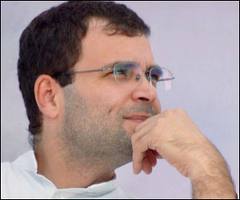
CBI finds foreign hand behind bid to malign Rahul Gandhi

September 25, 2012

rahul

New Delhi, September 25: The CBI on Monday informed the Supreme Court about the involvement of a "foreign hand" to tarnish Congress general secretary Rahul Gandhi's image and reputation by accusing him of abducting a fictitious woman.


The agency also claimed that a petition in the Allahabad high court by one Kishore Samrite making baseless allegations against the Congress leader was "funded", emphasizing that it had even seized chits showing he received money for paying lawyers' fees.


In its status report, submitted to the court in a sealed cover, the CBI said the woman Rahul was accused of abducting did not exist, and had been conjured up in reports uploaded on three foreign websites, which Samrite used with an ulterior motive. "She is non-existent, her address is fictitious and there is no record whatsoever with the UP government or local bodies," the CBI informed a bench of Justices B S Chauhan and Swatanter Kumar.


The bench is hearing an appeal by Samrite challenging the HC's decision to impose a fine of Rs 50 lakh for filing a frivolous petition. SC had stayed the HC order on April 6 last year.


On the HC's directions, the CBI on March 11 last year lodged an FIR against Samrite, owners of the websites and unknown persons accusing them of conspiracy and booking them under several sections of the Indian Penal Code, including criminal defamation.


Before the SC on April 6 stayed the HC order, the CBI within 25 days had reached the website owners located abroad asking for details of the IP addresses from which the offensive content was uploaded on the websites.


"Those website owners told CBI to come through the proper legal channel," additional solicitor general Harin Raval informed the court. He said CBI was considering issuance of letters rogatory through Indian courts to request officials in those countries for assistance in the investigation when the SC stay order stopped further probe.


"During questioning, Samrite said the litigation was funded. He has given the CBI details of who had funded the litigation. The investigating officer has recovered chits about money deposited by him after receiving it from the funders. The money was used to pay lawyers," Raval said.


Samrite, a former SP MLA from Madhya Pradesh, had claimed that he had filed the petition in the HC on the direction of top SP leaders. On being questioned by the court, Samrite's counsel Kamini Jaiswal had informed the bench that her client had filed the petition in 2010 on the direction of SP leaders Mulayam Singh Yadav and Akhilesh Yadav.


The UP government had objected to the names of top leaders of the ruling party being taken so casually. Senior advocate Rakesh Dwivedi told the bench that Samrite was a liar whose petition needed to be thrown out without any consideration of his plea.

 

Comments

Add new comment

  • Coastaldigest.com reserves the right to delete or block any comments.
  • Coastaldigset.com is not responsible for its readers’ comments.
  • Comments that are abusive, incendiary or irrelevant are strictly prohibited.
  • Please use a genuine email ID and provide your name to avoid reject.
News Network
June 23,2020

New Delhi, Jun 23: The Delhi High Court Tuesday granted bail to Jamia student Safoora Zargar, who is pregnant and was arrested under anti-terror law UAPA in a case related to communal violence in northeast Delhi during protests against the Citizenship Amendment Act, as Solicitor General Tushar Mehta did not oppose it on humanitarian grounds.

At the outset of the hearing, Mehta, representing Delhi Police, submitted that Zargar can be released on regular bail on humanitarian grounds and the decision has not been taken on merits of the case and should not be made a precedent.

Justice Rajiv Shakdher, who conducted the hearing through video conferencing, released Zargar, who is 23-week pregnant, on bail on furnishing a personal bond of Rs 10,000 and surety of like amount.

The court said she shall not indulge in any activity for which she has been charged with and shall not hamper the investigation or influence the witnesses.

Comments

Add new comment

  • Coastaldigest.com reserves the right to delete or block any comments.
  • Coastaldigset.com is not responsible for its readers’ comments.
  • Comments that are abusive, incendiary or irrelevant are strictly prohibited.
  • Please use a genuine email ID and provide your name to avoid reject.
News Network
June 18,2020

New Delhi, Jun 18: The border clash between Indian and Chinese soldiers in Ladakh broke the brittle quiet – and also the sense of security for anxious Chinese nationals in India who fear a backlash with anti-Chinese sentiment spiralling in the country.

With the high altitude violent face-off in eastern Ladakh’s Galwan Valley spurring hashtags such as “Boycott China” and “Teach Lesson to China” and leading to street protests, the undercurrents of tension were evident.

Wary of being identified, some said they had been reassured by their friends but were still apprehensive for themselves and their families.

"They (Chinese families) don''t want to speak to the media. They are not going out and are worried about their security and well being. Their families are also worried back home," Mohammed Saqib, secretary general of the India China Economic & Cultural Council, told PTI.

He added that his Chinese friends in India been calling him since they heard news about Monday night’s clashes in which 20 Indian soldiers were killed -- the worst military confrontation in five decades -- and expressed concern over growing anti-China sentiments.

A Chinese national from Beijing working in Gurgaon for a Chinese mobile firm initially refused to talk, saying he did not want to speak to the media and later shared his thoughts only on condition of anonymity.

"There is talk of border standoff and tensions, but we know Indians are very warm people and that is why I have told my family that all is fine here and they should not worry," he said.

Another Chinese national working in Gurgaon said he and his family are feeling the stress amid the spiralling conflict between India and China, but many friends have been reassuring him.

"They (Chinese in India) are under a lot of stress naturally. Such a conflict puts a lot of stress as they could bear the brunt and the same applies to Indians in China," B R Deepak, professor at the Centre for Chinese and South East Asian Studies of the Jawaharlal Nehru University said.

He said it was unfortunate that the border standoff derailed the commemorative programmes aimed at strengthening ties at a time the two countries were gearing to celebrate 70 years of establishment of diplomatic ties.

Experts also feel the border clash is likely to have a significant negative impact on the economic and people to people ties.

There are scores of Chinese in India working in various Chinese firms and also those who are studying in universities like JNU.

About 3,000 Chinese people, doing business or studying in big cities in India, were stranded in India at the start of the COVID-19 crisis, and about half of them returned to China before the lockdown began on March 25.

The Chinese Embassy in New Delhi announced on May 25 that they will arrange for flights to take back students, tourists and businesspersons to five Chinese cities, including Shanghai and Guangzhou.

"It will impact the psychology of the Chinese here. There are 2,000 Chinese firms in various sectors in India which are going to be impacted," Deepak said.

Future investments from the Chinese side could also be impacted, he said.

Moreover, as far as people-to-people contacts are concerned, the number of Chinese students choosing India as a preferred destination is likely to go down, Deepak said.

Alka Acharya, another China expert, said there are two kinds of impacts of such an incident -- short term and medium term.

Usually after the initial nationalistic reaction in the short term things tend to normalise in the medium term, but with such a border clash happening for the first time in decades clearly the resonance would be much more in both India and China, said Acharya, professor at the Centre for East Asian Studies, School of International Studies, in JNU.

“Due to the impact of the COVID-19 crisis on the economy, whether India can take a hardline in terms of economics towards China, is a tricky question,” she said.

In the immediate context, there may be a dip in economic ties with calls for boycott of Chinese goods and services, Acharya said.

The manner in which this crisis is resolved will affect how ties will be affected in the medium term, she said.

The headlines have added to the anxiety.

A group of ex-armymen gathered near the Chinese embassy to protest the killing of 20 Indian Army personnel in Ladakh’s Galwan Valley. And another group of around 10 protesters belonging to the Swadeshi Jagaran Manch protested near the Teen Murti roundabout in Central Delhi.

The anti-China sentiment prevalent among the common public is also finding a reflection in government policy with sources saying the Department of Telecom (DoT) is set to ask state-owned Bharat Sanchar Nigam Ltd (BSNL) not to use Chinese telecom gear in its 4G upgradation.

Trade bodies like CAIT are also calling for a boycott of Chinese products.

And Chinese handset maker Oppo cancelled the livestream launch of its flagship 5G smartphone in the country amid protests.

Monday night’s clashes between the Chinese and Indian troops in Galwan Valley significantly escalated the already volatile border standoff between the two countries.

The casualties on the Chinese side are not yet known. However, government sources, citing an American intelligence report, claimed the total number of soldiers killed and seriously wounded could be 35.

Comments

Add new comment

  • Coastaldigest.com reserves the right to delete or block any comments.
  • Coastaldigset.com is not responsible for its readers’ comments.
  • Comments that are abusive, incendiary or irrelevant are strictly prohibited.
  • Please use a genuine email ID and provide your name to avoid reject.
Agencies
June 8,2020

New Delhi, Jun 8: Abortion access to around 1.85 million women was compromised across the country due to the nationwide restrictions imposed in response to the COVID-19 outbreak, a study conducted by Ipas Development Foundation (IDF) revealed.

These abortions were compromised at all points of care, including public and private sector facilities and chemist outlets during 68-day lockdown and the first week of Unlock 0.1 period. The study assesses the near-term impact of COVID-19 on abortion access in India since March 25 when the lockdown was imposed across the country with the announcement of Prime Minister Narendra Modi to contain the spread of novel coronavirus of COVID-19 pandemic.

It also highlights the need for a specially designed and integrated recovery plan for improving abortion services at facilities. The study estimates that access to abortion was highly compromised during lockdown 1 and 2 ( between March 25 and May 3) in which around 59 per cent of women seeking an abortion could not access the services.

However, with the Unlock phase or the recovery period as mentioned in the study starting on June 1, the situation is expected to improve - with 33 per cent abortions being compromised in 24 days. A huge number of women could not access safe abortion services during the lockdown, therefore it is extremely important that the healthcare system, public and private, is prepared to meet the needs of these women, the Ipas foundation says.

The model of the study strives to quantify the reduced access to abortions across three different points of care -public health facilities, private health facilities, and chemist outlets, said Vinoj Manning, CEO, Ipas Development Foundation in a statement.

"Majority of public health facilities and their staff are now focused on COVID-19 treatments and closures of private health facilities have compromised the access to safe abortions, which is a time-sensitive procedure."

He said that the study conducted by his foundation was to get a clearer picture of how COVID-19 restrictions have affected women seeking safe abortion services and what are the areas that would need focused efforts in the days to come.

Speaking on the methodology, Dr Sushanta Kumar Banerjee from Ipas Development Foundation said: "We conducted telephonic surveys and consulted with several experts from FOGSI leadership and social marketing organizations like PSI India Private Limited."

"After careful analysis of the data received from them, we have concluded that of the 3.9 million abortions that would have taken place in 3 months, access to around 1.85 million was compromised due to COVID-19 restrictions."

To facilitate the process Ipas Development Foundation has issued some initial recommendations which include: rapid mapping of facilities for first and second trimester abortions, assessing facilities' preparedness especially for second-trimester abortions, improving referral linkage and spread the word about the availability of the service, streamlining the supply chain for medical abortion drugs, and lastly including mechanisms to offset additional travel and out of pocket expenditures.

Ipas Development Foundation will be holding consultations with other partners and key stakeholders to facilitate meaningful collaborations to ensure access to safe abortions and ensure that no woman suffers long-term harm to her health due to lack of services.

Comments

Add new comment

  • Coastaldigest.com reserves the right to delete or block any comments.
  • Coastaldigset.com is not responsible for its readers’ comments.
  • Comments that are abusive, incendiary or irrelevant are strictly prohibited.
  • Please use a genuine email ID and provide your name to avoid reject.