



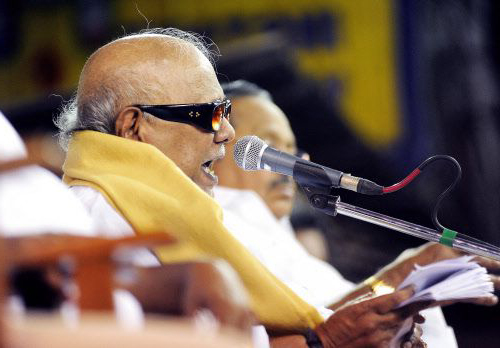
DMK turns down PM's offer of berths in Union Cabinet

September 26, 2012

karuna_Nidhi

Chennai, September 26: Ahead of the Union cabinet reshuffle, the DMK, a key member of the ruling UPA, has declined Prime Minister Manmohan Singh's offer of two cabinet or a few minister of state berths for the party.

The PM on Tuesday despatched minister of state in the PMO V Narayanasamy to meet DMK chief M Karunanidhi and make the offer. But senior DMK leaders said Karunanidhi conveyed to the minister that he was at the moment not interested in recommending any party representative for inclusion in the Union cabinet. Narayanasamy met Karunanidhi at his CIT Colony residence in Chennai for about 30 minutes during which he discussed the PM's offer. After the exit of Mamata Banerjee's Trinamool Congress, which has 19 MPs, from the UPA, the DMK with 18 representatives in the Lok Sabha is the Congress' largest ally.

"Though our senior MPs wanted use the opportunity to get a good portfolio or two, Kalaignar (Karunanidhi) appears to be of a different view. He has been thinking about the stability of the government and it is one of the reasons for not accepting the offer," a senior DMK leader said. "Many of our district secretaries are against continuing with the alliance with the Congress. They have been expressing their views to Kalaignar and asking him to distance the party from the Congress," said a former state minister.

Senior DMK leaders point out that anger against the UPA government has been growing following a series of anti-people measures like fuel price hike and cap on subsidized LPG cylinders. "Such issues are also likely to cast a shadow on our prospects. The party wishes to keep its options open on alliances for the next Lok Sabha elections," the leader said.

DMK seniors also point out to Karunanidhi's recent statements and comments against the Centre. "We have been supporting the government as we have no other option. At the same time, we have started to maintain a distance from the Congress," said a party MP. Karunanidhi is probably keen to maintain the same strategy by declining to have more representatives in the Union cabinet. "If we accept the offer and get new portfolios, the parties in the state will target us even more. We don't want to damage our image further," the MP said.

But a section of Union ministers and MPs in the party feel that Karunanidhi should accept the offer and strengthen the party's presence in the Union cabinet. "When I suggested this view, Kalaignar pointed out that the present ministers themselves did not have any power, how will the new ones wield more power," he said.

The DMK got three cabinet and four MoS berths in the UPA2 when it came to power. After the resignation of A Raja and Dayanidhi Maran, M K Alagiri is the only cabinet-rank DMK minister in the Manmohan Singh ministry. S S Palanimanickam, S Gandhiselvan, S. Jagathratchagan and D Napoleon are ministers of state.


Comments

Add new comment

  • Coastaldigest.com reserves the right to delete or block any comments.
  • Coastaldigset.com is not responsible for its readers’ comments.
  • Comments that are abusive, incendiary or irrelevant are strictly prohibited.
  • Please use a genuine email ID and provide your name to avoid reject.
Agencies
May 14,2020

New Delhi, May 14: India may witness the death of additional 1.2-6 lakh children over the next one year from preventable causes as a consequence to the disruption in regular health services due to the COVID-19 pandemic, UNICEF has warned.

The warning comes from a new study that brackets India with nine other nations from Asia and Africa that could potentially have the largest number of additional child deaths as a consequence to the pandemic.

These potential child deaths will be in addition to the 2.5 million children who already die before their fifth birthday every six months in the 118 countries included in the study.

The estimate is based on an analysis by researchers from the Johns Hopkins Bloomberg School of Public Health published in the Lancet.  

This means the global mortality rate of children dying before their fifth birthday, one of the key progress indicators in all of the global development, could potentially increase for the first time since 1960 when the data was first collected.

There were 1.04 million under-5 deaths in India in 2017, of which nearly 50% (0.57 million) were neonatal deaths. The highest number of under-5 deaths was in Uttar Pradesh (312,800 which included 165,800 neonatal deaths) and Bihar (141,500 which included 75,300 neonatal deaths).

The researchers looked at three scenarios, factoring in parameters like reduction in workforce, supplies and access to healthcare for services like family planning, antenatal care, childbirth care, postnatal care, vaccination and preventive care for early childhood. The effects are modelled for a period of three months, six months and 12 months.  

In scenario-1 marked by 10-18% reduction of coverage of all the services, the number of additional children deaths could be in the range of 30,000 plus over three months, more than 60,000 over six months and above 120,000 over the next 12 months.

Coronavirus India update: State-wise total number of confirmed cases, deaths on May 13

The numbers sharply rose to nearly 55,000; 109,000 and 219,000 respectively for scenario-2, which was associated with an 18-28% drop in all the regular services.

But in the worst-case scenario in which 40-50% of the services are not available, the number of additional deaths ballooned to 1.5 lakhs in the three months in the short-range to nearly six lakhs over a year.

The ten countries that could potentially have the largest number of additional child deaths are Bangladesh, Brazil, Congo, Ethiopia, India, Indonesia, Nigeria, Pakistan, Uganda and Tanzania.

In countries with already weak health systems, COVID-19 is causing disruptions in medical supply chains and straining financial and human resources.

Visits to health care centres are declining due to lockdowns, curfews and transport disruptions, and due to the fear of infection among the communities. Such disruptions could result in potentially devastating increases in maternal and child deaths, the UN agency warned.

Comments

Add new comment

  • Coastaldigest.com reserves the right to delete or block any comments.
  • Coastaldigset.com is not responsible for its readers’ comments.
  • Comments that are abusive, incendiary or irrelevant are strictly prohibited.
  • Please use a genuine email ID and provide your name to avoid reject.
News Network
June 8,2020

New Delhi, Jun 8: Delhi Chief Minister Arvind Kejriwal has gone into self-quarantine after developing sore throat and fever, and will get himself tested for COVID-19 on Tuesday, officials said on Monday.

They said the chief minister, who is also a diabetic, was feeling unwell since Sunday afternoon.

"He has mild fever and sore throat since Sunday afternoon. As advised by doctors, the chief minister will undergo COVID-19 test on Tuesday morning," officials said.

Officials said the CM had attended a Cabinet meeting on Sunday morning and thereafter, he did not attend any meeting.

The chief minister has been holding most of his meetings via video conferencing from his official residence for past two days.

This come as the number of coronavirus cases in the national capital crossed the 28,000-mark with 1,282 fresh infections while the death toll climbed to 812 on Sunday, a health bulletin issued by the Delhi government said. According to the health bulletin, the total number of COVID-19 cases in Delhi rose to 28,936 with 1,282 fresh cases.

A total of 51 fatalities were reported on June 6, the bulletin said, adding that these lives were lost between May 8 and June 5. It, however, said the cumulative death figure refers to fatalities where the primary cause of death was found to be COVID-19, according to a report of the Death Audit Committee on the basis of the case-sheets received from various hospitals.

Comments

Add new comment

  • Coastaldigest.com reserves the right to delete or block any comments.
  • Coastaldigset.com is not responsible for its readers’ comments.
  • Comments that are abusive, incendiary or irrelevant are strictly prohibited.
  • Please use a genuine email ID and provide your name to avoid reject.
News Network
May 15,2020

New Delhi, May 15: A group of doctors from the AIIMS, Raipur has recommended restrictions on the use of mobile phones in healthcare institutions amid the COVID-19 pandemic, warning that such devices can be a potential carrier of the virus and lead to infection among healthcare workers.

In a commentary published in the BMJ Global Health journal, the doctors stated that mobile phone surfaces are a peculiar 'high-risk' surface, which can directly come in contact with the face or mouth, even if hands are properly washed and one study indicates that some healthcare workers use phones every 15 minutes to two hours.

Though there have been many significant guidelines from various health organisations like the WHO and CDC focusing on prevention and control of disease, the commentary highlighted "there is no mention of or focus on mobile phones in these guidelines, including the WHO infection control and prevention guidelines, which recommends the use of handwashing".

In healthcare facilities, phones are used to communicate with other health care workers, look up recent medical guidelines, research drug interactions, understand adverse events and side effects, conduct telemedicine appointments and track patients among others, stated the document.

The document has been authored by Dr Vineet Kumar Pathak, Dr Sunil Kumar Panigrahi, Dr M Mohan Kumar, Dr Utsav Raj and Dr Karpaga Priya P from the Department of Community and Family Medicine.

"In their tendency to come in direct contact with the face, nose or eyes in healthcare settings, mobile phones are perhaps second only to masks, caps or goggles," the authors said.

"However, they are neither disposable nor washable like these other three, thus warranting disinfection. Mobile phones can effectively negate hand hygiene... There is growing evidence that mobile phones are a potential vector for pathogenic organisms," they said.

It is the need of the hour to address proper hygienic use of mobile phones in healthcare settings. In a study in India, almost 100 per cent of health workers of a tertiary care hospital used mobile phones in the hospital, but only 10 per cent of them had at any time wiped their mobile phones clean, the commentary published on April 22 said.

"The safest thing to do is to consider your phone as an extension of your hand, so remember you are transferring whatever is on your phone to your hand," Dr Pathak said.

Amidst the ongoing pandemic, two biggest mobile phone companies have uploaded their user support guidelines, saying that 70 pc isopropyl alcohol or Clorox Disinfecting Wipes can be used to gently wipe the exterior surface of phones in switched-off mode.

However, in doing so, the use of bleach or entry of moisture through any of the openings must be avoided, and any harsh chemical may damage the oleophobic screen, leading to damage in the touch screen sensitivity of the phone, the article stated.

Mobile phones are one of the most highly touched surfaces according to the Centers for Disease Control and Prevention (CDC), along with counters, tabletops, doorknobs, bathroom fixtures, toilets, keyboards, tablets and bedside tables.

The doctors recommended restriction on mobile phone usage in healthcare settings like hospital wards, ICUs and operation theatres, while advocating the use of headphones to prevent contact with the face while talking.

There should be no sharing of mobile phones, headphones or headsets of any kind. In addition, where available, the use of interdepartmental intercom facility may be promoted.

"Although hand hygiene and mobile phone use by a person are not mutually exclusive, it is high time to acknowledge the potential role of mobile phones in disease transmission cascade and to take evidence-based appropriate actions. This is especially important, given the ongoing COVID-19 pandemic," the authors said.

They said it is necessary for government agencies and the WHO to generate public awareness and to formulate suitable information, education and communication material on mobile phone hygiene, especially in healthcare settings.

AIIMS, New Delhi, Resident Doctors' Association (RDA) General Secretary, Dr Srinivas Rajkumar T said even outside health care settings, people should pay special attention to the usage of mobile phones as they carry them to all places.

"Phone and computer peripherals like keyboard, mouse, etc. should be covered with transparent plastic covers which can be cleaned without interfering with their function. Cleaning hands by soap or alcohol-based hand sanitizer before and after contact with phone and between contact with other surfaces can decrease the risk of potential transmission.

"Using a handsfree headset, dedicated operator/assistant per ward handling the communication via common line in hospitals while on duty can enable communication without compromising safety," Dr Srinivas said.

Comments

Add new comment

  • Coastaldigest.com reserves the right to delete or block any comments.
  • Coastaldigset.com is not responsible for its readers’ comments.
  • Comments that are abusive, incendiary or irrelevant are strictly prohibited.
  • Please use a genuine email ID and provide your name to avoid reject.