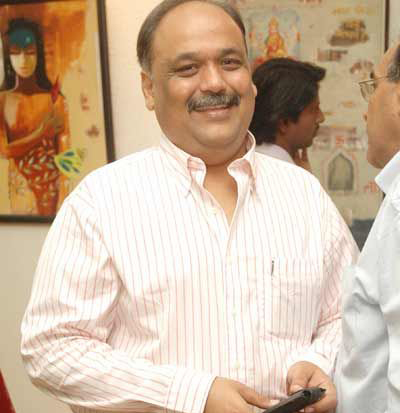
BJP MP's company got Rs 1,350cr dam deals illegally

October 1, 2012
Ajay-Sancheti

Mumbai, October 1: A non-existing company owned by BJP Rajya Sabha MP Ajay Sancheti bagged irrigation projects worth Rs 1,350 crore in Maharashtra in 2007-08.

The firm, Shakti Kumar M Sancheti Ltd, was renamed SMS Infrastructure in November 2005. Yet, Sancheti was awarded contracts by the Vidarbha Irrigation Development Corporation (VIDC) under the name of the old company. "Once the name of a company is changed, the old name ceases to exist and the new name comes into existence. The Sancheti group used the old name as well as the new name concurrently to obtain more contracts than permitted,'' said officials. Government sources said VIDC's norms permitted a maximum of three contracts to a single contractor. Its tender condition clearly stipulated that in case of violation, the contractor would be blacklisted.

Sancheti is a close aide of BJP president Nitin Gadkari and his family has RSS links for the last three generations. His uncle, Chainsukh Sancheti, is the BJP MLA from Buldhana district.

Documents accessed by TOI reveal that the now defunct firm (Shakti Kumar) went on to bag four contracts; two in Gosikhurd in Bhandara district, one in Amravati district and another in Yavatmal district collectively worth Rs 1,350 crore. (VIDC later cancelled one of the tenders because it was awarded at an exorbitant rate.)

Simultaneously, SMS Infrastructure also procured projects worth an additional Rs 389 crore between 2006 and 2009.

Sancheti was not available for comment despite several attempts to contact him.

MPs protest 250% dam cost escalation

In November 2011, two MPs wrote to Union water resources minister Pawan Kumar Bansal about the unusual increase in the cost of the Purna barrage-2 (Ner Dhamana) irrigation project. The work was awarded to Sancheti. BJP's Haribhau Jawale and Shiv Sena's Nandrao Adul complained that its cost had shot up from Rs 182 crore to Rs 638 crore. "The design finalization was done way ahead after the tender was awarded. This resulted in excess expenditure by more than three times,'' said Jawale's letter. He further said that the original 2008 administrative approval was obtained without following due procedure. "If tender had been awarded post-finalization of design, it would have saved a lot of money and resources. As a result, cost of irrigating the land is estimated at Rs 9.19 lakh a hectare whereas the normal cost is around Rs 2 lakh a hectare,'' he added. The Centre had imposed a condition that the project be completed within the sanctioned amount. "However, reality seems to be far different as the project cost is revised drastically. Definitely, there seems to major manipulation causing undue benefit to certain vested interests,'' said Jawale. He urged the minister not to sanction the revised estimate as it was an "unrealistic'' one.


Comments

Add new comment

  • Coastaldigest.com reserves the right to delete or block any comments.
  • Coastaldigset.com is not responsible for its readers’ comments.
  • Comments that are abusive, incendiary or irrelevant are strictly prohibited.
  • Please use a genuine email ID and provide your name to avoid reject.
Agencies
June 29,2020

From March through May, around 1 crore migrant workers fled India’s megacities, afraid to be unemployed, hungry and far from family during the world’s biggest anti-Covid-19 lockdown.

Now, as Asia’s third-largest economy slowly reopens, the effects of that massive relocation are rippling across the country. Urban industries don’t have enough workers to get back to capacity, and rural states worry that without the flow of remittances from the city, already poor families will be even worse off -- and a bigger strain on state coffers.

Meanwhile, migrant workers aren’t expected to return to the cities as long as the virus is spreading and work is uncertain. States are rolling out stimulus programs, but India’s economy is hurtling for its first contraction in more than 40 years, and without enough jobs, a volatile political climate gets more so.

“This will be a huge economic shock, especially for households of short-term, cyclical migrants, who tend to come from vulnerable, poor and low-caste and tribal backgrounds,” said Varun Aggarwal, a founder of India Migration Now, a research and advocacy group based in Mumbai.

In the first 15 days of India’s lockdown, domestic remittances dropped by 90%, according to Rishi Gupta, chief executive officer of Mumbai-based Fino Paytech Ltd., which operates the country’s biggest payments bank.

By the end of May, remittances were back to around 1750 rupees ($23), about half the pre-Covid average. Gupta’s not sure how soon it’ll fully recover. “Migrants are in no hurry to come back,” Gupta said. “They’re saying that they’re not thinking of going back at all.”

If workers stay in their home states long term, policymakers will have more than remittances to worry about. If consumption falls and the new surplus of labor drives wages down, Agarwal said, “there will also be a second-order shock to the local economy. Overall, not looking good.”

India announced a $277 billion stimulus package in May and followed it up with a $7 billion program aimed at creating jobs for 125 days for migrants in villages across 116 districts. Separately, local authorities are also looking for solutions.

Officials in Bihar have identified 2,500 acres of land that could be made available to investors, said Sushil Modi, deputy chief minister of Bihar, a state in east India. “We can use this crisis as an opportunity to speed up reforms,” he said.

The investors haven’t materialised yet, and in the meanwhile, state governments are relying on the national cash-for-work program that guarantees 100 days worth of wages per household.

Skilled workers don’t want to do manual labor offered through the program, and even if they did, says Amitabh Kundu of RIS, many think of it as beneath their station. “There will be an increase in social tensions,” he predicts. “Caste may again start playing a role. It’s absolute chaos.”

For skilled workers, initiatives vary:

* Uttar Pradesh, which received 3.2 million people, is compiling lists of skilled workers who need employment and trying to place them with local manufacturing and real estate industry associations. So far, the government says, it’s placed 300,000 people with construction and real estate firms.

* Bihar has placed returners in state-run infrastructure projects and hired others to stitch uniforms and make furniture for government-run schools, even as they waited in quarantine centres, said Pratyay Amrit, head of the state’s disaster management department.

* The eastern state of Odisha announced an urban wage employment program aimed at putting as many as 450,000 day labourers to work through September. Some 25,000 people have been employed, so far, under the scheme, G. Mathivathanan, principal secretary for housing and urban development said.

Attracting Investments

It’s not clear any of this will be enough to make a dent, says Ravi Srivastava, professor at New Delhi-based Institute of Human Development, adding that the states don’t have much of a track record on economic development.

“It was the failure of these states to improve governance and put development plans in place that led to the out-migration in the first place,” he said.

But officials and workers’ rights advocates see opportunity. Uttar Pradesh has established liaisons to encourage companies from the US, Japan and South Korea to establish manufacturing in the state. There and in Madhya Pradesh and Rajasthan, the government has made labour laws more friendly to employers, making it easier to hire and fire workers.

Modi, the minister from Bihar, said the migration may also give workers--historically a disenfranchised group--new power, particularly as urban centres struggle. “The way industries treated workers during the lockdown -- didn’t pay them, the living conditions were poor -- now these industries will realize the value of this force,” Modi said.

“In the days to come, labour will emerge as a force that can’t be ignored anymore,” he added. “That’s the new normal. We will work out how to ensure dignity, rights to our people who are going to work in other states.”

Bihar is due for elections by November, a vote that could be an early test of the mass migration’s political consequences. The state is currently governed by a coalition that includes Prime Minister Narendra Modi’s Bharatiya Janata Party. Amitabh Kundu, a fellow at the Research and Information System for Developing Countries, a New Delhi-based government think-tank, said migrant workers are likely to be angry voters.

“Chief ministers are telling these migrants that they will not have to go back for work,” he said. “But their capacity to do something miraculous in the next four to five months is doubtful. If they can retain even one-fourth of the migrants, I would call it a success.”


Comments

Add new comment

  • Coastaldigest.com reserves the right to delete or block any comments.
  • Coastaldigset.com is not responsible for its readers’ comments.
  • Comments that are abusive, incendiary or irrelevant are strictly prohibited.
  • Please use a genuine email ID and provide your name to avoid reject.
News Network
January 20,2020

New Delhi, Jan 20: Union Finance Minister Nirmala Sitharaman on Sunday said the kind of cleaning in the system that the BJP-led government had to carry out after coming to power in 2014 was "unbelievable" and it undertook the exercise without any grudge or worry.

Between 2014-16, there were a lot of questions as to why reforms did not come fast and there were comments that the government was incapable of bringing them, she said delivering the Nani Palkhivala Memorial lecture on "Road Map to $5 Trillion Economy" here.

Pointing out that there were allegations and criticism that the government wants to do something but it did not, Sitharaman said, "I am fully willing to buy that." She recalled that Prime Minister Narendra Modi often said he did not believe in incremental changes and the country needed good transformational change. The stage in which India is today, it cannot have little marginal increments, but good transformational change.

"But still one might say in the last five years the government never did. That can be a critical analysis and I am fully willing to buy that. Because post-2014 the kind of cleaning up the government had to do was unbelievable and we undertook that exercise without a grudge without a worry.. we had to do it and it is part of the game," she said. Elaborating, Sitharaman said states have their own views on Land Acquisition Bill and the government could not have done anything because land, after all, is with them.

Commenting on the topic 'Road Map to $5 trillion economy,' she said quoting Prime Minister Narendra Modi's comments, the government would take the route "Sarkar ka abhaav nahi hona chahiye, prabhaav hona chahiye aur dabaav nahi hona chahiye."

"Abhaav and dabaav both of which are not desirable, abhaav is the inadequacy or lack of adequate presence or shortfall. You do not need a shortfall. You need a government where it should be present, where it is expected to function.", she said.

"So there should not be abhaav. Dabaav (meaning pressure) is not something you want from the government. So, you want Prabhaav. It is broadly an influence, facilitation, broadly the philosophy with which it is mandated, she said.

Noting that the government has got the mandate through the election, she said, "The mandate was spelt out in so many different ways in its manifesto. So the route towards $5 trillion is this."

"We have to be there to facilitate. We have to be there to make it easy. We have to be where you need us, where there is no policy (reforms from the government)," she said.

On the Insolvency and Bankruptcy Code (IBC) implemented by the government, the union minister said the approach of the IBC was not to shut business. "IBC takes on the approach in having some kind of resolution where all people who exploited the company do not come back through the "back door," she said.

IBC was done through better management so that the institution is alive and kicking. It is something which she wanted to carry forward from Modi 1.0 to 2.0. "The point I am trying to make on this road to $5 trillion economy is that it is not just an abstraction, this is not how I want India to be. But in micro-level too, we are coming in response to every stakeholder," she said.

Comments

Well Wisher
 - 
Tuesday, 21 Jan 2020

LOL. Do not say anything, else she will get angry.

Add new comment

  • Coastaldigest.com reserves the right to delete or block any comments.
  • Coastaldigset.com is not responsible for its readers’ comments.
  • Comments that are abusive, incendiary or irrelevant are strictly prohibited.
  • Please use a genuine email ID and provide your name to avoid reject.
News Network
July 19,2020

New Delhi, Jul 19: Blaming the BJP for the political drama in Rajasthan, senior Congress leader Digvijaya Singh on Sunday asked Sachin Pilot not to leave the grand old party.

In an interview to news agency, the former Madhya Pradesh chief minister said Pilot should not follow Jyotiraditya Scindia into the BJP, as he has bright future in Congress.

His remarks follow Pilot's open rebellion against the Ashok Gehlot government, which has been on shaky ground with at least 18 legislators backing the rebel leader.

Pilot was sacked as Rajasthan deputy chief minister and the state Congress chief recently and the Congress has accused the BJP of making efforts to topple the Gehlot-led government by indulging in horse-trading.

"The BJP is behind the crisis in Rajasthan," Singh said.

The Congress veteran said he tried to call Pilot but his calls and text messages went unanswered.

"Age is on your side. Ashok (Gehlot) may have offended you, but all such issues are best resolved amicably. Dont make the mistake that Scindia made. BJP is unreliable. Nobody who joined it from any other party has succeeded there," Singh said.

He said this is the first time that Pilot hasn't responded to him.

"Sachin is like my son. He respects me and I also like him. I called him three-four times and also texted him. He didn't revert. He used to respond immediately earlier," he said.

"It is good to be ambitious. How can one move forward without having ambitions, but along with ambition, one must also have commitment to your organisation, ideology and the nation," Singh said.

For latest updates on the Rajathan Political Crisis, click here

"I heard that he (Pilot) may form a new party. But what is the need for it. Has Congress not given him anything? He was made an MP at 26, a Union minister at 32, the state Congress president at 34 and deputy chief minister at 38. What else does he want? Time is on his side," Singh said.

If Pilot had any issue, then as the state party unit president, he should have called a meeting and discussed the matter, he said. Pilot could have involved Congress national general secretary and Rajasthan in-charge Avinash Pande in talks with Gehlot to resolve differences, he added.

"If you have faith in your legislators, why have you have confined 18-19 of them in ITC Grand hotel at Manesar in Haryana," Singh said.

This is the same hotel where the BJP kept MLAs from Maharashtra, Karnataka and Madhya Pradesh (during political dramas in those states), he said.

Pilot should forget whatever has happened, come back and sit across the table to discuss how Congress could be strengthened, he said

Comments

Add new comment

  • Coastaldigest.com reserves the right to delete or block any comments.
  • Coastaldigset.com is not responsible for its readers’ comments.
  • Comments that are abusive, incendiary or irrelevant are strictly prohibited.
  • Please use a genuine email ID and provide your name to avoid reject.