


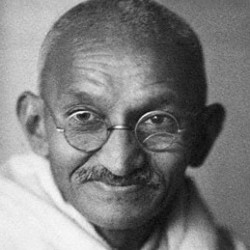
How Gandhi replaced Britain's monarchs in offices

October 2, 2012

Gandhi

Mumbai, October 2: For nearly two years after India became independent, pictures of the king and queen of Britain continued to adorn government offices and departments.

It was only from June 2, 1949 that the government of then Bombay state ordered all offices to replace the photographs of British colonial rulers with those of Mahatma Gandhi, who by then had been assassinated.

In keeping with the principles of austerity practiced by the Mahatma, old frames from the British photos were used to mount pictures of the Father of the Nation, according to archival material released by Raj Bhavan here Monday, the eve of Gandhi Jayanti.

"The photographs of their majesties ... should be carried to a remote place where the frame and glasses should be removed.

The frames and glasses which remain intact and neat and tidy should be used for framing Mahatma Gandhi's photographs," says the government resolution issued by the Political and Services Department of the government of Bombay.

The government record (GR) copies, issued by then chief secretary M.D. Bhat, were marked to the governor, premier of Bombay, the High Court, divisional commissioners, heads of government departments, ministers, collectors and chief administrators of Kolhapur and Sangli and special commissioner of Baroda.

"It is apparent from the GR and circular that the government advocated austerity while asking government departments to re-use the old photo frames in tune with the ideology of the new entrant to the photo frame, Mahatma Gandhi," a Raj Bhavan official said.

The resolution further said: "The actual material on which the photographs or portraits of the king and queen are photographed or portrayed should be stored in a safe place where there is no inflammable material nearby.

The question as to what should be done with the photographs without frames will be decided after three years."

The GR also specified the kinds of pictures the government had approved for use in various offices.

It had approved pictures received from three agencies - Rex Photo Studio, Bombay, bust size 16 inches by 22 inches; Vanguard Studio, Bombay, size 14 inches by 17 inches; Dandi Kuch upright position, and Associated Photo Service, Delhi, bust size with folded hands size 10 inches by 12 inches.

The interesting aspect was that the GR also specified which government office should use which particular photograph of Mahatma Gandhi.

Later, in another GR issued on Oct 14, 1949, the prices for the three types of pictures were also communicated.

The first one, without frame, was fixed at Rs.30, the second one at Rs.18 and the third at Rs.8 per copy.

Today, no government office in the country is complete without a photograph of Mahatma Gandhi, displayed in a prominent location in its premises.


Comments

Add new comment

  • Coastaldigest.com reserves the right to delete or block any comments.
  • Coastaldigset.com is not responsible for its readers’ comments.
  • Comments that are abusive, incendiary or irrelevant are strictly prohibited.
  • Please use a genuine email ID and provide your name to avoid reject.
News Network
June 29,2020

New Delhi/ Jammu, Jun 29: Syed Ali Shah Geelani, the face of Kashmir's separatist politics for over three decades, has quit the Hurriyat Conference, the biggest separatist amalgam in Kashmir. The 90-year-old, who had led the separatist movement in Kashmir Valley since the 1990s, was a lifelong chairman of the Hurriyat.

He has mostly been in house arrest since 2010, when anger and violence over police firing on protesters consumed Kashmir.

In an audio message, Syed Ali Shah Geelani said he was announcing his resignation from the All Party Hurriyat Conference because of "the current circumstances" in the umbrella group.

"In view of the current state of the Hurriyat Conference, I am announcing my complete dissociation from the forum. In this context I have already sent a detailed letter to all constituents of the forum," said Geelani in an audio message released this morning.

This marks a major development for separatist politics in Jammu and Kashmir after the government ended its special status under the constitution's Article 370 in August last, split it into two union territories and enforced massive restrictions in movement besides jailing scores of leaders.

Geelani also released a two-page letter in which he accused constituents of Hurriyat of inaction after the scrapping of Article 370.

"I sent messages to you through various means so the next course of action could be decided but all my efforts were in vain. Now that the sword of accountability is hanging over your heads for the financial and other irregularities, you thought of calling the advisory committee meeting," he wrote.

The letter accused Hurriyat constituents of hatching "conspiracy and resorting to lies against him" and also teaming up with the Hurriyat chapter in Pakistan Occupied Kashmir, which had targeted him. "Instead of reprimanding them, you called a meeting in Srinagar and ratified their stand. You people have become part of the conspiracy and lies," said the letter.

"The lack of discipline and other shortcomings were ignored and you did not allow a robust accountability system to be established over the years but today, you have crossed all limits and indulged in rebellion against the leadership."

Sources say Geelani had been attacked by groups in Pakistan for what they called his failure to respond to the government's big move. Many questioned the silence of the separatist hardliner, who was prone to calls for protest shutdowns and election boycotts.

A three-time MLA from Sopore, Geelani quit electoral politics after militancy erupted in Kashmir. Recent reports have claimed that he has been unwell.

Comments

Add new comment

  • Coastaldigest.com reserves the right to delete or block any comments.
  • Coastaldigset.com is not responsible for its readers’ comments.
  • Comments that are abusive, incendiary or irrelevant are strictly prohibited.
  • Please use a genuine email ID and provide your name to avoid reject.
Agencies
February 5,2020

New Delhi, Feb 5: AIMIM chief Asaduddin Owaisi on Wednesday expressed his suspicion over the government using force to clear the Shaheen Bagh stretch where an agitation has been ongoing for over 50 days against Citizenship Amendment Act (CAA).

While speaking to ANI over the phone, Owaisi was asked that there are indications from the government that after February 8, Shaheen Bagh will be cleared.

In reply, he said, "Might be they will shoot them, they might turn Shaheen Bagh into Jallianwala Bagh. This might happen. BJP minister gave a statement to 'shoot a bullet'. The government must give an answer as (to) who is radicalising."

Further speaking about NPR and NRC, Owaisi said, "Government must give a clear cut answer that till 2024 NRC will not be implemented. Why are they spending Rs 3900 crore for NPR? I feel this way because I was a History student. Hitler during his reign conducted census twice and after that, he pushed the jews in a gas chamber. I don't want our country (to) go in that way."

Comments

Add new comment

  • Coastaldigest.com reserves the right to delete or block any comments.
  • Coastaldigset.com is not responsible for its readers’ comments.
  • Comments that are abusive, incendiary or irrelevant are strictly prohibited.
  • Please use a genuine email ID and provide your name to avoid reject.
News Network
April 21,2020

New Delhi, Apr 21: India's count of positive coronavirus cases reached 18,985 after 1,329 new cases were reported in the last 24 hours, the Ministry of Health and Family Welfare said on Tuesday.

Out of the total cases, 15,122 are active cases, 3,259 have been discharged or cured and one has migrated. With 44 new deaths reported in the last 24 hours, the toll stands at 603.

As per the evening update by the ministry, Maharashtra continues to be the worst-hit state with 4,669 cases, out of which 572 patients have been discharged and cured and 232 deaths.

Delhi's total count of confirmed cases stand at 2,081, which includes 431 cured or discharged cases and 47 deaths.

Gujarat has reported a total of 2,066 positive COVID-19 cases, out of which 131 patients have recovered or discharged, while 77 patients have lost their lives.

Madhya Pradesh's count of COVID-19 cases stand at 1,540, including 127 cured or discharged cases and 76 deaths.

Rajasthan has so far reported 1,576 positive cases, out of which 205 patients have recovered or discharged and 25 people have lost their lives.

Tamil Nadu's COVID-19 figure has risen to 1,520, with 457 patients recovered and 17 fatalities. Uttar Pradesh has reported 1,294 cases, out of which 140 patients have recovered and 20 are dead.

Comments

Add new comment

  • Coastaldigest.com reserves the right to delete or block any comments.
  • Coastaldigset.com is not responsible for its readers’ comments.
  • Comments that are abusive, incendiary or irrelevant are strictly prohibited.
  • Please use a genuine email ID and provide your name to avoid reject.