


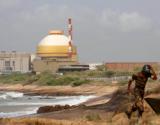
India can meet its energy needs without nuclear plants: Study

October 4, 2012


nuclear_plantsBangalore, October 4: India's energy needs can be met entirely by solar and other renewable sources, says a new study by two professors at the Indian Institute of Science (IISc) in Bangalore.  Their report published in the journal Current Science may add ammunition to the anti-nuclear agitation in India.


The analysis by Hiremath Mitavachan and Jayaraman  Srinivasan of  IISc's Divecha Centre for Climate Change overturns the argument that nuclear power is essential for India because the country does not have enough land to exploit the potential of solar energy in India.


According to their study, 4.1 percent of the total uncultivable and waste land area in India  is enough to meet the projected annual demand of 3,400 terawatt-hour (TWh) by 2070 by solar energy alone (1 terawatt-hour per year equals 114 megawatts). The land area required will be further reduced to 3.1 percent "if we bring the other potential renewable energy sources of India into picture", they claim. They conclude that land availability is not a limiting constraint for the solar source as believed.


They say their calculations are based on present-day solar photovoltaic (PV) technology and do not include higher efficiencies achieved by new solar cells. Neither have they considered roof-top PV systems that can be established without any need for additional land.


The IISc researchers' conclusion is in conformity with that of a report prepared last year  by the Australian government which said: "There is more than enough suitable land in India, with high direct beam solar, to meet the entire nation's electricity needs in principle."


Convinced that sunlight differs from other energy sources in the way it uses the land, the researchers compared the land-use pattern of three primary energy sources - coal, nuclear and hydro - with solar energy.  They then calculated the percentage of India's land area that would be required to meet the future projected energy demand. Coal power plants not only transform the land around the facility but also require land for mining coal and its upstream processing, the authors note.  An average dam displaces 31,340 persons and submerges 8,748 hectares of land. The direct land footprint of a nuclear power plant includes power plant area, buffer zone, waste disposal area and the land that goes into mining uranium.


"Our study shows that solar power plants require less land in comparison to hydro-power plants and are comparable with coal and nuclear energy power generation when life-cycle transformations are considered," Srinivasan said.


While nuclear and fossil fuel-based technologies must continuously transform some land to extract the fuels or dispose of the waste, this is not the case with solar plants. In fact, the same land used for PV solar power plants can be utilised for other purposes like grazing.


The roof-top solar power technology, along with that proposed by IISc professors, "will be able to meet most of the electricity demand, and has the potential to transform the power sector," says Shankar Sarma, a power policy analyst  and author of forthcoming book "Integrated Power Policy."


Atul  Chokshi of the IISc Department of Materials Engineering and an expert on solar energy agrees. He reported recently  that a three kilowatt  rooftop solar panel system on the 425 million households   can generate a total energy per year 1900 TWh - half of the projected energy demand by 2070.

Comments

Add new comment

  • Coastaldigest.com reserves the right to delete or block any comments.
  • Coastaldigset.com is not responsible for its readers’ comments.
  • Comments that are abusive, incendiary or irrelevant are strictly prohibited.
  • Please use a genuine email ID and provide your name to avoid reject.
News Network
June 30,2020

Srinagar, Jun 30: On the deadly attack at Karachi Stock Exchange on Monday morning, a Kashmiri social activist and journalist warned that the incident is a stark reminder to all those in Pakistan supporting Jihad and attacked Pakistan prime minister Imran Khan for ignoring development agenda in Balochistan.

Yana Mir, the editor-in-chief of The Real Kashmir News, said, "Karachi Stock Exchange attack is a reminder to all those in Pakistan supporting Jihad. Remember @imrankhan that Youth is restless and they want development agenda. These young boys of BLA are also looking for a life which is settled and peaceful. Wake up Imran Khan and you Kashmiris also. Pakistan is going to finish you. Open your eyes."
Four heavily armed terrorists attacked the busy Pakistan Stock Exchange building in Karachi with grenades today, killing four security guards and a police officer before being shot dead in an exchange of fire, authorities said.

The terrorists, who arrived in a car, stormed the Karachi Stock Exchange building by firing indiscriminately and lobbed grenades at the main gate of the multi-storey building situated in the city's high-security commercial hub.

Balochistan is a well-known region rich in natural resources but the Balochis have always been deprived of basic facilities. No hospitals are available in Balochistan. If there are some then medical facilities and equipment are not available in hospitals. The education system is pathetic and similar is the case with the infrastructure: the roads, water system, agriculture and almost all fields of life.

It is pertinent to mention that enforced disappearances and abductions by the Pakistani military establishment have also been carried out regularly and for innumerable times in Balochistan. Leaders, activists, and vocal members of various student organizations have been detained by the security forces and kept in confinement. While others have been shot dead.

This crime against humanity has been going on for so long and so systematically in Balochistan that it has come to be considered as a normal state of affairs in the province. Many social and human rights activists have flagged the issue of oppression by the Pakistani establishment before the United Nations and other international agencies.

According to the Commission of Inquiry on Enforced Disappearances, an entity established by the Pakistani government, about 5,000 cases of enforced disappearances have been registered since 2014. Most of them are still unresolved.

Independent local and international human rights organisations put the numbers much higher. Around 20,000 have reportedly been abducted only from Balochistan, out of which more than 2,500 have turned up dead as bullet-riddled dead bodies, bearing signs of extreme torture.

Before being elected as Prime Minister, Imran Khan had admitted in multiple interviews about the involvement of Pakistan's intelligence agencies in enforced disappearances as well as extrajudicial killings and vowed to resign if he was unable to put an end to the practice, holding those involved responsible. But times have passed and only reports are available to narrate the true story.

Comments

Add new comment

  • Coastaldigest.com reserves the right to delete or block any comments.
  • Coastaldigset.com is not responsible for its readers’ comments.
  • Comments that are abusive, incendiary or irrelevant are strictly prohibited.
  • Please use a genuine email ID and provide your name to avoid reject.
News Network
May 6,2020

New Delhi, May 6: Taking a cue from states, the Centre announced one of the steepest hikes in duties on petrol and diesel in the recent past, by raising it by Rs 10 and Rs 13 per litre, respectively, in a notification issued late on Tuesday.

Retail prices, however, will see no change as the price hike will be absorbed by oil marketing companies against the fall in crude prices.

Road and infrastructure cess was hiked by Rs 8 for petrol and diesel and the special additional excise duty (SAED) was hiked by Rs 2 per litre and Rs 5 per litre, respectively. While the road cess will only go into the Centre’s coffers, the hike on account of SAED will be passed on to states via devolution at 42 per cent. Hence, the states will get only Rs 0.84 per litre in case of petrol and Rs 2.1 in case of diesel.

The decision comes after several states increased the value added tax (VAT) on petrol and diesel making use of the lower price regime. The Delhi government on Tuesday increased VAT on petrol and diesel to 30 per cent each, from 27 and 16.75, respectively. As a result, the price of petrol in Delhi increased by Rs 1.67 to Rs 71.26 a litre and diesel by Rs 7.10 to Rs 69.29 in Delhi on Tuesday.

Amid falling international crude oil prices, the Centre introduced an enabling provision in March to raise excise duty on petrol and diesel by Rs 8 per litre in the Finance Act. The government had on March 14 raised excise duty on petrol and diesel by? 3 per litre each, which was to help raise an additional ?39,000 crore in revenue annually.

This duty hike included Rs 2 a litre increase in SAED and Rs 1 in road and infrastructure cess. It raised SAED to Rs 10 for petrol and Rs 4 for diesel. The limit has now been increased to Rs 18 a litre in case of petrol and Rs 12 in case of diesel by way of amendment of the Eighth Schedule of the Finance Act.

Economists said the move would impact retail inflation by over half a percentage point at least. “With lower consumption, there was loss of revenue for Centre and states, who earn Rs 6 trillion annually or Rs 50,000 crore monthly from fuel. Amid lockdown in April, the collection must have come down to just Rs 5,000 crore, and this will hold for May.

This means that Centre and states have lost 20 per cent of annual revenue from fuel. Hence, they have hiked duties to recover losses,” said Madan Sabnavis, chief economist, CARE Ratings. He added that the hike will impact inflation by at least 0.6-0.7 percentage points.

According to industry experts, an estimate of the additional government revenue cannot be made as the consumption of petrol and diesel has dropped to 40 per cent of what it was before the lockdown. The duty hike comes following a drop in international crude oil prices in April, owing to lower consumption figures globally. At 11.50 pm on Tuesday, Brent was priced at $30.67 a barrel, while West Texas Intermediate (WTI) crude was seen at $24.36 a barrel. On Monday, the Indian basket of crude oil was priced at $23.38 a barrel, after touching a 15-year low last month.

Comments

Add new comment

  • Coastaldigest.com reserves the right to delete or block any comments.
  • Coastaldigset.com is not responsible for its readers’ comments.
  • Comments that are abusive, incendiary or irrelevant are strictly prohibited.
  • Please use a genuine email ID and provide your name to avoid reject.
News Network
January 15,2020

New Delhi, Jan 15: The mother of 23-year-old paramedic student, who was raped and brutally assaulted by six men in December 2012, on Tuesday said she knew that the curative petitions of the convicts will be rejected and is confident that they will be hanged on January 22.

Her remarks came after the Supreme Court on Tuesday refused to stay the execution of two of the four death row convicts in the 2012 Nirbhaya gang rape and murder case while dismissing their curative petitions against their conviction and capital punishment.

"The curative please had to be rejected. This was the third time they had gone to the Supreme Court. Whatever pleas they file, we are ready to face them and we will fight it out. We feel that they will be hanged on January 22. We want that to happen," Nirbhaya's mother told PTI over phone.

The four convicts -- Vinay Sharma (26), Mukesh Kumar (32), Akshay Kumar Singh (31) and Pawan Gupta (25) -- are to be hanged on January 22 at 7 am in Tihar jail as a Delhi court issued their death warrants on January 7.

Vinay and Mukesh had filed curative petitions on January 9.

Shortly after the apex court refused to stay the execution of two of them, Mukesh moved a mercy petition before President Ram Nath Kovind.

Mukesh also approached the Delhi High Court for quashing the death warrant. The high court is expected to take up his petition on Wednesday.

Comments

Add new comment

  • Coastaldigest.com reserves the right to delete or block any comments.
  • Coastaldigset.com is not responsible for its readers’ comments.
  • Comments that are abusive, incendiary or irrelevant are strictly prohibited.
  • Please use a genuine email ID and provide your name to avoid reject.