



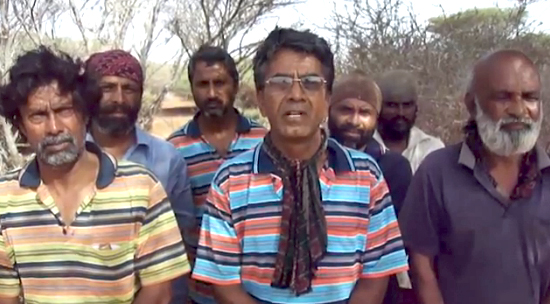
Seven Indian sailors, held hostage by Somali pirates for 2 years, appeal for help

October 6, 2012
Indian_Sailors

New Delhi, October 6: Seven Indian sailors, who have been held hostage by Somali pirates for the last two years, have appealed to the PM, the President, Congress leader Sonia Gandhi and opposition leader Sushma Swaraj for help.

The sailors have narrated their ordeal in a video message uploaded on YouTube and have sought immediate intervention of the government. "Our condition is very bad. I don't know what action the government is taking. We have been here for a very long time now. We are fed up and mentally tensed. Our health is not good. So we are requesting the honourable President of India, honourable Prime Minister, UPA President Mrs Sonia Gandhi and opposition leader Mrs Sushma Swaraj to please save us. Save our life. We want our release. Please help us," appeals a sailor, Bahadur Singh, in the message. The video was reportedly uploaded on the web 45 days ago, but was accessed by the family of one of the hostages yesterday.

One of the sailors, the vessel's Second Officer Bhaskaran Nair Unnikrishnan, is reportedly a diabetic patient and is said to be in urgent need of medicines.

The sailors were taken hostage on September 28, 2010 when their ship, MT Asphalt, was hijacked by Somali pirates. The vessel and eight of its crew members were released on April 15, 2011after the intervention of the Mumbai-based shipping company. But these seven sailors were held back as hostages.

The hijackers have demanded that the Indian government release 100 Somali pirates in exchange for the release of these seven sailors. But sources say the government is unwilling to release them.

The Director General of shipping has reportedly time and again written to the owners of the ship to negotiate with the pirates. But the talks have not moved forward as the shipping company is reportedly unwilling to intervene in the matter as its ship has been released, sources add.

A total of 43 Indians are currently in the custody of Somali pirates. Of these, 15 have spent over two years as hostages.


Comments

Add new comment

  • Coastaldigest.com reserves the right to delete or block any comments.
  • Coastaldigset.com is not responsible for its readers’ comments.
  • Comments that are abusive, incendiary or irrelevant are strictly prohibited.
  • Please use a genuine email ID and provide your name to avoid reject.
News Network
January 14,2020

New Delhi, Jan 14: The curative petitions of Vinay Sharma and Mukesh, who were sentenced to death in the Nirbhaya gang rape and murder case, was on Tuesday rejected by a five-judge Supreme Court Bench led by Justice N.V. Ramana.

In a three-page order, the Bench concluded, after an in chamber consideration that began about 1.45 p.m., that there was no merit in their pleas to spare them from the gallows.

“We have gone through the curative petitions and relevant documents. In our opinion, no case is made out within the parameters indicated in the decision of this Court in Rupa Ashok Hurra versus Ashok Hurra. Hence, the curative petitions are dismissed,” the court held.

Curative is a rare remedy devised by a Constitution Bench of the Supreme Court in its judgment in the Rupa Ashok Hurra case in 2002. A party can take only two limited grounds in a curative petition - one, he was not heard by the court before the adverse judgment was passed, and two, the judge was biased. A curative plea, which follows the dismissal of review petition, is the last legal avenue open for convicts in the Supreme Court. Sharma was the first among the four convicts to file a curative.

The Bench also rejected their pleas to stay the execution of their death sentence and for oral hearing in open court.

Besides Justice Ramana, the Bench comprised Arun Mishra, Rohinton Nariman, R. Banumathi and Ashok Bhushan.

Curative petitions were filed in the Supreme Court by both convicts on January 9. The petitions had come just days after a Delhi sessions court schedulled the execution of all the four convicts in Tihar jail on January 22.

Sharma and Mukesh, in separate curative petitions, argued that there was a “sea change” in the death penalty jurisprudence since their convictions. Carrying out the death sentence on such changed circumstances would be a “gross miscarriage of justice”.

In his plea, Sharma said the Court had commuted the death penalty in several rape and murder cases since 2017, when it first confirmed the death penalty to the Nirbhaya convicts.

“fter the pronouncement of judgment in 2017, there have been as many as 17 cases involving rape and murder in which various three-judge Benches of the Supreme Court have commuted the sentence of death,” the petition contended.

The Supreme Court recently dismissed a review petition filed by Akshay Singh, another of the four four condemned men, to review its May 5, 2017 judgment confirming the death penalty. It also refused his plea to grant him three weeks' time to file a mercy petition before the President of India.

A Bench led by Justice R. Banumathi had said it was open for the Nirbhaya case convicts to avail whatever time the law prescribes for the purpose of filing a mercy plea.

Akshay (33), Mukesh (30), Pawan Gupta (23) and Sharma (24) had brutally gang-raped a 23-year-old paramedical student in a moving bus on the intervening night of December 16-17, 2012. She died of her injuries a few days later.

The case shocked the nation and led to the tightening of anti-rape laws. Rape, especially gang rape, is now a capital crime.

One of the accused in the case, Ram Singh, allegedly committed suicide in the Tihar jail. A juvenile, who was among the accused, was convicted by a juvenile justice board. He was released from a reformation home after serving a three-year term.

Comments

Add new comment

  • Coastaldigest.com reserves the right to delete or block any comments.
  • Coastaldigset.com is not responsible for its readers’ comments.
  • Comments that are abusive, incendiary or irrelevant are strictly prohibited.
  • Please use a genuine email ID and provide your name to avoid reject.
News Network
January 20,2020

New Delhi, Jan 20: Surging inflation and slowing growth are raising serious concerns about the future growth prospects of the economy and as a remedial measure the government should resolve supply-side hurdles and ensure more stringent governance norms, a report said on Monday.

According to the Dun and Bradstreet Economy forecast, even though the Index of Industrial Production (IIP) turned positive in November 2019, it is likely to remain subdued.

"Slowdown in consumption and investment along with high inflationary pressures, geopolitical issues and uncertainty over the recovery of the economic growth are likely to keep IIP subdued," the report noted.

Dun and Bradstreet expect IIP to remain around 1.5-2.0 percent during December 2019.

As per government data, industrial output grew 1.8 percent in November, turning positive after three months of contraction, on account of growth in the manufacturing sector.

On the price front, uneven rainfall along with floods in many states and geopolitical issues have led to a surge in headline inflation even as demand remains muted.

The Consumer Price Index (CPI) in December rose to about five-and-half year high of 7.35 percent from 5.54 percent in November, mainly driven by high vegetable prices.

"The sharp rise in inflation has constrained monetary policy stimulus while revenue shortfall has placed limits on the government expenditure," Dun & Bradstreet India Chief Economist Arun Singh said.

According to Singh, growth-supporting measures and deceleration in growth are likely to cause slippage in fiscal deficit target by a wider margin.

"The government should focus on taking small steps to address the slowdown; in particular, resolve the supply-side hurdles and ensure more stringent governance norms," Singh said.

Unless these concerns are addressed through a comprehensive policy framework, it will not be easy for India to clock a sustainable growth rate to become a USD 5 trillion economy, he added.

Comments

Add new comment

  • Coastaldigest.com reserves the right to delete or block any comments.
  • Coastaldigset.com is not responsible for its readers’ comments.
  • Comments that are abusive, incendiary or irrelevant are strictly prohibited.
  • Please use a genuine email ID and provide your name to avoid reject.
News Network
April 3,2020

Washington, Apr 3: The World Bank has approved USD 1 billion emergency funding for India to help it tackle the coronavirus pandemic, which has claimed 76 lives and infected 2,500 people in the country.

The World Bank's first set of aid projects, amounting to USD 1.9 billion, will assist 25 countries, and new operations are moving forward in over 40 nations using the fast-track process, the bank said on Thursday.

The largest chunk of the emergency financial assistance has gone to India USD 1 billion.

"In India, USD 1 billion emergency financing will support better screening, contact tracing, and laboratory diagnostics; procure personal protective equipment; and set up new isolation wards," the World Bank said after its Board of Executive Directors approved the first set of emergency support operations for developing countries around the world, using a dedicated, fast-track facility for COVID-19 response.

In South Asia, the World Bank also approved USD 200 million for Pakistan, USD 100 million for Afghanistan, USD 7.3 million for the Maldives and USD 128.6 million for Sri Lanka.

The World Bank said it was now working to grant up to USD 160 billion over the next 15 months to support measures to tackle the pandemic which will focus on the immediate health consequences and bolster economic recovery.

The broader economic program will aim to shorten the time to recovery, create conditions for growth, support small and medium enterprises, and help protect the poor and vulnerable.

"The World Bank Group is taking broad, fast action to reduce the spread of COVID-19 and we already have health response operations moving forward in over 65 countries," said World Bank Group President David Malpass.

"We are working to strengthen (the) developing nations' ability to respond to the COVID-19 pandemic and shorten the time to economic and social recovery," Malpass said.

According to the bank, USD 100 million will support Afghanistan to slow and limit the spread of COVID-19 through enhanced detection, surveillance, and laboratory systems, as well as strengthen essential health care delivery and intensive care.

In Pakistan, USD 200 million will support preparedness and emergency response in the health sector and include social protection and education measures, the bank said.

A total of 1,002,159 COVID-19 cases have been reported across more than 175 countries and territories with 51,485 deaths reported so far, according to Johns Hopkins University data.

Comments

Add new comment

  • Coastaldigest.com reserves the right to delete or block any comments.
  • Coastaldigset.com is not responsible for its readers’ comments.
  • Comments that are abusive, incendiary or irrelevant are strictly prohibited.
  • Please use a genuine email ID and provide your name to avoid reject.