


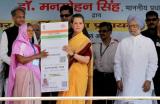
Aadhaar-enabled direct cash transfer system launched

October 20, 2012

aadhar

Dudu, October 20: Millions across the country may soon get benefits of various government schemes such as cooking gas subsidies and old age pension with the launch of the much-awaited Aadhaar-enabled direct cash transfer system here.

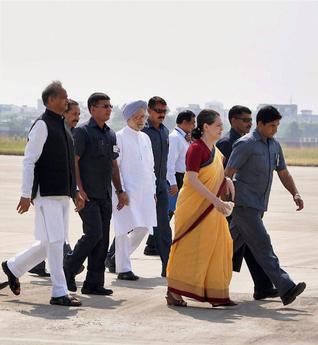
Prime Minster Manmohan Singh and UPA chairperson Sonia Gandhi launched the much touted payment mechanism which is aimed at checking corruption and pilferage in the social sector schemes that seek to promote financial inclusion.

The launch of the scheme coincides with the second anniversary of Aadhaar project, which is being implemented by the Unique Identification Authority of India (UIDAI).

In the last two years, the UIDAI has generated over 20 crore Aadhaar numbers. The Aadhaar number 21 crore was handed over to a villager in Dudu by Sonia Gandhi at a function here which was also attended by Finance Minister P Chidambaram, Chief Minister of Rajasthan Ashok Gehlot, Planning Commission Deputy Chairman Montek Singh Ahluwalia, Union Ministers Sachin Pilot, Ashwani Kumar and Namo Narain Meena among others.

“This is very significant thing and it will help reducing wastage, fraud and corruption,” said UIDAI Chairman Nandan Nilekani.
IN20_AADHAR

Use of Aadhaar-based delivery mechanism will improve compliance management, reduce leakages and increase efficiency and accountability of the government’s social sector schemes.

The government is rolling out Aadhaar enabled service delivery initiative in 51 districts across the country. It will be used for making pension payments, MNREGA payments, PDS distribution, scholarship payments, an official statement said.

UIDAI Director General R S Sharma said, 80 per cent of the work in the 20 districts out of total 51 districts, will be completed by December 2012. Around 80 per cent work in the remaining 31 districts will be completed by the March 31, 2013.

UIDAI has been mandated to cover a total population of 60 crore by March 2014 across 18 states including Delhi, Haryana, Punjab, Tamil Nadu, Himachal Pradesh and Rajasthan.

Comments

Add new comment

  • Coastaldigest.com reserves the right to delete or block any comments.
  • Coastaldigset.com is not responsible for its readers’ comments.
  • Comments that are abusive, incendiary or irrelevant are strictly prohibited.
  • Please use a genuine email ID and provide your name to avoid reject.
Agencies
February 17,2020

New Delhi, Feb 17: The Supreme Court said on Monday that people have a fundamental right to protest against a law but the blocking of public roads is a matter of concern and there has to be a balancing factor.

Hearing pleas over the road blocks due to the ongoing protests at Shaheen Bagh against the Citizenship Amendment Act (CAA), a bench comprising Justices S K Kaul and K M Joseph said its concern is about what will happen if people start protesting on roads.

Democracy works on expressing views but there are lines and boundaries for it, the bench said.

It asked senior advocate Sanjay Hegde and advocate Sadhana Ramachandran to talk to Shaheen Bagh protestors and persuade them to move to an alternative site where no public place is blocked.

The matter has been posted for next hearing on February 24.

People have a fundamental right to protest but the thing which is troubling us is the blocking of public roads, the bench said.

Solicitor General Tushar Mehta said Shaheen Bagh protestors should not be given a message that every institution is on its knees trying to persuade them on this issue.

The apex court said that if nothing works, we will leave it to the authorities to deal with the situation.

Protestors have made their made their point and the protests have gone on for quite some time, it said.

Restrictions have been imposed on the Kalindi Kunj-Shaheen Bagh stretch and the Okhla underpass, which were closed on December 15 last year due to the protests against CAA and Register of Citizens.

The top court had earlier said the anti-CAA protesters at Delhi's Shaheen Bagh cannot block public roads and create inconvenience for others.

The apex court was hearing an appeal filed by advocate Amit Sahni, who had approached the Delhi high court seeking directions to the Delhi Police to ensure smooth traffic flow on the Kalindi Kunj-Shaheen Bagh stretch, which was blocked by anti-CAA protesters on December 15.

While dealing with Sahni's plea, the high court had asked local authorities to deal with the situation keeping in mind law and order.

Separately, former BJP MLA Nand Kishore Garg has filed a petition in the apex court seeking directions to the authorities to remove the protestors from Shaheen Bagh.

One of the pleas has sought laying down of comprehensive and exhaustive guidelines relating to outright restrictions for holding protests or agitations leading to obstruction of public place.

In his plea, Garg has said that law enforcement machinery was being "held hostage to the whims and fancies of the protesters" who have blocked vehicular and pedestrian movement from the road connecting Delhi to Noida.

State has the duty to protect fundamental rights of citizen who were continuously being harassed by the blockage of arterial road, it said.

"It is disappointing that the state machinery is muted and a silent spectator to hooliganism and vandalism of the protesters who are threatening the existential efficacy of the democracy and the rule of law and had already taken the law and order situation in their own hand," the plea had said.

In his appeal, Sahni had sought supervision of the situation in Shaheen Bagh, where several women are sitting on protest, by a retired Supreme Court judge or a sitting judge of the Delhi High Court.

Sahni has said in his plea that protests in Shaheen Bagh has inspired similar demonstrations in other cities and to allow it to continue would set a wrong precedent.

Comments

Add new comment

  • Coastaldigest.com reserves the right to delete or block any comments.
  • Coastaldigset.com is not responsible for its readers’ comments.
  • Comments that are abusive, incendiary or irrelevant are strictly prohibited.
  • Please use a genuine email ID and provide your name to avoid reject.
News Network
July 5,2020

New Delhi, Jul 5: World's largest, 10,000-bed Sardar Patel COVID Care Centre and Hospital (SPCCCH) at Radha Soami Satsang Beas in Chhatarpur area of the national capital has made operational on Sunday.

Inaugurated by Lieutenant Governor of Delhi, Anil Baijal, the facility has been created on an emergency basis by the South Delhi District Administration with support of the Ministry of Home Affairs in a record time of 10 days.
Notably, this coronavirus treatment centre which is set up in Chhatarpur area of the national capital is said to be the "largest" of its kind in the world.
O
"The Sardar Patel COVID Care Centre and Hospital has been developed to help the citizens of Delhi and NCR who are affected by the coronavirus. Our team of doctors and medical staffs will take care of this facility. Sardar Patel COVID Care Centre and Hospital will have 10 per cent of beds with oxygen facility," the Delhi LG said after the inaugural.
Talking about the facilities at the new coronavirus centre, Baijal further stated, "We have counsellors for mentally traumatised patients. We have a team of good psychiatrists and specialists in medicine."

The facility will function as an isolation centre for mild and asymptomatic COVID positive patients. 10 per cent of the beds will have oxygen facility in case the patient develops severe breathlessness and requires tertiary hospital care, read a statement.

Operationally, the facility has been linked to the Deen Dayal Upadhyay Hospital and Madan Mohan Malviya Hospital. The referral tertiary care hospitals are Lok Nayak Jai Prakash Narayan Hospital and Rajiv Gandhi Super Speciality Hospital.

ITBP will be running the first 2,000 beds with their 170 doctors/specialists and more than 700 nurses and paramedics, the statement added.
Most of the basic infrastructure such as beds, mattresses and linen has been donated by various civil society organisations and non-governmental organisations. 

A recreational centre has been made available to the patients along with a library, board games and skipping ropes. People admitted to the facility will be provided five healthy meals a day along with immunity-boosting chawanprash, juices and hot kadha, the statement added.

Comments

Add new comment

  • Coastaldigest.com reserves the right to delete or block any comments.
  • Coastaldigset.com is not responsible for its readers’ comments.
  • Comments that are abusive, incendiary or irrelevant are strictly prohibited.
  • Please use a genuine email ID and provide your name to avoid reject.
News Network
March 12,2020

New Delhi, Mar 12: The Supreme Court told the Uttar Pradesh government on Thursday that as of now, there was no law that could back their action of putting up roadside posters of those accused of vandalism during anti-CAA protests in Lucknow.

An apex court bench refused to stay the March 9 Allahabad High Court order directing the Yogi Adityanath administration to remove the posters.

The top court, which grilled the Uttar Pradesh government for putting up such posters in public, described the plea as a matter that needed "further elaboration and consideration".

A vacation bench of justices U U Lalit and Aniruddha Bose said a "bench of sufficient strength" would consider next week the Uttar Pradesh government's appeal against the Allahabad High Court order directing the state administration to remove the posters of those accused of vandalism during anti-CAA protests.

It directed the apex court registry to put up the case file before Chief Justice of India (CJI) S A Bobde so that a "bench of sufficient strength can be constituted at the earliest to hear and consider" the case next week.

During the hearing, the bench told Solicitor General Tushar Mehta, appearing for the Uttar Pradesh government, that it was a matter of "great importance".

It asked Mehta whether the state government had the power to put up such posters.

The top court, however, said there was no doubt that action should be taken against rioters and they should be punished.

Mehta told the court that the posters were put up as a "deterrent" and the hoardings only said that these persons were liable to pay for their alleged acts during the violence.

Senior advocate A M Singhvi, appearing for former IPS officer S R Darapuri whose poster has also been affixed in Lucknow, told the bench that the state was duty-bound to show the authority of law backing its action.

He said the action of the Uttar Pradesh government amounted to a "mega blanket" approach of naming and shaming these persons without final adjudication and it was an open invitation to common men to lynch them as the posters also had their addresses and photographs.

Comments

Add new comment

  • Coastaldigest.com reserves the right to delete or block any comments.
  • Coastaldigset.com is not responsible for its readers’ comments.
  • Comments that are abusive, incendiary or irrelevant are strictly prohibited.
  • Please use a genuine email ID and provide your name to avoid reject.