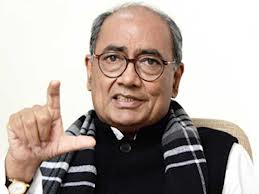
Digvijaya questions offshore funding of Kejriwal's NGO

October 20, 2012

digvijay


New Delhi, October 20: Stepping up his attack against Arvind Kejriwal, Congress general secretary Digvijaya Singh posed a number of questions to him raising doubts about offshore funding of his NGO and asking why he never raised issue of corruption in BJP-ruled states.

A day after shooting off a letter to Kejriwal in which the Congress leader described him as a "self-serving ambitious megalomaniac having "streak" of Hitler, Singh today sent the activist a list of 27 questions asking him to "respond to them with clarity and honesty as you demand from others."

"Why there are no details of individual donors and Corporate donors on any website of your NGOs....Is it a fact that the NGO, Kabir, with whom you are closely associated, received $172000 and $197000 from Ford Foundation in 2005 and 2009 respectively?

"Was this foreign money used to organise seminars, advocacy, discussions, programmes, social media campaigns and publicity material related to the issue of corruption?" Singh asked.

The AICC leader also sought to know Kejriwal's "relationship with US based NGO Avaaz" which, he said, has been funding civil disobedience movement in Libya, Tunisia, Egypt and Syria. Singh said, "What is the logistical and other support your anti-corruption movement received from Avaaz?"

In the backdrop of the controversy surrounding land deals of some of Kejriwal's associates including Prashant Bhusan and Anjali Damania, Singh asked the activist whether he will be "willing to take responsibility as a leader and resign from IAC or give up public life, if any of his staff members of colleagues in the IAC are found to have been involved in any irregularity."

Singh reminded while Kejriwal asked for the resignation of law minister Salman Khurshid for irregularity committed by people working in his Trust, he "never objected when Anna Hazare said that he cannot be held responsible for the action of colleagues/office-bearers in Bhrashtachar Virodhi Jan Andolan Trust".

Comments

Add new comment

  • Coastaldigest.com reserves the right to delete or block any comments.
  • Coastaldigset.com is not responsible for its readers’ comments.
  • Comments that are abusive, incendiary or irrelevant are strictly prohibited.
  • Please use a genuine email ID and provide your name to avoid reject.
News Network
June 8,2020

New Delhi, Jun 8: Places of worship on Monday across the country reopened after staying shut since March due to the COVID-19 induced lockdown.

Scores of temples, mosques and gurudwaras were seen opening up keeping in view the Standard Operating Procedure (SOP) issued by Union Home Ministry to prevent coronavirus spread.

As per Ministry of Health guidelines, touching of idols/holy books, choir/singing groups, etc are not allowed.

In Delhi, people gathered at Gauri Shankar Temple in Chandni Chowk to offer prayers. With national capital seeing a rise in coronavirus cases, the devotees were seen wearing masks and taking precautions. People were also seen offering prayers at Kalka Ji Temple.

Several people arrived at Sri Bangla Sahib Gurudwara to offer prayers. Devotees were made to pass through the disinfectant tunnel before entering the Gurdwara in order to prevent the virus.

In Uttar Pradesh, Chief Minister Yogi Adityanath offered prayers at Gorakhnath Temple after state government allowed re-opening of places of worship from today.

Devotees were seen offering prayers at Eidgah Mosque in Lucknow.

Devotees also offered prayers at Shree Dodda Ganapathi Temple in Basavanagudi, Bengaluru.

Hanuman Garhi Temple in Ayodhya also reopened on Monday.

Prayers were offered at Durga Mata Mandir near Jagraon Bridge in Ludhiana, as the government has allowed reopening of places of worship.

Although religious places have opened in most of the states, however, there are some states which are yet to do so.

Preparations related to Yatra of Char Dhams including Badrinath have been completed, however, local representative of the areas from where the routes of this yatra pass have requested the government to not allow the commencement of the Yatra.

Based on the assessment of the situation, the Odisha Government ordered that all religious places/places of worship for the public will continue to remain closed till June 30.

Earlier, the Union Ministry of Home Affairs (MHA) said that religious places and places of worship for public, hotels, restaurants and other hospitality services along with shopping malls will be permitted to open from June 8.

However, these facilities will not be able to resume operations inside containment zones designated by authorities in states.

Comments

Add new comment

  • Coastaldigest.com reserves the right to delete or block any comments.
  • Coastaldigset.com is not responsible for its readers’ comments.
  • Comments that are abusive, incendiary or irrelevant are strictly prohibited.
  • Please use a genuine email ID and provide your name to avoid reject.
News Network
January 3,2020

Dhaka, Jan 3: Bangladesh's paramilitary force chief said on Thursday that a total of 445 Bangladeshi nationals returned from India in last two months following the publication of the National Register of Citizens (NRC) by the Indian government.

Border Guard Bangladesh (BGB) Director General Maj Gen Md Shafeenul Islam disclosed the figure during a press briefing here.

"About 1,000 people were arrested in 2019 for illegal border crossings from India to Bangladesh, with 445 of them returning home in November and December," he said.

After verifying their identities through local representatives, BGB came to know that all the intruders are Bangladeshis, Islam said, adding that 253 cases were lodged against them for illegal trespass, while initial investigations found that at least three of them were human traffickers.

The BGB Director said the trespassing did not create any tension between the border forces of Bangladesh and India.

Last week, Islam visited India where he said that the creation of the NRC is completely an "internal affair" of India and the cooperation between the border guarding forces of the two countries is very good.

He said the BGB will continue to do its work of preventing illegal border crossings as per its mandate.

A BGB delegation, led by Islam, was on a bilateral visit to India to hold DG-level border talks with its counterparts, the Border Security Force (BSF).

The talks took place from December 26-29, during which a host of issues related to cross-border smuggling and activities of criminals and others along the 4,096-km-long front were discussed.

Responding to a question, Islam said, "No discussion was held at the conference over the (NRC) issue".

He said during the five-day talks held in New Delhi, the BGB demanded that the BSF should take effective steps to prevent killings of Bangladeshis on frontiers as casualty figures sharply rose in 2019.

"The number of border killings in 2019 was highest in the last four years. As per our calculation, the number of such unexpected deaths was 35," the BGB chief said.

However, the BSF estimate of the casualty figure is much lower than our calculation, he said.

Islam said the BSF is following the policy of maintaining maximum restraint and minimal use of force even after being attacked by "armed border offenders".

A statement issued by the BSF last month in New Delhi after the conclusion of the DG-level talks said, "On the concern of the BGB regarding the death of Bangladeshi nationals on borders, it was informed to them that a non-lethal weapon policy is strictly followed by BSF personnel on borders.

"Firing is resorted to only in self-defence, when BSF patrols are gheraoed and attacked by ‘dah’ (a sharp-edged weapon) etc. It was specified that the BSF does not discriminate between criminals based on nationality," it said.

Comments

Add new comment

  • Coastaldigest.com reserves the right to delete or block any comments.
  • Coastaldigset.com is not responsible for its readers’ comments.
  • Comments that are abusive, incendiary or irrelevant are strictly prohibited.
  • Please use a genuine email ID and provide your name to avoid reject.
Agencies
June 6,2020

United Nations, Jun 6: The coronavirus disease has not "exploded" in India, but the risk of that happening remains as the country moves towards unlocking its nationwide lockdown that was imposed in March to contain the Covid-19, according to a top WHO expert.

WHO Health Emergencies Programme Executive Director Michael Ryan on Friday said the doubling time of the coronavirus cases in India is about three weeks at this stage.

“So the direction of travel of the epidemic is not exponential but it is still growing,” he said, adding that the impact of the pandemic is different in different parts of India and varies between urban and rural settings.

“In South Asia, not just in India but in Bangladesh and...in Pakistan, other countries in South Asia, with large dense populations, the disease has not exploded. But there is always the risk of that happening,” Ryan said in Geneva.

He stressed that as the disease generates and creates a foothold in communities, it can accelerate at any time as has been seen in a number of settings.

Ryan noted that measures taken in India such as the nationwide lockdown have had an impact in slowing transmission but the risk of an increase in cases looms as the country opens up.

“The measures taken in India certainly had an impact in dampening transmission and as India, as in other large countries, open up and as people begin to move again, there's always a risk of the disease bouncing back up,” he said.

He added that there are specific issues in India regarding the large amount of migration, the dense populations in the urban environment and the fact that many workers have no choice but to go to work every day.

India went past Italy to become the sixth worst-hit nation by the COVID-19 pandemic.

India saw a record single-day jump of 9,887 coronavirus cases and 294 deaths on Saturday, pushing the nationwide infection tally to 2,36,657 and the death toll to 6,642, according to the health ministry.

The lockdown in India, was first clamped on March 25 and spanned for 21 days, while the second phase of the curbs began on April 15 and stretched for 19 days till May 3. The third phase of the lockdown was in effect for 14 days and ended on May 17. The fourth phase ended on May 31.

The country had registered 512 coronavirus infection cases till March 24.

The nation-wide lockdown in containment zones will continue till June 30 in India but extensive relaxations in a phased manner from June 8 are listed in the Union home ministry's fresh guidelines on tackling the Covid-19 pandemic issued last week.

WHO Chief Scientist Soumya Swaminathan said the over 200,000 current coronavirus cases in India, a country of over 1.3 billion people, "look big but for a country of this size, it's still modest.”

She stressed that it is important for India to keep track of the growth rate, the doubling time of the virus and to make sure that that number doesn't get worse.

She said that India is a “heterogeneous and huge country” with very densely populated cities and much lower density in some rural areas and varying health systems in different states and these offer challenges to the control of Covid-19.

Swaminathan added that as the lockdown and restrictions are lifted, it must be ensured that all precautions are taken by people.

“We've been making this point repeatedly that really if you want behaviour change at a large level, people need to understand the rationale for asking them to do certain things (such as) wearing masks,” she said.

In many urban areas in India, it's impossible to maintain physical distancing, she said adding that it then becomes very important for people to wear appropriate face coverings when they are out, in office settings, in public transport and educational institutions.

“As some states are thinking about opening, every institution, organisation, industry and sector needs to think about what are the measures that need to be put in place before you can allow a functioning and it may never be back to normal.”

She said that in many professions working from home can be encouraged but in several jobs, people have to go to work and in such cases measures must be put in place that allow people to protect themselves and others.

“I think communication and behaviour change is a very large part of this whole exercise,” she added.


Comments

Add new comment

  • Coastaldigest.com reserves the right to delete or block any comments.
  • Coastaldigset.com is not responsible for its readers’ comments.
  • Comments that are abusive, incendiary or irrelevant are strictly prohibited.
  • Please use a genuine email ID and provide your name to avoid reject.