



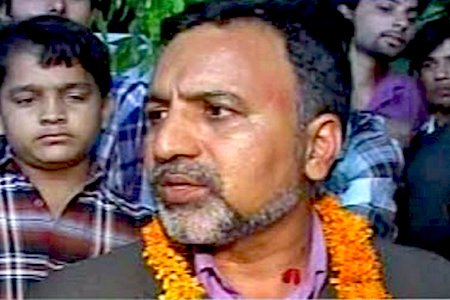
Israeli embassy car blast: I was framed in the case, says Kazmi

October 22, 2012

kazmi_tictac_630

New Delhi, October 22: Journalist Syed Mohammad Ahmed Kazmi, who was released on bail after seven months in the Israeli diplomat car attack case on Friday, has claimed that he was framed because he use to regularly make phone calls on Iranian numbers for official purposes. "I was picked up because I use to call Iran every day for journalistic purposes. They needed a scapegoat living in the Lodhi Road area," he said.

Kazmi said that he is sure that the case will not result in conviction and that the "truth will prevail". "Generally bail is given when the court is satisfied that the case will not result in conviction. I am innocent and I will love to hear at the end of the case that I'm free from all charges," said the journalist. "I have definitely been framed. I have been in journalism for the last 30 years. I started with an Iranian news agency in 1983 and therefore it was natural for me to travel to Iran. All allegations are false. They tried to frame me because of outside powers," he added.

He, however, refused to comment on whether he knows Houshang Afshar Irani and Sedaghatzadeh Masoud - the two prime accused in the case. Irani was identified as the man who attached a magnetic charge to the car of the wife of the Israeli diplomat in Delhi and Masoud is believed to be the overall co-ordinator of the international operation. Kazmi alleged that all media reports in the case have been one-sided and now that he is free he is sure that the truth will prevail. "I'm ready for a long fight. I'm not going anywhere. I will fight till truth comes out," he said.

The Supreme Court on Friday granted bail to Kazmi, who had been behind bars since March 6 in the Israeli diplomat car attack case. "We direct that the appellant (Kazmi) be released on bail to the satisfaction of the Chief Metropolitan Magistrate, upon such conditions as may be deemed fit and proper, including surrender of passport, reporting to the local police station, and not leaving the city limits where he would be residing without the leave of the Court, so as to ensure his presence at the time of the trial," a bench headed by Chief Justice Altamas Kabir said.

Kazmi, who claims to have been writing for an Iranian agency, was picked up after a probe showed that he had been in touch with the suspect who is believed to have stuck the magnetic bomb on Israeli diplomat Tal Yehoshua's car on February 13, according to the police. He is alleged to have helped the suspect in conducting the recce of the Israeli Embassy to keep a tab on arrival and departure of diplomats.

Israeli diplomat Tal Yehoshua Koren, 42, wife of Israeli Defence Attache Colonel Yossi Refaelov and an Indian driver of the embassy vehicle, were among four persons injured in the blast caused by the magnetic bomb. While allowing Kazmi's plea, the bench said, "We are unable to appreciate the procedure adopted by the Chief Metropolitan Magistrate, which has been endorsed by the High Court and we are of the view that Kazmi acquired the right for grant of statutory bail on July 17, 2012, when his custody was held to be illegal by the Additional Sessions Judge," the bench said.

Meanwhile, the Rashtriya Swayamsevak Sangh (RSS) on Saturday questioned the bail granted to Kazmi saying that if he was given bail, why hadn't Sadhvi Pragya Thakur been granted bail yet. "Justice Kabir, CJI, said Kazmi, accused in the attack on an Israeli diplomat's wife in Delhi has statutory right to bail. He is released. What about Sadhvi Pragya? Is the Supreme Court setting another new precedent by granting bail to Kazmi against whom ample evidence of direct involvement in the plot is available?" said RSS spokesperson Ram Madhav Varanasi.



Comments

Add new comment

  • Coastaldigest.com reserves the right to delete or block any comments.
  • Coastaldigset.com is not responsible for its readers’ comments.
  • Comments that are abusive, incendiary or irrelevant are strictly prohibited.
  • Please use a genuine email ID and provide your name to avoid reject.
News Network
March 27,2020

Mumbai, Mar 27: The Reserve Bank of India (RBI) on Friday lowered the key repo rate by 75 basis points to 4.4 per cent in a bid to arrest the economic slowdown amid coronavirus (COVID-19) outbreak.
The reverse repo rate now stands at 4 per cent, down by 90 basis points, said RBI Governor Shaktikanta Das adding this has been done to make it unattractive for banks to passively deposit funds with the central bank and instead lend it to the productive sectors.
The six-member monetary policy committee (MPC) met on March 24, 25 and 27 and voted 4:2 in favour of the repo rate reduction. The MPC also decided to continue with the accommodative stance as long as it is necessary to revive growth and mitigate the impact of COVID-19 on the economy while ensuring that inflation remains within the target.
"The need of the hour is to shield the economy from the pandemic," said Das. "We need to mitigate the impact of coronavirus, revive economic growth and provide financial stability."
Repo rate is the rate at which a country's central bank lends money to commercial banks, and the reverse repo rate is the rate at which it borrows from them.
The RBI Governor further said that the economic growth and inflation projection will be highly contingent depending on the duration, spread and intensity of the pandemic.
"Global economic activity has come to a near standstill as COVID-19 related lockdowns and social distancing are imposed across a widening swathe of affected countries. Expectations of a shallow recovery in 2020 from 2019's decade low in global growth have been dashed," said Das.
"The outlook is now heavily contingent upon the intensity, spread and duration of the pandemic. There is a rising probability that large parts of the global economy will slip into recession," he said.
However, the RBI has injected liquidity of Rs 2.8 lakh crore via various instruments equal to 1.4 per cent of GDP. "Along with today's measures, liquidity measures equal to 3.2 per cent of GDP. The RBI will take continuous measures to ensure liquidity in the system."
The RBI governor has said that all banking institutions can offer a three-month moratorium on all loans for a period of three months. The RBI has also allowed banks to restructure the working capital cycle for companies without worrying that these will have to be classified as a non-performing asset (NPA).
The three-month moratorium will permit banks to avoid a large onset of NPAs during the 21-day lockdown and keep their books healthy.
Das said banks and other financial institutions should do all they can to keep credit flowing to economic agents facing financial stress on account of the isolation that the virus has imposed.
"Market participants should work with regulators like the RBI and the Securities and Exchange Board of India (SEBI) to ensure the orderly functioning of markets in their role of price discovery and financial intermediation," he said.

Comments

Add new comment

  • Coastaldigest.com reserves the right to delete or block any comments.
  • Coastaldigset.com is not responsible for its readers’ comments.
  • Comments that are abusive, incendiary or irrelevant are strictly prohibited.
  • Please use a genuine email ID and provide your name to avoid reject.
Agencies
June 29,2020

From March through May, around 1 crore migrant workers fled India’s megacities, afraid to be unemployed, hungry and far from family during the world’s biggest anti-Covid-19 lockdown.

Now, as Asia’s third-largest economy slowly reopens, the effects of that massive relocation are rippling across the country. Urban industries don’t have enough workers to get back to capacity, and rural states worry that without the flow of remittances from the city, already poor families will be even worse off -- and a bigger strain on state coffers.

Meanwhile, migrant workers aren’t expected to return to the cities as long as the virus is spreading and work is uncertain. States are rolling out stimulus programs, but India’s economy is hurtling for its first contraction in more than 40 years, and without enough jobs, a volatile political climate gets more so.

“This will be a huge economic shock, especially for households of short-term, cyclical migrants, who tend to come from vulnerable, poor and low-caste and tribal backgrounds,” said Varun Aggarwal, a founder of India Migration Now, a research and advocacy group based in Mumbai.

In the first 15 days of India’s lockdown, domestic remittances dropped by 90%, according to Rishi Gupta, chief executive officer of Mumbai-based Fino Paytech Ltd., which operates the country’s biggest payments bank.

By the end of May, remittances were back to around 1750 rupees ($23), about half the pre-Covid average. Gupta’s not sure how soon it’ll fully recover. “Migrants are in no hurry to come back,” Gupta said. “They’re saying that they’re not thinking of going back at all.”

If workers stay in their home states long term, policymakers will have more than remittances to worry about. If consumption falls and the new surplus of labor drives wages down, Agarwal said, “there will also be a second-order shock to the local economy. Overall, not looking good.”

India announced a $277 billion stimulus package in May and followed it up with a $7 billion program aimed at creating jobs for 125 days for migrants in villages across 116 districts. Separately, local authorities are also looking for solutions.

Officials in Bihar have identified 2,500 acres of land that could be made available to investors, said Sushil Modi, deputy chief minister of Bihar, a state in east India. “We can use this crisis as an opportunity to speed up reforms,” he said.

The investors haven’t materialised yet, and in the meanwhile, state governments are relying on the national cash-for-work program that guarantees 100 days worth of wages per household.

Skilled workers don’t want to do manual labor offered through the program, and even if they did, says Amitabh Kundu of RIS, many think of it as beneath their station. “There will be an increase in social tensions,” he predicts. “Caste may again start playing a role. It’s absolute chaos.”

For skilled workers, initiatives vary:

* Uttar Pradesh, which received 3.2 million people, is compiling lists of skilled workers who need employment and trying to place them with local manufacturing and real estate industry associations. So far, the government says, it’s placed 300,000 people with construction and real estate firms.

* Bihar has placed returners in state-run infrastructure projects and hired others to stitch uniforms and make furniture for government-run schools, even as they waited in quarantine centres, said Pratyay Amrit, head of the state’s disaster management department.

* The eastern state of Odisha announced an urban wage employment program aimed at putting as many as 450,000 day labourers to work through September. Some 25,000 people have been employed, so far, under the scheme, G. Mathivathanan, principal secretary for housing and urban development said.

Attracting Investments

It’s not clear any of this will be enough to make a dent, says Ravi Srivastava, professor at New Delhi-based Institute of Human Development, adding that the states don’t have much of a track record on economic development.

“It was the failure of these states to improve governance and put development plans in place that led to the out-migration in the first place,” he said.

But officials and workers’ rights advocates see opportunity. Uttar Pradesh has established liaisons to encourage companies from the US, Japan and South Korea to establish manufacturing in the state. There and in Madhya Pradesh and Rajasthan, the government has made labour laws more friendly to employers, making it easier to hire and fire workers.

Modi, the minister from Bihar, said the migration may also give workers--historically a disenfranchised group--new power, particularly as urban centres struggle. “The way industries treated workers during the lockdown -- didn’t pay them, the living conditions were poor -- now these industries will realize the value of this force,” Modi said.

“In the days to come, labour will emerge as a force that can’t be ignored anymore,” he added. “That’s the new normal. We will work out how to ensure dignity, rights to our people who are going to work in other states.”

Bihar is due for elections by November, a vote that could be an early test of the mass migration’s political consequences. The state is currently governed by a coalition that includes Prime Minister Narendra Modi’s Bharatiya Janata Party. Amitabh Kundu, a fellow at the Research and Information System for Developing Countries, a New Delhi-based government think-tank, said migrant workers are likely to be angry voters.

“Chief ministers are telling these migrants that they will not have to go back for work,” he said. “But their capacity to do something miraculous in the next four to five months is doubtful. If they can retain even one-fourth of the migrants, I would call it a success.”

Comments

Add new comment

  • Coastaldigest.com reserves the right to delete or block any comments.
  • Coastaldigset.com is not responsible for its readers’ comments.
  • Comments that are abusive, incendiary or irrelevant are strictly prohibited.
  • Please use a genuine email ID and provide your name to avoid reject.
Agencies
July 1,2020

Sopore, Jammu And Kashmir: A three-year-old boy survived as his grandfather was killed in a terror attack on the Central Reserve Police Force (CRPF) in Jammu and Kashmir's Sopore town this morning. A CRPF jawan was also killed in the line of duty as terrorists opened fire on a patrol team.

In heart-wrenching images, the child is seen sitting on the blood-splattered body of his grandfather, a civilian caught in the crossfire. The boy was numb with fear when he was picked up by policemen, according to the police.

The Kashmir police also tweeted a photo of the child being carried to safety by a policeman.

"Jammu and Kashmir police rescued a three-year-old boy from getting hit by bullets during the terrorist attack in Sopore," said the tweet by the Kashmir Zone Police.

The child was travelling in a Maruti car with his grandfather from Srinagar to Handwara when it was hit by a spray of bullets in Sopore town, which is in Baramulla district about 50 km from Srinagar.

The police said terrorists hiding in a mosque fired indiscriminately at the patrol team as it was getting off a bus. The CRPF troops retaliated but the terrorists managed to escape.

According to the CRPF, the grandfather stopped the car and got out to run to a safe spot but was shot dead in the firing by terrorists. The boy was later rescued by a policeman standing nearby.

Last week, a six-year-old boy was killed during a terror attack on the CRPF in Anantnag.

Little Nihaan Bhat was sleeping in a parked car when he was hit by a bullet. Police say the terrorist was on a bike and opened fire from a pistol on a CRPF patrol. One jawan was killed. The child's killing drew widespread anger and condemnation.

The terrorist believed to be involved in the Anantnag attack escaped yesterday after an encounter with security forces. Police said two other terrorists who were hiding with him at a village were killed.

Comments

Add new comment

  • Coastaldigest.com reserves the right to delete or block any comments.
  • Coastaldigset.com is not responsible for its readers’ comments.
  • Comments that are abusive, incendiary or irrelevant are strictly prohibited.
  • Please use a genuine email ID and provide your name to avoid reject.