



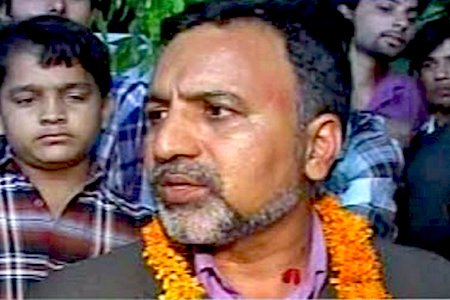
Israeli embassy car blast: I was framed in the case, says Kazmi

October 22, 2012

kazmi_tictac_630

New Delhi, October 22: Journalist Syed Mohammad Ahmed Kazmi, who was released on bail after seven months in the Israeli diplomat car attack case on Friday, has claimed that he was framed because he use to regularly make phone calls on Iranian numbers for official purposes. "I was picked up because I use to call Iran every day for journalistic purposes. They needed a scapegoat living in the Lodhi Road area," he said.

Kazmi said that he is sure that the case will not result in conviction and that the "truth will prevail". "Generally bail is given when the court is satisfied that the case will not result in conviction. I am innocent and I will love to hear at the end of the case that I'm free from all charges," said the journalist. "I have definitely been framed. I have been in journalism for the last 30 years. I started with an Iranian news agency in 1983 and therefore it was natural for me to travel to Iran. All allegations are false. They tried to frame me because of outside powers," he added.

He, however, refused to comment on whether he knows Houshang Afshar Irani and Sedaghatzadeh Masoud - the two prime accused in the case. Irani was identified as the man who attached a magnetic charge to the car of the wife of the Israeli diplomat in Delhi and Masoud is believed to be the overall co-ordinator of the international operation. Kazmi alleged that all media reports in the case have been one-sided and now that he is free he is sure that the truth will prevail. "I'm ready for a long fight. I'm not going anywhere. I will fight till truth comes out," he said.

The Supreme Court on Friday granted bail to Kazmi, who had been behind bars since March 6 in the Israeli diplomat car attack case. "We direct that the appellant (Kazmi) be released on bail to the satisfaction of the Chief Metropolitan Magistrate, upon such conditions as may be deemed fit and proper, including surrender of passport, reporting to the local police station, and not leaving the city limits where he would be residing without the leave of the Court, so as to ensure his presence at the time of the trial," a bench headed by Chief Justice Altamas Kabir said.

Kazmi, who claims to have been writing for an Iranian agency, was picked up after a probe showed that he had been in touch with the suspect who is believed to have stuck the magnetic bomb on Israeli diplomat Tal Yehoshua's car on February 13, according to the police. He is alleged to have helped the suspect in conducting the recce of the Israeli Embassy to keep a tab on arrival and departure of diplomats.

Israeli diplomat Tal Yehoshua Koren, 42, wife of Israeli Defence Attache Colonel Yossi Refaelov and an Indian driver of the embassy vehicle, were among four persons injured in the blast caused by the magnetic bomb. While allowing Kazmi's plea, the bench said, "We are unable to appreciate the procedure adopted by the Chief Metropolitan Magistrate, which has been endorsed by the High Court and we are of the view that Kazmi acquired the right for grant of statutory bail on July 17, 2012, when his custody was held to be illegal by the Additional Sessions Judge," the bench said.

Meanwhile, the Rashtriya Swayamsevak Sangh (RSS) on Saturday questioned the bail granted to Kazmi saying that if he was given bail, why hadn't Sadhvi Pragya Thakur been granted bail yet. "Justice Kabir, CJI, said Kazmi, accused in the attack on an Israeli diplomat's wife in Delhi has statutory right to bail. He is released. What about Sadhvi Pragya? Is the Supreme Court setting another new precedent by granting bail to Kazmi against whom ample evidence of direct involvement in the plot is available?" said RSS spokesperson Ram Madhav Varanasi.



Comments

Add new comment

  • Coastaldigest.com reserves the right to delete or block any comments.
  • Coastaldigset.com is not responsible for its readers’ comments.
  • Comments that are abusive, incendiary or irrelevant are strictly prohibited.
  • Please use a genuine email ID and provide your name to avoid reject.
Agencies
January 4,2020

New Delhi, Jan 4: "Sovereign, socialist, secular, democratic republic" is how India is referred to in the preamble of the Constitution. However, J Nandakumar, a key RSS leader and All India Convenor Prajna Pravah, a Sangh offshoot, wants India to reconsider the inclusion of the word "secular", claiming secularism is a "western, Semitic concept".

In an exclusive interview to news agency, Nandakumar said: "Secularism is a western, Semitic concept. It came into existence in the West. It was actually against Papal dominance."

He argued that India does not need a secular ethos as the nation has moved "way beyond secularism" since it believes in universal acceptance as against the western concept of tolerance.

The RSS functionary on Thursday released a book here named "Hindutva in the changing times". The book launch event was also attended by senior RSS functionary Krishna Gopal.

Nandakumar, who has attacked the Mamata Banerjee government in his book for alleged "Islamisation of West Bengal", told IANS: "We have to see whether we need to put up a board of being secular, or that whether we should prove this through our behaviour, actions and roles."

It is for society to take a call on this, rather than by any political class, on whether the preamble to the Indian Constitution should continue to have the word "secular" in it or not, he added.

In between signing his books and obliging wannabe Hindutva cadres with selfies, Nandakumar said that the very existence of the word "secular" in the preamble was not necessary and how the constitution founders too were against it.

"Baba Saheb Ambedkar, Ladi Krishnaswamy Aiyaar -- all debated against it and said it (secular) wasn't necessary to be included in the preamble. That time it was demanded, discussed and decided not to include it," he said.

Ambedkar's opinion was, however, disregarded when Indira Gandhi "bulldozed" the word "secular", in 1976, said the head of the Prajna Pravah, an umbrella body of several right-wing think-tanks

As Nandakumar prepared to return to his base in Kerala, where, he emphasises, the RSS has its work cut out in the "fight against the Kunnor model", he said that the inclusion of "secular" was done with the intent to damage the concept of Hindutva.

"It was to demolish, destroy the overarching principle of Hindutva that binds us together", he said.

Asked whether the Sangh would pressurise the BJP, which has 303 seats in the Lok Sabha, to omit "secular" from the Constitution preamble, Nandakumar smilingly refused to reply.

Comments

Add new comment

  • Coastaldigest.com reserves the right to delete or block any comments.
  • Coastaldigset.com is not responsible for its readers’ comments.
  • Comments that are abusive, incendiary or irrelevant are strictly prohibited.
  • Please use a genuine email ID and provide your name to avoid reject.
News Network
June 15,2020

New Delhi, Jun 15: A total of 1,15,519 samples of COVID-19 have been tested in the last 24 hours taking the total samples tested to 57,74,133 in the country, the Indian Council of Medical Research (ICMR) said.

"Total sample tested 57,74,133 and samples tested in the last 24 hours is 1,15,519," said ICMR.

With an increase of 11,502 cases in the past 24 hours, the COVID-19 count in India reached 3,32,424 on Monday, according to the Union Health and Family Welfare Ministry.

The COVID-19 count includes 1,53,106 active cases while 1,69,798 patients have been cured and discharged or migrated so far, and the toll due to COVID-19 has now reached 9,520.

Comments

Add new comment

  • Coastaldigest.com reserves the right to delete or block any comments.
  • Coastaldigset.com is not responsible for its readers’ comments.
  • Comments that are abusive, incendiary or irrelevant are strictly prohibited.
  • Please use a genuine email ID and provide your name to avoid reject.
Agencies
June 15,2020

New Delhi, Jun 15: Average temperature of India experienced a rise of 0.7 degree Celsius, along with decline in rainfall, significant increase in frequency of very severe cyclonic storms and droughts in over a decade due to human activities, the Ministry of Earth Sciences in its research report said.

The contentions were made in a report issued by the ministry on the impact of climate change. It will be published by Union Minister Harsh Vardhan on June 19.

According to the report, "Since the middle of the twentieth century, India witnessed rise in temperature; decrease in monsoon; rise in extreme temperature and rainfall, droughts, and sea levels; and increase intensity of severe cyclones.

The report, prepared by researchers of the Centre for Climate Change Research, a cell under The Ministry's Indian Institute of Tropical Meteorology, Pune, further stated that there is compelling scientific evidence that human activities have influenced these changes in regional climate.

India's average temperature has risen by around 0.7 degrees Celsius during 1901-2018, it said, adding that the rise is largely on account of GHG-induced warming and partially offset by forcing due to anthropogenic aerosols.

It states that the average temperature over India is projected to rise by 4.4 degrees Celsius, while the intensity of heat waves is likely to increase by 3-4 times by the end of the century.

In the 30-year period between 1986 and 2015, temperatures of the warmest day and the coldest night of the year have risen by about 0.63 degrees Celsius and 0.4 degree Celsius.

According to the report, by the end of the century, the temperatures of the warmest day and the coldest night are projected to rise by approximately 4.7 degrees Celsius and 5.5 degrees Celsius, respectively.

Alarmingly, sea surface temperature of the tropical Indian Ocean has also risen by one degrees Celsius on average during 1951-2015.

"The frequency of very severe cyclonic storms during the post-monsoon season has increased significantly (+1 event per decade) during the last two decades (2000-2018)," it added.

This came in the backdrop of Cyclone 'Amphan' and 'Nisarga' which made landfalls on May 20 and June 3 and killed several people, flattened villages, and destroyed farms.

"This is the first-ever climate change assessment report for India. This report will be very useful for policy makers, researchers, social scientists, economists, and students," said M. Rajeevan, secretary, the Ministry of Earth Sciences.

Besides this, the report also highlighted various other unnerving data on climate change in the country. Both the frequency and extent of droughts have increased significantly during 1951-2016.

The overall decrease of seasonal "summer monsoon rainfall" during the last 6-7 decades has led to an increased propensity for droughts over India.

"In particular, areas over central India, southwest coast, southern peninsula and north-eastern India have experienced more than 2 droughts per decade, on average, during this period. The area affected by drought has also increased by 1.3 per cent per decade over the same period."

The Hindu Kush Himalayas (HKH) also experienced a temperature rise of about 1.3 degree Celsius during 1951-2014.

Several areas of the Himalayas have experienced a declining trend in snowfall and also retreat of glaciers in recent decades. By the end of the twenty-first century, its annual mean surface temperature is projected to increase by about 5.2 degree Celsius.

The summer monsoon precipitation from June to September over India has also declined by around 6 per cent from 1951 to 2015, with notable decreases over the Indo-Gangetic Plains and the Western Ghats, the report further states.

Comments

Add new comment

  • Coastaldigest.com reserves the right to delete or block any comments.
  • Coastaldigset.com is not responsible for its readers’ comments.
  • Comments that are abusive, incendiary or irrelevant are strictly prohibited.
  • Please use a genuine email ID and provide your name to avoid reject.