



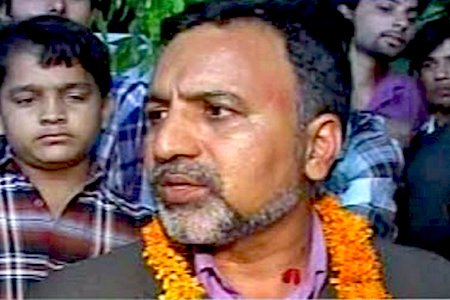
Israeli embassy car blast: I was framed in the case, says Kazmi

October 22, 2012

kazmi_tictac_630

New Delhi, October 22: Journalist Syed Mohammad Ahmed Kazmi, who was released on bail after seven months in the Israeli diplomat car attack case on Friday, has claimed that he was framed because he use to regularly make phone calls on Iranian numbers for official purposes. "I was picked up because I use to call Iran every day for journalistic purposes. They needed a scapegoat living in the Lodhi Road area," he said.

Kazmi said that he is sure that the case will not result in conviction and that the "truth will prevail". "Generally bail is given when the court is satisfied that the case will not result in conviction. I am innocent and I will love to hear at the end of the case that I'm free from all charges," said the journalist. "I have definitely been framed. I have been in journalism for the last 30 years. I started with an Iranian news agency in 1983 and therefore it was natural for me to travel to Iran. All allegations are false. They tried to frame me because of outside powers," he added.

He, however, refused to comment on whether he knows Houshang Afshar Irani and Sedaghatzadeh Masoud - the two prime accused in the case. Irani was identified as the man who attached a magnetic charge to the car of the wife of the Israeli diplomat in Delhi and Masoud is believed to be the overall co-ordinator of the international operation. Kazmi alleged that all media reports in the case have been one-sided and now that he is free he is sure that the truth will prevail. "I'm ready for a long fight. I'm not going anywhere. I will fight till truth comes out," he said.

The Supreme Court on Friday granted bail to Kazmi, who had been behind bars since March 6 in the Israeli diplomat car attack case. "We direct that the appellant (Kazmi) be released on bail to the satisfaction of the Chief Metropolitan Magistrate, upon such conditions as may be deemed fit and proper, including surrender of passport, reporting to the local police station, and not leaving the city limits where he would be residing without the leave of the Court, so as to ensure his presence at the time of the trial," a bench headed by Chief Justice Altamas Kabir said.

Kazmi, who claims to have been writing for an Iranian agency, was picked up after a probe showed that he had been in touch with the suspect who is believed to have stuck the magnetic bomb on Israeli diplomat Tal Yehoshua's car on February 13, according to the police. He is alleged to have helped the suspect in conducting the recce of the Israeli Embassy to keep a tab on arrival and departure of diplomats.

Israeli diplomat Tal Yehoshua Koren, 42, wife of Israeli Defence Attache Colonel Yossi Refaelov and an Indian driver of the embassy vehicle, were among four persons injured in the blast caused by the magnetic bomb. While allowing Kazmi's plea, the bench said, "We are unable to appreciate the procedure adopted by the Chief Metropolitan Magistrate, which has been endorsed by the High Court and we are of the view that Kazmi acquired the right for grant of statutory bail on July 17, 2012, when his custody was held to be illegal by the Additional Sessions Judge," the bench said.

Meanwhile, the Rashtriya Swayamsevak Sangh (RSS) on Saturday questioned the bail granted to Kazmi saying that if he was given bail, why hadn't Sadhvi Pragya Thakur been granted bail yet. "Justice Kabir, CJI, said Kazmi, accused in the attack on an Israeli diplomat's wife in Delhi has statutory right to bail. He is released. What about Sadhvi Pragya? Is the Supreme Court setting another new precedent by granting bail to Kazmi against whom ample evidence of direct involvement in the plot is available?" said RSS spokesperson Ram Madhav Varanasi.



Comments

Add new comment

  • Coastaldigest.com reserves the right to delete or block any comments.
  • Coastaldigset.com is not responsible for its readers’ comments.
  • Comments that are abusive, incendiary or irrelevant are strictly prohibited.
  • Please use a genuine email ID and provide your name to avoid reject.
Agencies
May 27,2020

New Delhi, May 27: India’s fourth recession since Independence, first since liberalisation, and perhaps the worst to date is here, according to rating agency, Crisil.

CRISIL sees the Indian economy shrinking 5 per cent in fiscal 2021 (on-year), because of the Covid-19 pandemic. The first quarter will suffer a staggering 25 per cent contraction.

About 10 per cent of gross domestic product (GDP) in real terms could be permanently lost. "So going back to the growth rates seen before the pandemic is unlikely in the next three fiscals", Crisil said.

Crisil has revised its earlier forecast downwards. "Earlier, on April 28, we had slashed our prediction to 1.8 per cent growth from 3.5 per cent growth. Things have only gone downhill since", it said.

While we expect non-agricultural GDP to contract 6 per cent, agriculture could cushion the blow by growing at 2.5 per cent.

In the past 69 years, India has seen a recession only thrice as per available data in fiscals 1958, 1966 and 1980. The reason was the same each time a monsoon shock that hit agriculture, then a sizeable part of the economy.

"The recession staring at us today is different," it added. For one, agriculture could soften the blow this time by growing near its trend rate, assuming a normal monsoon. Two, the pandemic-induced lockdowns have affected most non-agriculture sectors. And three, the global disruption has upended whatever opportunities India had on the exports front.

Economic conditions have slid precipitously since the April-end forecast of 1.8 per cent GDP growth for fiscal 2021 (baseline), Crisil said.

On the lockdown extension, it said that the government has extended the lockdown four times to deal with the rising number of cases, curtailing economic activity severely (lockdown 4.0 is ending on May 31).

The first quarter of this fiscal will be the worst affected. June is unlikely to see major relaxations as the Covid-19 affliction curve is yet to flatten in India.

"Not only will the first quarter be a washout for the non-agricultural economy, services such as education, and travel and tourism among others, could continue to see a big hit in the quarters to come. Jobs and incomes will see extended losses as these sectors are large employers," Crisil said.

CRISIL also foresees economic activity in states with high Covid-19 cases to suffer prolonged disruption as restrictions could continue longer.

A rough estimate based on a sample of eight states, which contribute over half of India's GDP, shows that their 'red zones' (as per lockdown 3.0) contributed 42 per cent to the state GDP on average regardless of the share of such red zones.

On average, the orange zones contribute 46 per cent, while the green zones where activity is allowed to be close to normal contribute only 12 per cent to state GDP.

The economic costs are higher than earlier expectations, according to Crisil. The economic costs now beginning to show up in the hard numbers are far worse than initial expectations.

Industrial production for March fell by over 16%. The purchasing managers indices for the manufacturing and services sectors were at 27.4 and 5.4, respectively, in April, implying extraordinary contraction. That compares with 51.8 and 49.3, respectively, in March.

Exports contracted 60.3 per cent in April, and new telecom subscribers declined 35 per cent, while railway freight movement plunged 35 per cent on-year.

"Indeed, given one of the most stringent lockdowns in the world, April could well be the worst performing month for India this fiscal," it said.

Added to that is the economic package without enough muscle. The government recently announced a Rs 20.9 lakh crore economic relief package to support the economy. The package has some short-term measures to cushion the economy, but sets its sights majorly on reforms, most of which will have payoffs only over the medium term.

"We estimate the fiscal cost of this package at 1.2 per cent of GDP, which is lower than what we had assumed in our earlier estimate (when we foresaw a growth in GDP)," it said.

"We believe a catch-up to the pre-crisis trend level of GDP growth will not be possible in the next three fiscals despite policy support. Under the base case, we estimate a 10 per cent permanent loss to real GDP (from the decadal-trend level), assuming average growth of about 7 per cent between fiscals 2022 and 2024," Crisil said.

Interestingly, after the Global Financial Crisis (GFC), a sharp growth spurt helped catch up with the trend within two years. GDP grew 8.2 per cent on average in the two fiscals following the GFC. Massive fiscal spending, monetary easing and swift global recovery played a role in a V-shaped recovery.

To catch-up would require average GDP growth to surge to 11 per cent over the next three fiscals, something that has never happened before.

The research said that successive lockdowns have a non-linear and multiplicative effect on the economy a two-month lockdown will be more than twice as debilitating as a one-month imposition, as buffers keep eroding.

Partial relaxations continue to be a hindrance to supply chains, transportation and logistics. Hence, unless the entire supply chain is unlocked, the impact of improved economic activity will be subdued.

Therefore, despite the stringency of lockdown easing a tad in the third and the fourth phases, their negative impact on GDP is expected to massively outweigh the benefits from mild fiscal support and low crude oil prices, especially in the April-June quarter. "Consequently, we expect the current quarter's GDP to shrink 25 per cent on-year," it said.

Counting lockdown 4.0, Indians have had 68 days of confinement. S&P Global estimates that one month of lockdown shaves 3 per cent off annual GDP on average across Asia-Pacific.

Since India's lockdown has been the most stringent in Asia, the impact on economic growth will be correspondingly larger.

Google's Community Mobility Reports show a sharp fall in movement of people to places of recreation, retail shops, public transport and workplace travel. While data for May shows some improvement in India, mobility trends are much below the average or baseline, and lower compared with countries such as the US, South Korea, Brazil and Indonesia.

Comments

Add new comment

  • Coastaldigest.com reserves the right to delete or block any comments.
  • Coastaldigset.com is not responsible for its readers’ comments.
  • Comments that are abusive, incendiary or irrelevant are strictly prohibited.
  • Please use a genuine email ID and provide your name to avoid reject.
News Network
May 13,2020

New Delhi, May 13: Vice President M. Venkaiah Naidu on Wednesday said that Prime Minister Narendra Modi's announcement of Rs 20 lakh crore stimulus package "will go a long way in overcoming challenges" posed by the COVID-19 pandemic.

"Welcome the Rs. 20 lakh crore stimulus package announced by the Prime Minister, Shri Narendra Bhai Modi Ji to revive economy, boost efficiency of various sectors through reforms & make India self reliant and resilient. #AtmaNirbharBharatAbhiyan," the Vice President tweeted.

Calling the reforms as the "need of the hour", he further said: "Bold reforms are the need of the hour to realize the dream of #AtmanirbharBharat."

Expressing confidence in the five-pillar approach, he said that it would help promote local industries "while making India face global competition effectively".

"I am confident that a focused approach on the five pillars- Economy, Infrastructure, Technology driven System, Vibrant Demography & Demand--will promote local industries led growth while making India face global competition effectively. #AtmaNirbharBharatAbhiyan," he said.

"I am certain this timely economic package will go long way in overcoming challenges posed by the unprecedented COVID-19 pandemic. #AtmaNirbharBharatAbhiyan #IndiaFightsCorona," he wrote on the micro-blogging site.

The Prime Minister had on Tuesday announced Rs 20 lakh crore special economic package for the country to become 'self-reliant' and deal with COVID-19.

Comments

Add new comment

  • Coastaldigest.com reserves the right to delete or block any comments.
  • Coastaldigset.com is not responsible for its readers’ comments.
  • Comments that are abusive, incendiary or irrelevant are strictly prohibited.
  • Please use a genuine email ID and provide your name to avoid reject.
News Network
March 26,2020

Mar 26: As Kashmir reported its first COVID-19 death on Thursday, Islamic scholars urged people to follow the Ministry of Home Affairs guidelines on funeral and burial of those who die due to coronavirus pandemic.

“Medical science can’t be ignored and whatever directions there are in the (MHA) guidelines should be followed. As far as the funeral of the person, only family members should participate in the funeral and burial after wearing the protection kits,” the scholars said.

The MHA has stressed that there should be no bathing, kissing, hugging and reciting of verses while the body should be transported in a secured bag. Health experts have stressed that the grave for the person should be dug eight feet deep instead of normal six feet.

“The body of the person should be transported in a secured bag and the vehicle in which he is transported has to be decontaminated by the trained staff who should be wearing N-95 masks and protection equipment,” read the MHA guidelines.

Kashmir witnessed the first death of a COVID-19 patient from uptown city Hyderpora, who had a travel history of outside J&K as he was part of a ‘Tableegi Jamaat’.

Dr Naveed, Head of Department, at Chest Diseases Hospital Srinagar, said that no one from the family should go closer to the body and if someone from the family wants to see the face, he/she has to wear a complete protective gear.

“Burial bath is not recommended for the body. Grave for him should be dug eight feet deep instead of normal six feet,” he said.

As far as funeral prayers, he said, those intending to offer funeral should wear protective gear and maintain sufficient distance between the body and people.

Comments

Add new comment

  • Coastaldigest.com reserves the right to delete or block any comments.
  • Coastaldigset.com is not responsible for its readers’ comments.
  • Comments that are abusive, incendiary or irrelevant are strictly prohibited.
  • Please use a genuine email ID and provide your name to avoid reject.