


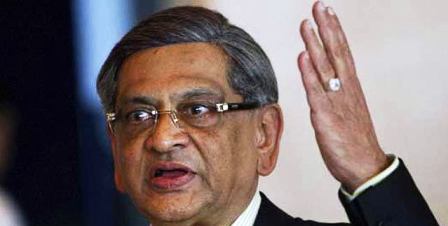
I am making way for younger blood: Krishna

October 27, 2012

krishna

New Delhi, October 27: S M Krishna, who resigned as External Affairs Minister, on Saturday said it was “time up” for him to make way for younger blood and appeared to keep his options open on playing a role in Karnataka politics.

“...the flavour of the season is that youngsters must take over the reins of responsibility and I felt that it was time up for me to make way for younger blood to take over. I am glad that this initiative has been by and large appreciated,” he told reporters after meeting Prime Minister Manmohan Singh, a day after he quit the government.

Asked whether it was the Prime Minister or he himself who decided to step down as Union Minister, Mr. Krishna said, “The decision came from within. And my wife had a major role to play in the decision making.”

He also said that his decision to make way for younger blood does not denigrate the importance of experience.

“This in no way denigrates the importance of experience. I think experience is an important attribute. And particularly in pursuing the foreign relations with other countries there has to be patience and patience abundantly and also perseverance,” he said.

Asked about his statement that his resignation does not denigrate experience and whether he would play a role for the party in Karnataka where assembly elections are due next year, he said, “Well, I said youngsters should lead. And then we are there to support the youngsters in their efforts to forge ahead.”

To a suggestion that his stint in the MEA was short, the former Karnataka Chief Minister said his tenure was for a “respectable” period.

Mr. Krishna said he had also met Congress president Sonia Gandhi who appreciated his work as the External Affairs Minister. “She wanted me to continue in whatever I am going to do as member of Parliament,” he said.

On his tenure in the Ministry, he said there has been an all-round improvement in India’s relations both with its immediate neighbours and the immediate neighbourhood.

“Nobody can claim that all the issues have been resolved with our neighbours. But statesmanship lies in the fact that how well you manage those issues which seem to be confronting you all the time...whether it is in reference to China or Pakistan, I think the last three years has seen quite a bit of improvement in our relationship,” Mr. Krishna said.

He said New Delhi had issues with China on border front but it did not affect the overall relationship that India has pursued to have with Beijing.

“It is the same case with Pakistan. I think under the direction of the Prime Minister, we took up the initiative and I made two trips to Islamabad and my counterpart Hina Rabbani Khar came to Delhi. That certainly did help improve the relationship between our two countries,” he said.

He said Pakistan and China are two classic cases where Indian interests have always with theirs.

“But we have been able to manage with both the countries and today I can say with a sense of conviction that we have a manageable relationship with both the countries,” he said.

He said there are “so many” regrets on what he was unable to do as External Affairs Minister. “Foreign affairs is not two plus two...such easy deductions are not possible but one should keep working towards that.”

He said transparency is one issue on which he was a stickler to the irritation of his colleagues. He said transparency was an unstoppable trend in the light of whatever is happening around. “It is the only effective answer to those who criticise government.”

He said in the field of Haj and passports, the ministry have achieved a lot by doing a “remarkable” work.


Comments

Add new comment

  • Coastaldigest.com reserves the right to delete or block any comments.
  • Coastaldigset.com is not responsible for its readers’ comments.
  • Comments that are abusive, incendiary or irrelevant are strictly prohibited.
  • Please use a genuine email ID and provide your name to avoid reject.
News Network
February 29,2020

New Delhi, Feb 29: India’s economy expanded at its slowest pace in more than six years in the last three months of 2019, with analysts predicting further deceleration as the global Covid 19 coronavirus outbreak stifles growth in Asia’s third-largest economy.

The gross domestic product (GDP) data released yesterday showed government spending, private investment and exports slowing down, while there is a slight upturn in consumer spending and improvement in rural demand lent support.

The quarterly figure of 4.7% growth matched the consensus in a Reuters poll of analysts but was below a revised - and greatly increased - 5.1% rate for the previous quarter.

The central bank has warned that downside risks to global growth have increased as a result of the coronavirus epidemic, the full effects of which are still unfolding.

Prime minister Narendra Modi’s government has taken several steps to bolster economic growth, including a privatisation push and increased state spending, after cutting corporate tax rates last September.

In its annual budget presented this month, the government estimated that annual economic growth in the financial year to March 31 would be 5%, its lowest for last 11 years.

Modi’s government is targeting a slight recovery in growth to 6% for 2020/21, still far below the level needed to generate jobs for millions of young Indians entering the labour market each month.

The annual GDP figure for the September quarter was ramped up from an earlier estimate of 4.5%, while the April-June reading was similarly lifted to 5.6% from 5%, data released by the Ministry of Statistics showed on Friday.

Capital Investment Drop

In the December quarter, private investment grew 5.9%, up from 5.6% in the previous quarter, while government spending rose by 11.8%, against 13.2% in the previous three months.

However, corporate capital investment contracted by 5.2% after a 4.1% decline in the previous quarter, indicating that interest rate cuts by the central bank have failed to encourage new investment. Manufacturing, meanwhile, contracted by 0.2%.

“It appears growth slowdown is not just cyclical but more entrenched with consumption secularly joining the slowdown bandwagon even as the investment story continues to languish,” said Madhavi Arora of Edelweiss Securities in Mumbai.

Many economists said that the government stimulus could take four to six quarters of time before lifting the economy and the impact of those efforts could be outweighed by the global fallout from the coronavirus epidemic that began in China.

“The coronavirus remains the critical risk as India depends on China for both demand and supply of inputs,” said Abheek Barua, chief economist at HDFC Bank.

Indian shares sank on Friday for a sixth session running, capping their worst week in more than a decade. The NSE Nifty 50 index shed 7.3% over the week, while the Sensex dropped 6.8%, the worst weekly declines since the 2008-09 financial crisis.

Separately, India’s infrastructure output rose 2.2% year on year in January, data showed on Friday.

A spike in inflation to a more than 5-1/2 year high of 7.59% in January is expected to make the RBI hold off from further cuts to interest rates for now, while keeping its monetary stance accommodative.

Comments

Add new comment

  • Coastaldigest.com reserves the right to delete or block any comments.
  • Coastaldigset.com is not responsible for its readers’ comments.
  • Comments that are abusive, incendiary or irrelevant are strictly prohibited.
  • Please use a genuine email ID and provide your name to avoid reject.
News Network
May 25,2020

New Delhi, May 25: Realtors' apex body CREDAI has written a letter to Prime Minister Narendra Modi, seeking immediate relief measures to tide over the crisis caused by the COVID-19 pandemic.

The association, which has around 15,000 developer members, has sought one-time debt restructuring, lower interest rate on home loans and tax sops to boost liquidity and demand in the sector.

In an open letter to the prime minister, the Confederation of Real Estate Developers' Associations of India (CREDAI) said, "In this distressful situation arising out of the COVID-19 calamity, we in the real estate sector seek immediate relief for our survival."

Stating that the sector contributes substantially to the country's GDP and has backward and forward linkages with almost 250 industries, CREDAI said, "Our survival, therefore, is not just desirable, it is rather crucial for the economy."

Liquidity crunch, stagnant demand and cartelization of raw materials are major impediments for the industry to kickstart, it added.

CREDAI made seven recommendations to revive the sector and sought immediate intervention from the prime minister.

Pointing out that the situation is "much worse" than global financial crisis in 2008, CREDAI said "a one-time restructuring scheme as was permitted by RBI in 2008 may be quickly instituted by all lending institutions."

Since real estate was already reeling under a cyclical downturn before COVID-19, debt restructuring needs to be allowed for all accounts which were standard as on December 31, 2019, it added.

CREDAI demanded that all banks, non-banking financial companies (NBFCs) and housing finance companies (HFCs) should be directed to provide additional credit equal to 20 per cent of the existing real estate project related advances with no additional security and without the classification of project as NPA.

The penal interest charged by banks and financial institutions should be suspended for a period of one year or until such time as it takes for the pandemic to abate.

To revive housing demand, CREDAI suggested that "government should reduce the maximum rate of interest on new home loans to 5 per cent by subsidizing the interest component of EMIs for next five years."

The limit of principal deduction on housing loan under Section 80C should be increased to 2.5 lakh.

Interest deduction under Section 24 on housing loan for homebuyers may be increased to Rs 10 lakh, it said.

There should be no capital gains for residential properties held for a period longer than one year.

CREDAI also demanded that the subvention scheme be allowed again by National Housing Bank (NHB) and the Reserve Bank.

Under the scheme, builders used to pay EMIs on behalf of homebuyers during construction of projects.

"The economic uncertainty and job insecurity at the moment would not allow purchase of residential property at this time. A scheme whereby a homebuyer would need to pay only margin money with no EMI for 24 months will address this insecurity," the letter said.

The association pointed out that prices of cement and steel have been increased during the lockdown period, and asked for crackdown on cartelisation by manufacturers.

On the GST front, CREDAI said that the current regime of GST provides a rate of 1 per cent  for affordable housing.

"The limit of Rs 45 lakh serves as a criterion of affordability for the purpose of GST. On all other housing, GST is applied at the rate of 5 per cent without input tax credit. It has been felt that the criterion of Rs 45 lakh is too low an index of affordability anywhere across the country, and especially so in the metros," the letter said.

It will serve as an inducement to buyers in the metros if the benefit of GST at the rate of 1 per cent is extended to units costing up to Rs 75 lakh, the association said.

CREDAI pointed out that the flat rate of 5 per cent GST for under construction residential housing is causing cost build up and is acting as a deterrent for sale of under construction projects since there is no GST on completed units.

It suggested that GST rate of 1 per cent and 5 per cent, without input tax credit, should continue.

"However, an option of GST @12 per cent for normal housing/ 8 per cent for affordable housing (with 1/3rd deduction for land i.e. effective GST rate of 8 per cent for normal housing and effective GST rate of 5 per cent for affordable housing) with input tax credit (ITC) benefits in line with the scheme applicable for the works contracts for government may be revived and made applicable to the real estate," the letter said.

Lastly, CREDAI demanded that a Rs 25,000 crore stress fund for completing stalled housing projects should be deployed at the earliest.

"We shall be grateful for your much-needed intervention for the above mentioned measures required to revive the real estate sector," CREDAI said in the letter to the PM.

Comments

Add new comment

  • Coastaldigest.com reserves the right to delete or block any comments.
  • Coastaldigset.com is not responsible for its readers’ comments.
  • Comments that are abusive, incendiary or irrelevant are strictly prohibited.
  • Please use a genuine email ID and provide your name to avoid reject.
Agencies
January 15,2020

Mumbai, Jan 15: Michael Debabrata Patra took over as Deputy Governor of the Reserve Bank of India (RBI) on Wednesday.

He was an Executive Director of India's central bank before being elevated to the post of Deputy Governor.

An RBI release said that as Deputy Governor, Patra will look after Monetary Policy Department including Forecasting and Modelling Unit (MPD/MU), Financial Markets Operations Department (FMOD), Financial Markets Regulation Department.

He will also look after Market Intelligence (FMRD/MI), International Department (Intl. D), Department of Economic and Policy Research (DEPR), Department of Statistics and Information Management (including Data and Information Management Unit) (DSIM/DIMU), Corporate Strategy and Budget Department (CSBD) and Financial Stability Unit.

Patra, a career central banker since 1985, has worked in various positions in the Reserve Bank of India.

As Executive Director, he was a member of the Monetary Policy Committee (MPC) of RBI, which is invested with the responsibility of monetary policy decision making in India. He will continue to be an ex-officio member of the MPC as Deputy Governor.

Prior to this, he was Principal Adviser of the Monetary Policy Department, Reserve Bank of India between July 2012 and October 2014.

He has worked in the International Monetary Fund (IMF) as Senior Adviser to Executive Director (India) during December 2008 to June 2012, when he actively engaged in the work of the IMF's Executive Board through the period of the global financial crisis and the ongoing Euro area sovereign debt crisis.

The release said that his book "The Global Economic Crisis through an Indian Looking Glass" vividly captures this experience.

He has also published papers in the areas of inflation, monetary policy, international trade and finance, including exchange rates and the balance of payments.

A fellow of the Harvard University where he undertook post-doctoral research in the area of financial stability, he has a PhD in Economics from the Indian Institute of Technology, Mumbai.

He will hold the post for three years or until further orders. The post fell vacant after Viral Acharya resigned on July 23 last year.

Comments

Add new comment

  • Coastaldigest.com reserves the right to delete or block any comments.
  • Coastaldigset.com is not responsible for its readers’ comments.
  • Comments that are abusive, incendiary or irrelevant are strictly prohibited.
  • Please use a genuine email ID and provide your name to avoid reject.