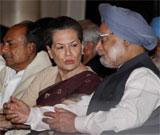
PM's new team gets down to work

October 29, 2012

pmteam

New Delhi, October 29: Prime Minister Manmohan Singh's new team got down to work Monday with new ministers taking charge and old ones relinquishing responsibilities after a mega revamp of the council of ministers that saw 15 new faces and many key ministries changing hands.

The major shake-up of the government Sunday, possibly the last before the 2014 general elections, saw Salman Khurshid taking over as India's new foreign minister, Pawan Kumar Bansal being made the new man to helm the railways ministry, M. Veerappa Moily being given petroleum and M.M. Pallam Raju being made human resource development minister.

S. Jaipal Reddy got science and technology and Kamal Nath got additional charge of parliamentary affairs besides urban development.

Amongst the ministers of state sworn in were Congress spokesperson Manish Tewari who got independent charge of information and broadcasting. Earlier with Ambika Soni, the ministry has been downgraded.

The exercise that sought to jettison perception of passivity in governance comes just ahead of two critical assembly elections in Himachal Pradesh and Gujarat.

"It is a combination of youth and experience," Manmohan Singh said Sunday after the ceremony at Rashtrapati Bhavan where President Pranab Mukherjee administered the oath of office.

"The road ahead is full of challenges," he said, expressing hope that this was the last such exercise before his UPA-II government heads for elections.

Congress general secretary Rahul Gandhi did not join the government - leaving the field open for him to play a larger role in the party.

Seventeen new faces were inducted Sunday of which two ministers were of cabinet rank.

Of the seven new ministers sworn in with cabinet rank, two are debutants -- former Rajya Sabha deputy chairperson K. Rahman Khan and Congress MP Chandresh Kumari Katoch. The other five - Ajay Maken, M.M. Pallam Raju, Dinsha Patel, Harish Rawat and Ashwini Kumar - have been elevated to cabinet rank.

Fifteen ministers of state were also sworn in.

Comments

Add new comment

  • Coastaldigest.com reserves the right to delete or block any comments.
  • Coastaldigset.com is not responsible for its readers’ comments.
  • Comments that are abusive, incendiary or irrelevant are strictly prohibited.
  • Please use a genuine email ID and provide your name to avoid reject.
News Network
June 23,2020

New Delhi, Jun 23: In an unexpected development, the pump price of diesel is all set to surpass the petrol price in the capital, making it the most expensive transport fuel for the first time in a long time.

Globally, diesel is priced slightly above petrol prices due to the very nature of the product that has a higher cost of production. But in India, due to the lopsided taxation structure, diesel attracts lesser of the tax between the two auto fuels keeping its prices lower than petrol for last several years.

Diesel is currently priced at Rs 79.40 a litre in the Capital, just 36 paise short of petrol price that is being retailed at Rs 79.76 a litre. Going by the trend of price movement in the two products for the last few days where diesel prices have consistently increased by 50-60 paise per litre while the daily increase in petrol prices have fallen to just 20 paise on Tuesday, it is set to surpass petrol prices in next few days.

"Diesel price movement is sharper in international market and if oil companies follow the global price trend, diesel prices will surpass that of petrol later this week. It will be after many years that this would happen and is expected to sustain for some time unless government changes the tax structure of the petroleum products again," said an oil sector expert from one of the big four audit and advisory firms asking not to be named.

Interestingly, even in India the base price of diesel is expensive than petrol. According to the Indian Oil Corporation (IOC), while the base price of petrol in Delhi currently comes to Rs 22.11 per litre, the same for diesel is higher at Rs 22.93 per litre (effective from June 16, 2020). This has been the case for a long time, but retail price of petrol can be higher than diesel due to central and state taxes.

What has now brought diesel prices to a whisker of petrol prices in the capital is the Delhi government's decision early May to increase the Value Added Tax on diesel from 16.75 per cent to 30 per cent and on petrol from 27 per cent to 30 per cent. This increased the retail price of diesel and petrol in Delhi by Rs 7.10 and Rs 1.67 a litre respectively. With Central taxes on the two products already reaching identical levels, the Delhi governments move hastened price parity between petrol and diesel.

Currently, the Central excise on petrol is Rs 32.98 a litre while that on diesel it is Rs 31.83 a litre. The VAT on petrol in Delhi is Rs 17.71 a litre and that on diesel is Rs 17.60 a litre.

While the movement of retail pricing is being seen with a sigh of relief by vehicle owners whose cars run on petrol, those buying the relatively expensive diesel cars are now repenting on their decision. The development is also being seen with caution by automobile companies who have spent millions to ramp up their facilities for diesel run vehicles. The expectation is that demand for such cars will now fall, causing more damage to companies where sales are already impacted due to persistent economic slowdown and now the spread of COVID-19 pandemic.

"The pricing development would push automobile companies to strategies being followed by companies in the western markets where diesel run cars are not sold on fuel pricing differential, but on overall make and quality that puts them ahead of petrol run cars," the expert quoted earlier.

Yes, but for commercial vehicle sector the rising price of diesel had not been welcomed. In fact, the commercial transport sector had time an again threatened strike against the move to raise fuel prices.

With petrol and diesel retail prices closing, the case for adultering fuel has also gone down much to the relief of vehicle owners.

Comments

Add new comment

  • Coastaldigest.com reserves the right to delete or block any comments.
  • Coastaldigset.com is not responsible for its readers’ comments.
  • Comments that are abusive, incendiary or irrelevant are strictly prohibited.
  • Please use a genuine email ID and provide your name to avoid reject.
News Network
June 9,2020

Jun 9: Prime Minister Narendra Modi wants all 1.3 billion Indians to be “vocal for local” — meaning, to not just use domestically made products but also to promote them. As an overseas citizen living in Hong Kong, I’m doing my bit by very vocally demanding Indian mangoes on every trip to the grocery. But half the summer is gone, and not a single slice so far.

My loss is due to India’s COVID-19 lockdown, which has severely pinched logistics, a perennial challenge in the huge, infrastructure-starved country. But more worrying than the disruption is the fruity political response to it. Rather than being a wake-up call for fixing supply chains, the pandemic seems to be putting India on an isolationist course. Why?

Granted that the liberal view that trade is good and autarky bad isn’t exactly fashionable anywhere right now. What makes India’s lurch troublesome is that the pace and direction of economic nationalism may be set by domestic business interests. The Indian liberals, many of whom are Western-trained academics, authors and — at least until a few years ago — policy makers, want a more competitive economy. They will be powerless to prevent the slide.

Modi’s call for a self-reliant India has been echoed by Home Minister Amit Shah, the cabinet’s unofficial No. 2, in a television interview. If Indians don’t buy foreign-made goods, the economy will see a jump, he said. The strategy — although it’s too nebulous yet to call it that — has a geopolitical element. A military standoff with China is under way, apparently triggered by India’s completion of a road and bridge near the common border in the tense Himalayan region of Ladakh. It’s very expensive to fight even a limited war there. With India’s economy flattened by COVID, New Delhi may be looking for ways to restore the status quo and send Beijing a signal.

Economic boycotts, such as Chinese consumers’ rejection of Japanese goods over territorial disputes in the East China Sea, are well understood as statecraft. In these times, it’s not even necessary to name an enemy. An undercurrent of popular anger against China, the source of both the virus and India’s biggest bilateral trade deficit, is supposed to do the job. But is it ever that easy?

A hastily introduced policy to stock only local goods in police and paramilitary canteens became a farcical exercise after the list of banned items ended up including products by the local units of Colgate-Palmolive Co., Nestle SA, and Unilever NV, which have had significant Indian operations for between 60 and 90 years, as well as Dabur India Ltd., a New Delhi-based maker of Ayurveda brands. The since-withdrawn list demonstrates the practical difficulty of bureaucrats trying to find things in a globalized world that are 100% indigenous.

Free-trade champions fret that the prime minister, whom they saw as being on their side six years ago, is acting against their advice to dismantle statist controls on land, labor and capital to help make the country more competitive. Engage with the world more, not less, they caution. But Modi also has to satisfy the Rashtriya Swayamsevak Sangh, the umbrella Hindu organisation that gets him votes. Its backbone of small traders, builders and businessmen — the RSS admits only men — was losing patience with the anemic economy even before the pandemic. Now, they’re in deep trouble, because India’s broken financial system won’t deliver even state-guaranteed loans to them.

The U.S.-China tensions — over trade, intellectual property, COVID responsibility and Hong Kong’s autonomy — offer a perfect backdrop. A dire domestic economy and trouble at the border provide the foreground. Big business will dial economic nationalism up and down to hit a trifecta of goals: Block competition from the People's Republic; make Western rivals fall in line and do joint ventures; and tap deep overseas capital markets. The first goal is being achieved with newly placed restrictions on investment from any country that shares a land border with India. The second aim is to be realized by corporate lobbying to influence India's whimsical economic policies. As for the third objective, with the regulatory environment becoming tougher for U.S.-listed Chinese companies like Alibaba Group Holding Ltd., an opportunity may open up for Indian firms.

All this may bring India Shenzhen-style enclaves of manufacturing and trade, but it will concentrate economic power in fewer hands, something that worries liberals. They’re moved by the suffering of India’s low-wage workers, who have borne the brunt of the COVID shutdown. But when their vision of a more just society and fairer income distribution prompts them to make common cause with the ideological Left, they’re quickly repelled by the Marxist voodoo that all cash, property, bonds and real estate held by citizens or within the nation “must be treated as national resources available during this crisis.” Who will invest in a country that does that instead of just printing money?

At the same time, when liberals look to the business class, they see a sudden swelling of support for ideas like a universal basic income. They wonder if this isn’t a ploy by industry to outsource part of the cost of labor to the taxpayer. Slogans like Modi’s vocal-for-local stir the pot and thicken the confusion. The value-conscious Indian consumer couldn’t give two hoots for calls to buy Indian, but large firms will know how to exploit economic nationalism. One day soon, I’ll get my mangoes — from them.


Comments

Add new comment

  • Coastaldigest.com reserves the right to delete or block any comments.
  • Coastaldigset.com is not responsible for its readers’ comments.
  • Comments that are abusive, incendiary or irrelevant are strictly prohibited.
  • Please use a genuine email ID and provide your name to avoid reject.
News Network
July 19,2020

Lucknow, Jul 19: The animal markets, which are usually bustling with activity ahead of Bakrid, are desolate this year.

The Covid-19 pandemic has shorn all festivals of public celebrations, and people are apprehensive that the tradition of animal sacrifice may be affected due to social distancing norms.

Also there is a massive drop in demand for sacrificial animals due to the financial impact of the crisis.

Chairman of All India Jamiat-ul-Quresh Sirajuddin Qureshi urged the government to come out with guidelines for carrying out the celebrations in the traditional way.

The festival will fall on July 31 or August 1. Buyers and sellers start thronging the animal markets almost two weeks ahead of the festival. But this year only a negligible number of buyers have turned up in animal markets in old Lucknow areas including Nakkhas, according to traders.

"It is very difficult to say as to what the government is thinking. 'Qurbani' is a matter of faith for the Muslims. We appeal to the government to deliberate and find a solution. This is a national problem, and our office bearers are speaking to different state governments," Qureshi said.

In the absence of guidelines, not many madrassas are buying animals for sacrifice, he said.

"The madrasas where collective 'qurbani' is done, are also not coming forward. In Bakrid, along with goats, buffaloes are also sacrificed. The government should ensure that people who are transporting the animals are not harassed by the police," Qureshi said.

Prominent Muslim cleric Khalid Rasheed Farang Mahali said he had raised the issue with the Uttar Pradesh chief minister.

"I have recently met Chief Minister Yogi Adityanath requesting him to issue guidelines for Bakrid. I am hopeful that the guidelines will be released soon," he said.

Rahat Ali, a goat trader from Rajasthan said, thousands of people will be affected due to the reduced demand for animals.

"The animal trade works in a chain involving farmers who rear animals, small traders and big traders.

"The traders buy the animals from the farmers. These are then sent to various states like Maharashtra, Gujarat and Uttar Pradesh. In the absence of demand, I did not purchase animals this year," he said.

Sajid, who supplies goats to various districts in western Uttar Pradesh, said the lockdown has affected the livelihood of people and not many have the money to buy animals for sacrifice.

"The lockdown has drained the people of their money. As a result, the animals are not getting sold," he said.

The Maharashtra government has come out with guidelines for Eid al-Adha, also known as Bakrid or Id-ul-Zuha, noting that there is a ban in place on all religious programmes and people should offer "namaz" in their homes and not in mosques.

It also said sacrificial animals should be bought online or over the phone as markets dealing with them will be closed, adding that "qurbani" should preferably be symbolic.

There will be no relaxation in restrictions for Eid in containment zones, and people are directed not to congregate in public places on the day of the festival, it added. 

Comments

Add new comment

  • Coastaldigest.com reserves the right to delete or block any comments.
  • Coastaldigset.com is not responsible for its readers’ comments.
  • Comments that are abusive, incendiary or irrelevant are strictly prohibited.
  • Please use a genuine email ID and provide your name to avoid reject.