


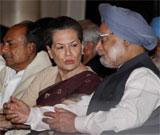
PM's new team gets down to work

October 29, 2012

pmteam

New Delhi, October 29: Prime Minister Manmohan Singh's new team got down to work Monday with new ministers taking charge and old ones relinquishing responsibilities after a mega revamp of the council of ministers that saw 15 new faces and many key ministries changing hands.

The major shake-up of the government Sunday, possibly the last before the 2014 general elections, saw Salman Khurshid taking over as India's new foreign minister, Pawan Kumar Bansal being made the new man to helm the railways ministry, M. Veerappa Moily being given petroleum and M.M. Pallam Raju being made human resource development minister.

S. Jaipal Reddy got science and technology and Kamal Nath got additional charge of parliamentary affairs besides urban development.

Amongst the ministers of state sworn in were Congress spokesperson Manish Tewari who got independent charge of information and broadcasting. Earlier with Ambika Soni, the ministry has been downgraded.

The exercise that sought to jettison perception of passivity in governance comes just ahead of two critical assembly elections in Himachal Pradesh and Gujarat.

"It is a combination of youth and experience," Manmohan Singh said Sunday after the ceremony at Rashtrapati Bhavan where President Pranab Mukherjee administered the oath of office.

"The road ahead is full of challenges," he said, expressing hope that this was the last such exercise before his UPA-II government heads for elections.

Congress general secretary Rahul Gandhi did not join the government - leaving the field open for him to play a larger role in the party.

Seventeen new faces were inducted Sunday of which two ministers were of cabinet rank.

Of the seven new ministers sworn in with cabinet rank, two are debutants -- former Rajya Sabha deputy chairperson K. Rahman Khan and Congress MP Chandresh Kumari Katoch. The other five - Ajay Maken, M.M. Pallam Raju, Dinsha Patel, Harish Rawat and Ashwini Kumar - have been elevated to cabinet rank.

Fifteen ministers of state were also sworn in.

Comments

Add new comment

  • Coastaldigest.com reserves the right to delete or block any comments.
  • Coastaldigset.com is not responsible for its readers’ comments.
  • Comments that are abusive, incendiary or irrelevant are strictly prohibited.
  • Please use a genuine email ID and provide your name to avoid reject.
News Networkwork
May 14,2020

Bengaluru, May 14: ABB India has posted a profit after tax of Rs 66 crore during the first quarter (January to March) due to lower volumes including service revenue and unfavourable mix.

In Q1 CY19, it had reported a profit after tax of Rs 89 crore. ABB India follows calendar year as its fiscal year.

The company reported a profit including exceptional items and before tax of Rs 87 crore. The resultant under-absorption and mark-to-market impact due to forex volatility were partly offset by refund incomes and a one-time gain on sale of solar business during the quarter.

Revenues for the first quarter stood at Rs 1,522 crore, impacted by lower sales, non-receipt of delivery clearance, lower service revenue in the nationwide lockdown due to the COVID-19 pandemic. This impact primarily occurred in March, the company said in a statement.

ABB India said it continues to maintain a stable cash position of Rs 1,464 crore as on March 31 in a market where cash collection continues to be a challenge.

Besides, despite many activities coming to a standstill in March, the quarter was marked by commissioning for a mining major at Raigarh in Chhattisgarh, electrical and automation systems for a cement major and port and electrics, drives and automation for a leading mill in Bangladesh.

Terminal installation and commissioning for LPG, power management electrical control system for a leading refinery and commissioning of two units of a power plant in Kerala are some of the other projects where ABB's involvement ensured continuity and safe operations, it said.

On a global scale, the impact of COVID-19, as well as the fall in oil prices, has significantly impacted the short-term outlook. The global economy is expected to contract in 2020 after a rapid deterioration in outlook driven by the pandemic.

Despite unprecedented stimuli by governments and central banks around the world and initial signs of recovering economic activity in China, macro-indicators point to a global recession of uncertain duration as many countries continue to face restrictions with anticipated long-term economic consequences, said ABB India.

While the company is taking prompt action to adapt its operations and cost base to safeguard profitability, it expects the results in the coming quarter to be impacted due to the loss of volumes.

Comments

Add new comment

  • Coastaldigest.com reserves the right to delete or block any comments.
  • Coastaldigset.com is not responsible for its readers’ comments.
  • Comments that are abusive, incendiary or irrelevant are strictly prohibited.
  • Please use a genuine email ID and provide your name to avoid reject.
News Network
April 19,2020

New Delhi, Apr 19: The government on Sunday prohibited the sale of non-essential items through e-commerce platforms during the ongoing lockdown, four days after allowing such companies to sale mobile phones, refrigerators and ready-made garments.

Union Home Secretary Ajay Bhalla issued an order excluding the non-essential items from sale by the e-commerce companies from the consolidated revised guidelines, which listed the exemption given to the services and people from the purview of the lockdown.

The order said the following clause "E-commerce companies. Vehicles used by e-commerce operators will be allowed to ply with necessary permissions" is excluded from the guidelines.

The previous order had said such items were allowed for sale through e-commerce platforms from April 20.

However, the reason for reversing the order is not known immediately.

Comments

Add new comment

  • Coastaldigest.com reserves the right to delete or block any comments.
  • Coastaldigset.com is not responsible for its readers’ comments.
  • Comments that are abusive, incendiary or irrelevant are strictly prohibited.
  • Please use a genuine email ID and provide your name to avoid reject.
News Network
January 6,2020

Jan 6: India’s Finance Ministry has delivered a challenge to its revenue collectors: meet tax targets despite $20 billion of corporate tax cuts.

Through a video conference on Dec. 16, officials were exhorted to meet the direct tax mop-up target of 13.4 trillion rupees ($187 billion), a government official told reporters. Collection in the eight months to November grew at 5% from a year earlier, against the desired 17%.

The missive shows Prime Minister Narendra Modi’s urgent need to buoy public finances in a slowing economy where April-November tax collections were half the amount budgeted. Authorities withheld some payments to states and have capped ministries’ expenditure as the fiscal deficit ballooned beyond the target.

The government’s efforts to maintain its deficit goal goes against advice from some quarters, including central bank Governor Shaktikanta Das, who urged more spending to spur economic growth.

It’s uncertain though how much room Modi’s administration has to boost expenditure, given that it may already be borrowing as much as 540 billion rupees through state-run companies, a figure that isn’t reflected on the federal balance sheet. Uncertainty about public finances pushed up sovereign yields in November and December, compelling Das to announce unconventional policies to keep costs in check.

“This is not a time to conceal the fiscal deficit by off-budget borrowing or deferring payments,” said Indira Rajaraman, an economist and a former member of the Reserve Bank of India’s board. “If they were to stick to the target, that would be catastrophic because there is so much pump-priming that is needed right now.”

GDP grew 4.5% in the quarter ended September, the slowest pace in more than six years as both consumption and investments cooled in Asia’s third-largest economy. Only government spending supported the expansion, piling pressure on Modi to keep stimulating.

S&P Global Ratings warned in December it may downgrade India’s sovereign ratings if economic growth doesn’t recover. Government support seems to be waning now, with ministries asked to cap spending in the final quarter of the financial year at 25% of the amount budgeted rather than 33% allowed earlier. This new rule will hamstring sectors including agriculture, aviation and coal, where not even half of annual targets have been disbursed.

As the federal government runs short of money, it’s been delaying payouts to state administrations.

Private hospitals have threatened to suspend cash-less services to government employees over non-payment of dues, while a builder informed the stock exchange about delayed rental payments from no less than the tax office itself.

India is considering a litigation-settlement plan that will allow companies to exit lingering tax disputes by paying a portion of the money demanded by the government, the Economic Times newspaper reported Saturday.

The move will help improve the ease of doing business besides unlocking a part of the almost 8 trillion rupees ($111 billion) caught up in these disputes. The step, which is being considered as part of the annual budget, could also bridge India’s fiscal gap.

Finance Minister Nirmala Sitharaman has refused to comment on the deficit goal before the official budget presentation due Feb. 1.

A deviation from target, if any, “will need to be balanced with a credible consolidation plan further-out,” said Radhika Rao, an economist at DBS Group Holdings Ltd. in Singapore.

Comments

Add new comment

  • Coastaldigest.com reserves the right to delete or block any comments.
  • Coastaldigset.com is not responsible for its readers’ comments.
  • Comments that are abusive, incendiary or irrelevant are strictly prohibited.
  • Please use a genuine email ID and provide your name to avoid reject.