


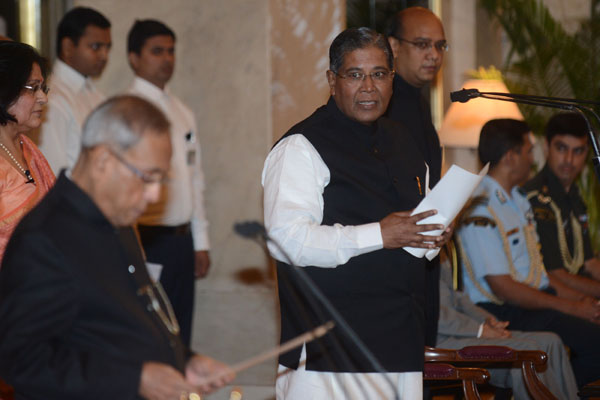
Khan favours reservation for backward Muslims

October 30, 2012
Minister_K_Rahman_Khan

New Delhi, October 30: New Minority Affairs Minister K Rahman Khan strongly favours reservation for backward Muslims as well as for Dalits among Christians and Muslims notwithstanding the Supreme Court's observation on the sub- quota issue.

The minister also intends to carry forward reforms in the administration of Wakfs across the country and bring a revised bill for this in the Winter Session of Parliament.

Khan, who took charge of the ministry yesterday, told PTI that though reservation is "not a panacea", it is a "right" for people who are backward or discriminated.

Unfazed by the adverse court judgements on 4.5 per cent sub-quota for Muslims, Khan is confident that the orders merely reflect some "technical lapses" on part of Government and does not amount to rejection of the sub-quota as such.

On the issue of minority sub quota rejected by the Andhra Pradesh High Court, Khan said, "That is the misunderstanding. The court has not rejected the quota. The court has only said that the procedure adopted to ascertain backwardness is not satisfactory."

Pointing out that reservation for minorities exist in Karnataka and Kerala, he said that reservation for minorities in Karnataka was based on the extensive surveys done to ascertain backwardness of Muslims.

"I feel that there was some technical lapses, which have been pointed out ìn the Supreme Court and the Andhra Pradesh High Court judgements (on 4.5 percent sub quota). My ministry will study in detail the judgements. What are the technical reasons on which the Supreme Court questioned the order?

"We will try to address those issues and come out with a response.....Lack of sufficient data as to explain the socio-economic backwardness of the country has led to the Court coming to the conclusion that it is a political move," Khan said.

Congress had promised to carve out a separate sub-quota for Muslims from the 27 OBC reservation quota, an order which did not find favour by the courts.

Khan stressed that the rejection of the sub quota by Supreme Court and the High Court was on "technical grounds".

"They have not said it was unconstitutional. The method adopted may be technically wrong. My ministry will try to set right the technical grounds on which it has been struck down," Khan said.

He, however, refrained from commenting on whether his ministry will make a fresh appeal in the Supreme Court on the issue, saying that he will take a decision after examining the matter in detail.

The Supreme Court has refused to stay the Andhra Pradesh High Court order quashing the December 2011 Office Memorandum (OM) of the government on the sub-quota.

The apex court also said that OM on the sub-quota issue did not have legislative support.

The SC bench had also questioned the calculation of providing sub-quota, wanted to know whether there was any constitutional and statutory support for granting 4.5 per cent sub-quota.

Besides, it had questioned the government for not consulting statutory bodies like the National Commission for Minorities (NCM) and the National Commission for Backward Classes (NCBC) in determining the sub-quota.

Replying to questions about efficacy of reservation as a tool to address discrimination, Khan said though he believes that "reservation is not a panacea" that will solve all problems plaguing a community, he believes "reservation is a right".

"If any section of the society remains backward or is discriminated, the Constitution has given the government the right under Articles 15 (4) and Articles 16 (4) under the Constitution to set right this discrimination or the unequal treatment.

"Once the government is convinced that a particular section has been discriminated or did not get equal opportunity, then that has to be set right through these Articles," he reasoned.

Stressing that reservation is a "Constitutional right," Khan said, "It cannot be ruled out because once you have taken this route to set right discrimination faced by one section of the society then the other will also demand it."

On the vexatious issue of providing reservation to Dalit Christians and Dalit Muslims, he made it clear that he will work to see that this is done.

Noting that Dalits among Hindus converted to Buddhism, Sikhism, Islam and Christianity, he pointed out that benefits of reservation for the Schedules Castes were extended to converts among the first two religious groups in 1950 through a government order as it was felt their socio-economic conditions did not change after conversion.

"So probity and equality demand that there should not be any discrimination. If few people converted to a particular religion, they get benefits and others who convert to some other religions should not get. That is what has been challenged in the Supreme Court. It is a Constitutional right of those who have gone to the court," Khan said.

To a question on whether he will support the demand, the Union Minister said, "I will definitely....I will definitely look towards it".

He was, however, quick to add "the matter is before the Supreme Court.

"The government has left it to the court to decide...so let us wait for the Supreme Court order," he said when asked about allegations that the government was not keen on providing reservation to Dalit Christians and Dalit Muslims.

On the contentious issue of Wakf reforms, Khan said his priority would be to bring the revised bill to strengthen the management of Wakf boards across the country in the Winter Session starting from November 21.

"The select committee has submitted its recommendations. The new bill has to be there. I will try my best to pass the Wakf bill in the coming session of Parliament. That is my first priority," Khan said.

Khan said that it is necessary that the Muslim community invests in infrastructure development for education and "Wakf is an area, where resources are available".

The Minority Affairs Minister said that a scientific study has not been done to identify schemes required for development of minorities.

"As the Deputy Chairman of Rajya Sabha also, I had spoken in Parliament about schemes not reaching people. Government is sincere about implementing schemes but there is some difficulty. All the schemes are implemented by the state government. If the state government fails, the blame comes on us that we have failed definitely. I am aware of the problems why it is not happening.

"I will try to see that schemes reach people and review if they are really helping people," Khan said, adding more stress should be given to develop infrastructure of education for minorities and for this, the community must come forward and invest.

"Motivating the community for this is a priority for me," he said, adding that even the Sachar Commission, which went into the issue of the backwardness of minorities, had suggested this.

"Whatever assurance my party has given to minorities in its election manifesto, I would like to implement them...in letter and spirit," he said, adding there is a need for a "scientific study" to find out what exactly is required to be done regarding the schemes for uplift of minorities.


Comments

Add new comment

  • Coastaldigest.com reserves the right to delete or block any comments.
  • Coastaldigset.com is not responsible for its readers’ comments.
  • Comments that are abusive, incendiary or irrelevant are strictly prohibited.
  • Please use a genuine email ID and provide your name to avoid reject.
News Network
January 9,2020

Dubai, Jan 9: A roadshow promoting Gujarat as an education hub of India will be held here from January 17, officials said.

Representatives of 22 universities and four colleges from Gujarat will be part of the two-day event organised by the Indian Consulate in Dubai.

"The roadshow will provide a glimpse of the thriving education sector in Gujarat and enable the interested candidates to get a first-hand understanding of the rich resources of the state in order to pursue higher education," according to a statement released by the Indian Consulate here on Wednesday.

A delegation led by Gujarat's Education Minister Bhupendrasinh Chudasama will take part in the event under the 'Study in Gujarat' campaign, the statement said.

The Principal Secretary of the state's Higher and Technical Education, Anju Sharma, will participate in the roadshow, which will conclude on January 18.

The participating educational institutions include Pandit Deendayal Petroleum University, Gujarat Forensic Science University, Nirma University, LD College of Engineering, Gujarat Arts and Science College, Vishwakarma Government College and SAL College.

"In the last decade and a half, Gujarat has been successful in establishing its identity as the leading educational hub of India. State of the art infrastructure, safe environment, curriculum at par with international standards and industry exposure gives students an edge during the course of their study," the statement said.

Comments

Add new comment

  • Coastaldigest.com reserves the right to delete or block any comments.
  • Coastaldigset.com is not responsible for its readers’ comments.
  • Comments that are abusive, incendiary or irrelevant are strictly prohibited.
  • Please use a genuine email ID and provide your name to avoid reject.
Agencies
July 6,2020

New Delhi, Jul 6: The Indian Academy of Sciences, a Bengaluru-based body of scientists, has said the Indian Council for Medical Research's (ICMR) target to launch a coronavirus vaccine by August 15 is "unfeasible" and "unrealistic".

The IASc said while there is an unquestioned urgent need, vaccine development for use in humans requires scientifically executed clinical trials in a phased manner.

While administrative approvals can be expedited, the "scientific processes of experimentation and data collection have a natural time span that cannot be hastened without compromising standards of scientific rigour", the IASc said in a statement.

In its statement, the IASc referred to the ICMR's letter which states that "it is envisaged to launch the vaccine for public health use latest by 15th August 2020 after completion of all clinical trials".

The ICMR and Bharat Biotech India Limited, a private pharmaceutical company, are jointly developing the vaccine against the novel coronavirus -- SARS-CoV-2.

The IASc welcomes the exciting development of a candidate vaccine and wishes that the vaccine is quickly made available for public use, the statement said.

"However, as a body of scientists including many who are engaged in vaccine development IASc strongly believes that the announced timeline is unfeasible. This timeline has raised unrealistic hope and expectations in the minds of our citizens," it said.

Aiming to launch an indigenous COVID-19 vaccine by August 15, the ICMR had written to select medical institutions and hospitals to fast-track clinical trial approvals for the vaccine candidate, COVAXIN.

Experts have also cautioned against rushing the process for developing a COVID-19 vaccine and stressed that it is not in accordance with the globally accepted norms to fast-track vaccine development for diseases of pandemic potential.

The IASc said trials for a vaccine involve evaluation of safety (Phase 1 trial), efficacy and side effects at different dose levels (Phase 2 trial), and confirmation of safety and efficacy in thousands of healthy people (Phase 3 trial) before its release for public use.

Clinical trials for a candidate vaccine require participation of healthy human volunteers. Therefore, many ethical and regulatory approvals need to be obtained prior to the initiation of the trials, it added.

The IASc said the immune responses usually take several weeks to develop and relevant data should not be collected earlier.

"Moreover, data collected in one phase must be adequately analysed before the next phase can be initiated. If the data of any phase are unacceptable then the clinical trial is required to be immediately aborted," it said.

For example, if the data collected from Phase 1 of the clinical trial show that the vaccine is not adequately safe, then Phase 2 cannot be initiated and the candidate vaccine must be discarded.

For these reasons, the Indian Academy of Sciences believes that the announced timeline is "unreasonable and without precedent", the statement said.

"The Academy strongly believes that any hasty solution that may compromise rigorous scientific processes and standards will likely have long-term adverse impacts of unforeseen magnitude on citizens of India," it said.

Comments

Add new comment

  • Coastaldigest.com reserves the right to delete or block any comments.
  • Coastaldigset.com is not responsible for its readers’ comments.
  • Comments that are abusive, incendiary or irrelevant are strictly prohibited.
  • Please use a genuine email ID and provide your name to avoid reject.
Agencies
January 22,2020

Kochi, Jan 22: The Left front government in Kerala on Monday decided to inform the Centre it would not cooperate with the updation of the NPR, saying there were fears among the public about the process and it has the "Constitutional responsibility" to alleviate them and ensure law and order.

A special cabinet meeting, chaired by Chief Minister Pinarayi Vijayan here, decided to inform the Registrar General and Census Commissioner under the Union Home Ministry that it was unable to cooperate with anything with regard to the updation of the NPR.

"The decision was taken as it was the Constitutional responsibility of the government to alleviate the fears of general public and ensure law and order situation in the state," a Chief Minister's Office release said.

However, the state would fully cooperate with the census procedures, it said.

The LDF government, which has been on a warpath against the Centre over the Citizenship Amendment Act, has last month stayed all activities related to updation of NPR, considering 'apprehensions' of public that it would lead to NRC in the wake of the controversial CAA.

"As the NPR is a process that leads to the National Register of Citizens (NRC), there is a sense of fear among the people that its implementation could lead to widespread insecurity", the CMO release said on Monday.

The experience of the state which had already compiled the NRC was an example for this, it added, in apparent reference to Assam.

Kerala had already stopped all procedures regarding the NPR updation, the release said adding there was also a report of the state police that the if the government went ahead with the procedures, it would adversely impact the law and order situation.

The district collectors have also informed the government that the Census procedures would be affected if the updation of the NPR was done along with it, the CMO release said.

The CPI(M)-led LDF government had recently convened a meeting of political parties and socio-religious organisations here on December 29 in the wake of the concerns among people in various stratas of the society, it said.

A special assembly session was convened and a resolution was passed requesting the Centre not to implement the CAA and the government had also approached the apex court against the law, it added.

Comments

Add new comment

  • Coastaldigest.com reserves the right to delete or block any comments.
  • Coastaldigset.com is not responsible for its readers’ comments.
  • Comments that are abusive, incendiary or irrelevant are strictly prohibited.
  • Please use a genuine email ID and provide your name to avoid reject.