


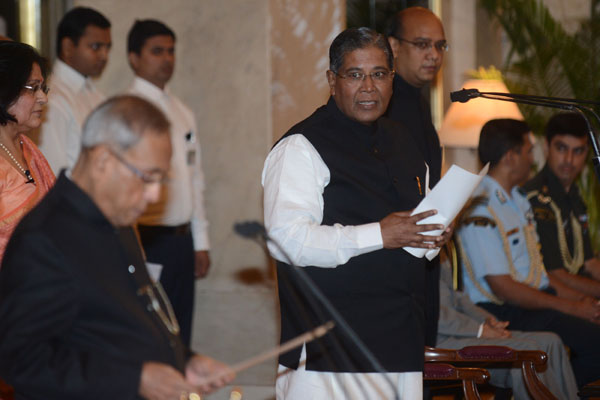
Khan favours reservation for backward Muslims

October 30, 2012
Minister_K_Rahman_Khan

New Delhi, October 30: New Minority Affairs Minister K Rahman Khan strongly favours reservation for backward Muslims as well as for Dalits among Christians and Muslims notwithstanding the Supreme Court's observation on the sub- quota issue.

The minister also intends to carry forward reforms in the administration of Wakfs across the country and bring a revised bill for this in the Winter Session of Parliament.

Khan, who took charge of the ministry yesterday, told PTI that though reservation is "not a panacea", it is a "right" for people who are backward or discriminated.

Unfazed by the adverse court judgements on 4.5 per cent sub-quota for Muslims, Khan is confident that the orders merely reflect some "technical lapses" on part of Government and does not amount to rejection of the sub-quota as such.

On the issue of minority sub quota rejected by the Andhra Pradesh High Court, Khan said, "That is the misunderstanding. The court has not rejected the quota. The court has only said that the procedure adopted to ascertain backwardness is not satisfactory."

Pointing out that reservation for minorities exist in Karnataka and Kerala, he said that reservation for minorities in Karnataka was based on the extensive surveys done to ascertain backwardness of Muslims.

"I feel that there was some technical lapses, which have been pointed out ìn the Supreme Court and the Andhra Pradesh High Court judgements (on 4.5 percent sub quota). My ministry will study in detail the judgements. What are the technical reasons on which the Supreme Court questioned the order?

"We will try to address those issues and come out with a response.....Lack of sufficient data as to explain the socio-economic backwardness of the country has led to the Court coming to the conclusion that it is a political move," Khan said.

Congress had promised to carve out a separate sub-quota for Muslims from the 27 OBC reservation quota, an order which did not find favour by the courts.

Khan stressed that the rejection of the sub quota by Supreme Court and the High Court was on "technical grounds".

"They have not said it was unconstitutional. The method adopted may be technically wrong. My ministry will try to set right the technical grounds on which it has been struck down," Khan said.

He, however, refrained from commenting on whether his ministry will make a fresh appeal in the Supreme Court on the issue, saying that he will take a decision after examining the matter in detail.

The Supreme Court has refused to stay the Andhra Pradesh High Court order quashing the December 2011 Office Memorandum (OM) of the government on the sub-quota.

The apex court also said that OM on the sub-quota issue did not have legislative support.

The SC bench had also questioned the calculation of providing sub-quota, wanted to know whether there was any constitutional and statutory support for granting 4.5 per cent sub-quota.

Besides, it had questioned the government for not consulting statutory bodies like the National Commission for Minorities (NCM) and the National Commission for Backward Classes (NCBC) in determining the sub-quota.

Replying to questions about efficacy of reservation as a tool to address discrimination, Khan said though he believes that "reservation is not a panacea" that will solve all problems plaguing a community, he believes "reservation is a right".

"If any section of the society remains backward or is discriminated, the Constitution has given the government the right under Articles 15 (4) and Articles 16 (4) under the Constitution to set right this discrimination or the unequal treatment.

"Once the government is convinced that a particular section has been discriminated or did not get equal opportunity, then that has to be set right through these Articles," he reasoned.

Stressing that reservation is a "Constitutional right," Khan said, "It cannot be ruled out because once you have taken this route to set right discrimination faced by one section of the society then the other will also demand it."

On the vexatious issue of providing reservation to Dalit Christians and Dalit Muslims, he made it clear that he will work to see that this is done.

Noting that Dalits among Hindus converted to Buddhism, Sikhism, Islam and Christianity, he pointed out that benefits of reservation for the Schedules Castes were extended to converts among the first two religious groups in 1950 through a government order as it was felt their socio-economic conditions did not change after conversion.

"So probity and equality demand that there should not be any discrimination. If few people converted to a particular religion, they get benefits and others who convert to some other religions should not get. That is what has been challenged in the Supreme Court. It is a Constitutional right of those who have gone to the court," Khan said.

To a question on whether he will support the demand, the Union Minister said, "I will definitely....I will definitely look towards it".

He was, however, quick to add "the matter is before the Supreme Court.

"The government has left it to the court to decide...so let us wait for the Supreme Court order," he said when asked about allegations that the government was not keen on providing reservation to Dalit Christians and Dalit Muslims.

On the contentious issue of Wakf reforms, Khan said his priority would be to bring the revised bill to strengthen the management of Wakf boards across the country in the Winter Session starting from November 21.

"The select committee has submitted its recommendations. The new bill has to be there. I will try my best to pass the Wakf bill in the coming session of Parliament. That is my first priority," Khan said.

Khan said that it is necessary that the Muslim community invests in infrastructure development for education and "Wakf is an area, where resources are available".

The Minority Affairs Minister said that a scientific study has not been done to identify schemes required for development of minorities.

"As the Deputy Chairman of Rajya Sabha also, I had spoken in Parliament about schemes not reaching people. Government is sincere about implementing schemes but there is some difficulty. All the schemes are implemented by the state government. If the state government fails, the blame comes on us that we have failed definitely. I am aware of the problems why it is not happening.

"I will try to see that schemes reach people and review if they are really helping people," Khan said, adding more stress should be given to develop infrastructure of education for minorities and for this, the community must come forward and invest.

"Motivating the community for this is a priority for me," he said, adding that even the Sachar Commission, which went into the issue of the backwardness of minorities, had suggested this.

"Whatever assurance my party has given to minorities in its election manifesto, I would like to implement them...in letter and spirit," he said, adding there is a need for a "scientific study" to find out what exactly is required to be done regarding the schemes for uplift of minorities.


Comments

Add new comment

  • Coastaldigest.com reserves the right to delete or block any comments.
  • Coastaldigset.com is not responsible for its readers’ comments.
  • Comments that are abusive, incendiary or irrelevant are strictly prohibited.
  • Please use a genuine email ID and provide your name to avoid reject.
News Network
April 2,2020

New Delhi, Apr 2: With 437 new cases reported in the last 24 hours, the tally of COVID-19 positive cases in India shot up to 1,834 on Wednesday night.

The number of deaths in the country due to COVID-19 has risen to 41.

The total number of active cases in the country is 1,649. 143 persons have been cured and discharged from the hospitals. One person has migrated, according to the data provided by the Ministry of Health and Family Welfare.

Earlier on Wednesday, Union Home Secretary Ajay Bhalla urged all state governments and Union Territory administrations to ensure the lockdown measures issued by the Ministry of Home Affairs are strictly implemented.

"All the state governments/UT administrations are requested to strictly implement the lockdown measures issued by MHA in the exercise of the powers under Disaster Management Act, 2005 in letter and spirit," Bhalla said.

Prime Minister Modi had earlier announced a 21-day lockdown in the entire country to deal with the spread of coronavirus, saying that "social distancing" is the only option to deal with the disease, which spreads rapidly.

Comments

Add new comment

  • Coastaldigest.com reserves the right to delete or block any comments.
  • Coastaldigset.com is not responsible for its readers’ comments.
  • Comments that are abusive, incendiary or irrelevant are strictly prohibited.
  • Please use a genuine email ID and provide your name to avoid reject.
News Network
July 10,2020

New Delhi, Jul 10: Nepal has banned all Indian news channels, except DD News, for alleged propaganda against the country.

Reports say that Nepal cable operators have stopped getting signals of Indian news channels.

Nepal government spokesperson Yuvaraj Khatiwada said: "We request all not to disseminate news that infringes sovereignty and self-respect of Nepalis. This includes the media of neighbouring countries. We might seek both political and legal remedies."

Earlier, Nepal has amended its map which show some Indian territory as part of it.

Nepal's parliament on June 13 adopted unanimously the Constitution Amendment Bill, paving the way for accommodating the updated political-administrative map, which includes Indian areas of Kalapani, Lipulekh and Limpiyadhura, in its symbol.

Comments

Add new comment

  • Coastaldigest.com reserves the right to delete or block any comments.
  • Coastaldigset.com is not responsible for its readers’ comments.
  • Comments that are abusive, incendiary or irrelevant are strictly prohibited.
  • Please use a genuine email ID and provide your name to avoid reject.
Agencies
March 1,2020

Kolkata, Mar 1: The Calcutta High Court has ruled that it is not mandatory for foreigners to produce a valid passport and its particulars for processing of application for grant of Indian citizenship if he is able to satisfy the appropriate authorities the reasons for non-availability of the document.

Justice Sabysachi Bhattacharya passed the order while disposing off a petition by granting the petitioner liberty to file an application before the authority "as contemplated in Rule 11 of the Citizenship Rules 2009, upon furnishing explanation as to the non-availability of the passport".

Bismillah Khan had filed the petition saying he was being denied the citizenship of India because of his inability to file an application under Section 5 (1) (c) of the Citizenship Act, 1955, apparently due to the mandatory requirement of furnishing a copy of the passport for such application.

The petitioner's counsel submitted that Khan was a Pakhtoon citizen and due to political turmoil in the said state, which subsequently merged partially into Afghanistan and partially into Pakistan, he, as a five-year old, had to migrate to India with his father in 1973.

Under such circumstances, the petitioner could not have any opportunity of having a valid passport, since they were refugees under distress, the counsel said.

The petitioner had previously approached a coordinate Bench of the court, wherein a single judge, passed an order on July 25, 2018, directing him to comply with the formalities required, as communicated by the secretary to the Government of India to the Secretary to the Government of West Bengal (Home), vide a letter dated December 7, 2017.

The court had then also given liberty to the petitioner to apply afresh before the appropriate authority under Section 5(1)(c) of the 1955 Act, having complied with all the formalities.

The petitioner then moved Bhattacharya's court submitting that a complete application as directed by the Coordinate Bench cannot be possibly filed by his client due to the mandatory requirement of uploading a copy of his passport, which the petitioner does not have due to reasons beyond his control.

The counsel said Khan is married to an Indian citizen, has a daughter and living in India for close to half a century.

The counsel for the union of India submitted that in view of no application having been filed by the petitioner, there is no scope of granting such proposed application at the present juncture for the Union.

The counsel argued that it is mandatory to file an application in Form III for the application of the petitioner under Section 5(1)(c) of the Act to be considered at all.

In view of the petitioner not complying with the mandatory requirement of submitting a copy of his passport, the state government cannot, under the law, forward such application to the union government.

After hearing all sides, Justice Bhattacharya said although the rule "contemplates that an application shall not be entertained unless the application is made in Form III, such provision ipso facto does not make the availability of a passport a mandatory requirement".

"..the Form given with the Rules or the Rules themselves cannot override the provision of the statute itself, under which the said Rules are framed, which does not stipulate such a mandate on the applicants for citizenship under Section 5 (1)(c) of the 1955 Act mandatorily to carry a passport".

The court said although such provision is included in the Form, which has to be complied with by the applicant, "it is nowhere indicated in such Form that all the relevant particulars, including the particulars regarding passport of the petitioner have to be furnished mandatorily, along with a copy of a valid foreign passport, even in the event the petitioner, for valid reasons, is not in a position to produce such passport".

Justice Bhattacharya ruled that under such circumstances, it cannot be held that the provision of producing a passport and its particulars is mandatory in nature and there has to be a relaxation in such requirement "in case the petitioner is able to satisfy the appropriate authorities the reasons for non- availability of such passport".

"Unless such a leeway is given to the applicants, genuine persons who otherwise have all the formal documents indicating that they have been residing in India for a long time and have married a resident of India would also be unable to apply for Indian Citizenship despite having lived their entire lives and contributed to the economy and diverse culture of this country."

He said such a scenario would be contradictory to the spirit of Article 14 of the Constitution of India.

"In such view of the matter, the requirement of having a passport has to be read as optional in Form III of the Citizenship Rules, 2009 and the authorities are deemed to have the power to relax such 6 requirement in the event the applicant satisfied the authorities for genuine reasons why the applicant is not in a position to produce such passport," the February 24 order said.

The court ruled that despite the provision of making applications online, a provision has to be made for persons who do not have all the particulars of their passport, which is read as optional, to file applications manually, which are to be treated as valid applications under Rule 5 of the Citizenship Rules, 2009.

The court also ordered that alternatively the necessary software be amended so that the online applications can be presented with or without passports, in the latter case furnishing detailed reasons as to non-furnishing of passports.

"Sanctioning of such forms, however, will be conditional upon the satisfaction of the relevant authorities about the reasons for the applicant not being able to produce her/his passport," the order said.

Comments

Add new comment

  • Coastaldigest.com reserves the right to delete or block any comments.
  • Coastaldigset.com is not responsible for its readers’ comments.
  • Comments that are abusive, incendiary or irrelevant are strictly prohibited.
  • Please use a genuine email ID and provide your name to avoid reject.