


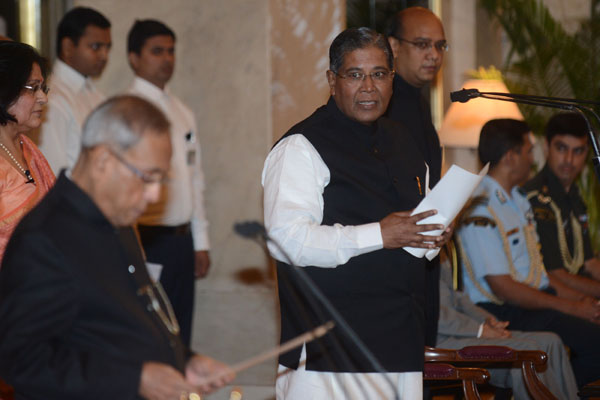
Khan favours reservation for backward Muslims

October 30, 2012
Minister_K_Rahman_Khan

New Delhi, October 30: New Minority Affairs Minister K Rahman Khan strongly favours reservation for backward Muslims as well as for Dalits among Christians and Muslims notwithstanding the Supreme Court's observation on the sub- quota issue.

The minister also intends to carry forward reforms in the administration of Wakfs across the country and bring a revised bill for this in the Winter Session of Parliament.

Khan, who took charge of the ministry yesterday, told PTI that though reservation is "not a panacea", it is a "right" for people who are backward or discriminated.

Unfazed by the adverse court judgements on 4.5 per cent sub-quota for Muslims, Khan is confident that the orders merely reflect some "technical lapses" on part of Government and does not amount to rejection of the sub-quota as such.

On the issue of minority sub quota rejected by the Andhra Pradesh High Court, Khan said, "That is the misunderstanding. The court has not rejected the quota. The court has only said that the procedure adopted to ascertain backwardness is not satisfactory."

Pointing out that reservation for minorities exist in Karnataka and Kerala, he said that reservation for minorities in Karnataka was based on the extensive surveys done to ascertain backwardness of Muslims.

"I feel that there was some technical lapses, which have been pointed out ìn the Supreme Court and the Andhra Pradesh High Court judgements (on 4.5 percent sub quota). My ministry will study in detail the judgements. What are the technical reasons on which the Supreme Court questioned the order?

"We will try to address those issues and come out with a response.....Lack of sufficient data as to explain the socio-economic backwardness of the country has led to the Court coming to the conclusion that it is a political move," Khan said.

Congress had promised to carve out a separate sub-quota for Muslims from the 27 OBC reservation quota, an order which did not find favour by the courts.

Khan stressed that the rejection of the sub quota by Supreme Court and the High Court was on "technical grounds".

"They have not said it was unconstitutional. The method adopted may be technically wrong. My ministry will try to set right the technical grounds on which it has been struck down," Khan said.

He, however, refrained from commenting on whether his ministry will make a fresh appeal in the Supreme Court on the issue, saying that he will take a decision after examining the matter in detail.

The Supreme Court has refused to stay the Andhra Pradesh High Court order quashing the December 2011 Office Memorandum (OM) of the government on the sub-quota.

The apex court also said that OM on the sub-quota issue did not have legislative support.

The SC bench had also questioned the calculation of providing sub-quota, wanted to know whether there was any constitutional and statutory support for granting 4.5 per cent sub-quota.

Besides, it had questioned the government for not consulting statutory bodies like the National Commission for Minorities (NCM) and the National Commission for Backward Classes (NCBC) in determining the sub-quota.

Replying to questions about efficacy of reservation as a tool to address discrimination, Khan said though he believes that "reservation is not a panacea" that will solve all problems plaguing a community, he believes "reservation is a right".

"If any section of the society remains backward or is discriminated, the Constitution has given the government the right under Articles 15 (4) and Articles 16 (4) under the Constitution to set right this discrimination or the unequal treatment.

"Once the government is convinced that a particular section has been discriminated or did not get equal opportunity, then that has to be set right through these Articles," he reasoned.

Stressing that reservation is a "Constitutional right," Khan said, "It cannot be ruled out because once you have taken this route to set right discrimination faced by one section of the society then the other will also demand it."

On the vexatious issue of providing reservation to Dalit Christians and Dalit Muslims, he made it clear that he will work to see that this is done.

Noting that Dalits among Hindus converted to Buddhism, Sikhism, Islam and Christianity, he pointed out that benefits of reservation for the Schedules Castes were extended to converts among the first two religious groups in 1950 through a government order as it was felt their socio-economic conditions did not change after conversion.

"So probity and equality demand that there should not be any discrimination. If few people converted to a particular religion, they get benefits and others who convert to some other religions should not get. That is what has been challenged in the Supreme Court. It is a Constitutional right of those who have gone to the court," Khan said.

To a question on whether he will support the demand, the Union Minister said, "I will definitely....I will definitely look towards it".

He was, however, quick to add "the matter is before the Supreme Court.

"The government has left it to the court to decide...so let us wait for the Supreme Court order," he said when asked about allegations that the government was not keen on providing reservation to Dalit Christians and Dalit Muslims.

On the contentious issue of Wakf reforms, Khan said his priority would be to bring the revised bill to strengthen the management of Wakf boards across the country in the Winter Session starting from November 21.

"The select committee has submitted its recommendations. The new bill has to be there. I will try my best to pass the Wakf bill in the coming session of Parliament. That is my first priority," Khan said.

Khan said that it is necessary that the Muslim community invests in infrastructure development for education and "Wakf is an area, where resources are available".

The Minority Affairs Minister said that a scientific study has not been done to identify schemes required for development of minorities.

"As the Deputy Chairman of Rajya Sabha also, I had spoken in Parliament about schemes not reaching people. Government is sincere about implementing schemes but there is some difficulty. All the schemes are implemented by the state government. If the state government fails, the blame comes on us that we have failed definitely. I am aware of the problems why it is not happening.

"I will try to see that schemes reach people and review if they are really helping people," Khan said, adding more stress should be given to develop infrastructure of education for minorities and for this, the community must come forward and invest.

"Motivating the community for this is a priority for me," he said, adding that even the Sachar Commission, which went into the issue of the backwardness of minorities, had suggested this.

"Whatever assurance my party has given to minorities in its election manifesto, I would like to implement them...in letter and spirit," he said, adding there is a need for a "scientific study" to find out what exactly is required to be done regarding the schemes for uplift of minorities.

Comments

Add new comment

  • Coastaldigest.com reserves the right to delete or block any comments.
  • Coastaldigset.com is not responsible for its readers’ comments.
  • Comments that are abusive, incendiary or irrelevant are strictly prohibited.
  • Please use a genuine email ID and provide your name to avoid reject.
Agencies
July 31,2020

New Delhi, Jul 31: With the highest single-day spike of 55,079 COVID-19 cases in the last 24 hours, India's coronavirus tally breached the 16 lakh mark on Friday, informed the Union Ministry of Health and Family Welfare.

With this latest spike, the total cases in the country stand at 16,38,871. Among these cases 5,45,318 are active. A total of 10,57,806 patients have been cured/discharged/migrated.

779 deaths due to COVID-19 have been reported in the country in the last 24 hours, taking the death toll to 35,747.

As per the Union Health Ministry, Maharashtra has a total of 1,48,454 active cases and recorded 14,729 deaths due to COVID-19.
Tamil Nadu has a total of 57,962 active cases and 3,838 deaths in the state.

Delhi has a total of 10,743 active cases and 3,936 deaths.

The Indian Council of Medical Research on Friday informed that a total number of COVID-19 samples tested up to 30th July is 1,88,32,970 including 6,42,588 samples tested yesterday.

Comments

Add new comment

  • Coastaldigest.com reserves the right to delete or block any comments.
  • Coastaldigset.com is not responsible for its readers’ comments.
  • Comments that are abusive, incendiary or irrelevant are strictly prohibited.
  • Please use a genuine email ID and provide your name to avoid reject.
News Network
April 7,2020

New Delhi, Apr 7: The death toll due to novel coronavirus rose to 114 and the number of cases in the country climbed to 4,421 on Tuesday, according to the Union Health Ministry.

While the number of active COVID-19 cases stood at 3,981, as many as 325 people were cured and discharged, and one had migrated, it stated. The total number of cases include 66 foreign nationals.

According to the ministry's data updated at 9 am, three new deaths were reported from Rajasthan, while Tripura recorded its first coronavirus case.

Maharashtra has reported the most coronavirus deaths at 45, followed by Gujarat at 12, Madhya Pradesh nine, Telangana and Delhi seven each, Punjab six and Tamil Nadu five fatalities.

Karnataka registered four deaths, while West Bengal, Uttar Pradesh, Andhra Pradesh and Rajasthan have recorded three fatalities each. Two deaths each have been reported from Jammu and Kashmir and Kerala. Bihar, Himachal Pradesh and Haryana have reported one fatality each, according to the health ministry data.

However, a PTI tally based on figures reported by states directly on Monday night showed at least 138 deaths across the country, while the confirmed cases reached 4,683. Of them, 359 have been cured and discharged.

There has been a lag in the Union Health Ministry figures, compared to the numbers announced by different states, which officials attribute to procedural delays in assigning the cases to individual states.

The highest number of confirmed cases are from Maharashtra at 748, followed by Tamil Nadu at 621 and Delhi with 523 cases. Kerala reported 327 COVID-19 cases, Telangana 321, Uttar Pradesh 305 and Rajasthan 288 cases. Andhra Pradesh reported 226 coronavirus cases.

Novel coronavirus cases have risen to 165 in Madhya Pradesh, 151 in Karnataka and 144 in Gujarat. Jammu and Kashmir has 109 cases, West Bengal has 91, Haryana 90 and Punjab 76 cases of the infection.

Thirty-two people were infected with the virus in Bihar while Uttarakhand has 31 patients and Assam 26. Odisha reported 21 coronavirus cases, Chandigarh 18, Ladakh 14 and Himachal Pradesh 13 cases.

Ten cases each have been reported from the Andaman and Nicobar Islands and Chhattisgarh. Goa has reported seven COVID-19 infections, followed by Puducherry with five cases. Jharkhand has reported four cases and Manipur two. Tripura, Mizoram and Arunachal Pradesh have reported one case of the infection each.

"State-wise distribution is subject to further verification and reconciliation," the ministry said on its website.

Comments

Add new comment

  • Coastaldigest.com reserves the right to delete or block any comments.
  • Coastaldigset.com is not responsible for its readers’ comments.
  • Comments that are abusive, incendiary or irrelevant are strictly prohibited.
  • Please use a genuine email ID and provide your name to avoid reject.
News Network
February 29,2020

New Delhi, Feb 29: India’s economy expanded at its slowest pace in more than six years in the last three months of 2019, with analysts predicting further deceleration as the global Covid 19 coronavirus outbreak stifles growth in Asia’s third-largest economy.

The gross domestic product (GDP) data released yesterday showed government spending, private investment and exports slowing down, while there is a slight upturn in consumer spending and improvement in rural demand lent support.

The quarterly figure of 4.7% growth matched the consensus in a Reuters poll of analysts but was below a revised - and greatly increased - 5.1% rate for the previous quarter.

The central bank has warned that downside risks to global growth have increased as a result of the coronavirus epidemic, the full effects of which are still unfolding.

Prime minister Narendra Modi’s government has taken several steps to bolster economic growth, including a privatisation push and increased state spending, after cutting corporate tax rates last September.

In its annual budget presented this month, the government estimated that annual economic growth in the financial year to March 31 would be 5%, its lowest for last 11 years.

Modi’s government is targeting a slight recovery in growth to 6% for 2020/21, still far below the level needed to generate jobs for millions of young Indians entering the labour market each month.

The annual GDP figure for the September quarter was ramped up from an earlier estimate of 4.5%, while the April-June reading was similarly lifted to 5.6% from 5%, data released by the Ministry of Statistics showed on Friday.

Capital Investment Drop

In the December quarter, private investment grew 5.9%, up from 5.6% in the previous quarter, while government spending rose by 11.8%, against 13.2% in the previous three months.

However, corporate capital investment contracted by 5.2% after a 4.1% decline in the previous quarter, indicating that interest rate cuts by the central bank have failed to encourage new investment. Manufacturing, meanwhile, contracted by 0.2%.

“It appears growth slowdown is not just cyclical but more entrenched with consumption secularly joining the slowdown bandwagon even as the investment story continues to languish,” said Madhavi Arora of Edelweiss Securities in Mumbai.

Many economists said that the government stimulus could take four to six quarters of time before lifting the economy and the impact of those efforts could be outweighed by the global fallout from the coronavirus epidemic that began in China.

“The coronavirus remains the critical risk as India depends on China for both demand and supply of inputs,” said Abheek Barua, chief economist at HDFC Bank.

Indian shares sank on Friday for a sixth session running, capping their worst week in more than a decade. The NSE Nifty 50 index shed 7.3% over the week, while the Sensex dropped 6.8%, the worst weekly declines since the 2008-09 financial crisis.

Separately, India’s infrastructure output rose 2.2% year on year in January, data showed on Friday.

A spike in inflation to a more than 5-1/2 year high of 7.59% in January is expected to make the RBI hold off from further cuts to interest rates for now, while keeping its monetary stance accommodative.

Comments

Add new comment

  • Coastaldigest.com reserves the right to delete or block any comments.
  • Coastaldigset.com is not responsible for its readers’ comments.
  • Comments that are abusive, incendiary or irrelevant are strictly prohibited.
  • Please use a genuine email ID and provide your name to avoid reject.