


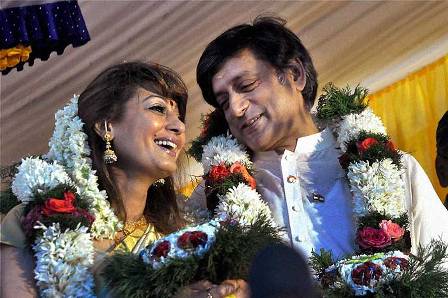
'My wife is worth more than your imaginary 50 crores', Tharoor tells Modi

October 30, 2012
shashi_tharoor_modi

New Delhi, October 30: When it comes to using social media tools like Facebook and Twitter to his advantage, very few can match newly-appointed Minister of State for Human Resources Development (HRD) Shashi Tharoor's battle skills.

Tharoor hit back at Gujarat Chief Minister Narendra Modi on Tuesday in his own inimitable style for calling his wife Sunanda Pushkar "a 50 crore girlfriend". Modi was alluding to the cricket controversy in 2010 involving Pushkar which led to Tharoor's resignation as Minister of State for External Affairs.

"My wife is worth a lot more than your imaginary 50 crores. She is priceless. But you need to be able to love someone to understand that," Tharoor tweeted to his 1.5 million followers on Twitter. It got retweeted over 800 times, sparking a Twitter clash between his and Modi's followers.

Admittedly, Tharoor's counter-attack was more sentimental compared to Modi's biting sarcasm on Monday while addressing a public rally as part of the campaign for the Himachal Pradesh Assembly elections. Though the BJP strongman didn't directly name either Tharoor or Pushkar, it was amply clear whom he was referring to.

"There was a Congress leader who was a minister in Parliament. He was accused of amassing wealth from cricket. He had said in Parliament that he is not connected to the Rs 50 crore in the lady's name. Have you ever heard of Rs 50 crore girlfriend?" Modi had said.

Modi did not stop at Tharoor. He mocked the Prime Minister, calling him 'Maun' Mohan Singh and took a jibe at Sonia Gandhi saying "she does not know how to run kitchen".

Tharoor is not new to Twitter controversies. He ran into trouble for a sarcastic response to a query that he would travel "cattle class out of solidarity with all our holy cows!" He had to later apologise for the comment.

But Modi didn't have it easy either. It was recently reported that nearly half of Modi's one million followers on Twitter are fake. An internet tool called 'Status People', created by a group of engineers in London, was used to track Modi's inactive users.


Comments

Add new comment

  • Coastaldigest.com reserves the right to delete or block any comments.
  • Coastaldigset.com is not responsible for its readers’ comments.
  • Comments that are abusive, incendiary or irrelevant are strictly prohibited.
  • Please use a genuine email ID and provide your name to avoid reject.
News Network
June 16,2020

New Delhi, Jun 16: Jet fuel or ATF price on Tuesday was hiked by 16.3 per cent while petrol price was increased by 47 paise per litre and that of diesel by a record 93 paise on the back of firming international oil rates.

Aviation turbine fuel (ATF) price was hiked by ₹5,494.5 per kilolitre (kl), or 16.3 per cent, to ₹39,069.87 per kl in the national capital, according to a price notification by state-owned oil marketing companies.

This is the second straight increase in ATF price this month. Rates were hiked by a record 56.5 per cent (₹12,126.75 per kl) on June 1.

Simultaneously, petrol and diesel prices were hiked for the 10th day in a row.

Petrol price in Delhi was hiked to ₹76.73 per litre from ₹76.26, while diesel rates were increased to ₹75.19 a litre from ₹74.26, the price notification said.

In 10 hikes, petrol price has gone up by ₹5.47 per litre and diesel by Rs 5.8 a litre.

Rates have been increased across the country and vary from state to state depending on the incidence of local sales tax or VAT.

The hike in diesel rates is the highest daily increase since the state-owned fuel retailers started daily revision in rates in May 2017.

Hike for 10th consecutive day

Tuesday’s increase in petrol and diesel price marks the 10th straight day of rise in rates since oil companies on June 7 restarted revising prices in line with costs, after ending an 82-day hiatus.

The freeze in rates was imposed in mid-March soon after the government hiked excise duty on petrol and diesel to shore up additional finances.

Oil PSUs Indian Oil Corp (IOC), Bharat Petroleum Corp Ltd (BPCL) and Hindustan Petroleum Corp Ltd (HPCL) instead of passing on the excise duty hikes to customers adjusted them against the fall in the retail rates that was warranted because of fall in international oil prices.

The June 1 hike in jet fuel price had come after seven consecutive reductions in rates since February. ATF price in Delhi before the reduction cycle began in February was ₹64,323.76 per kilolitre, which got reduced to ₹21,448.62 last month.

Industry officials said the hike was necessitated because benchmark international rates have bounced back from a two-decade low.

While ATF prices are revised on 1st and 16th of every month, petrol and diesel prices are revised on a daily basis.

Oil companies used to revise ATF prices on the first of every month, but adopted fortnightly revisions on March 21 to pass on the benefit of falling international oil prices to airlines.

Comments

Add new comment

  • Coastaldigest.com reserves the right to delete or block any comments.
  • Coastaldigset.com is not responsible for its readers’ comments.
  • Comments that are abusive, incendiary or irrelevant are strictly prohibited.
  • Please use a genuine email ID and provide your name to avoid reject.
Agencies
June 4,2020

New Delhi, Jun 4: CSIR Director-General Shekhar Mande said on Thursday that the World Health Organisation's (WHO) decision to halt hydroxychloroquine (HCQ) drug trial was taken in haste and the global body should have actually analysed the data before making the decision.

"I firmly believe that WHO decision was taken in haste it was a kind of knee jerk reaction they should have actually analyse the data on their own before temporarily suspend the trials that is my personal opinion," Mande said.

India's nodal government agency ICMR (Indian Council of Medical Research) overseeing the country's response to the coronavirus pandemic last month wrote to the WHO citing differences in dosage standards between Indian and international trials that could explain the efficacy issues of HCQ in treating COVID-19 patients.

In addition, Dr Sheela Godbole, National Coordinator of the WHO-India Solidarity Trial and Head of the Division of Epidemiology, ICMR-National AIDS Research Institute also wrote a letter via an email to Dr Soumya Swaminathan, Chief Scientist at World Health Organisation.

In a letter, Dr Godbole stated: "There was no reason to suspend the trial for safety concern," attributing it to the current RECOVERY data which differs significantly from the non-randomised assessment by Mehra et al, a scientific paper.

Referring to the letter, the CSIR head said, "We don't know what actually happened behind the scenes but the hypothesis is that because of the paper published in Lancet. It is a very well known journal and if Lancet has done due vigilance in publishing the paper. 

Therefore, the WHO thought the paper's findings are right that's why WHO hold based on what is published on Lancet. The WHO shouldn't have accepted it immediately this should have taken their own due vigilance to find out that study is right or not."

DG CSIR said because there is a global outcry it must have put pressure on both Lancet as well as WHO and both of them now retracted from their original position. "WHO has started a trial again and Lancet has put an expression of concern on their website both of these are very welcome development for science," he said.

"So I am pretty sure that Lancet would have published the reports only after seeing somewhere the drug failed to work," Mande said.

Comments

Add new comment

  • Coastaldigest.com reserves the right to delete or block any comments.
  • Coastaldigset.com is not responsible for its readers’ comments.
  • Comments that are abusive, incendiary or irrelevant are strictly prohibited.
  • Please use a genuine email ID and provide your name to avoid reject.
News Network
May 6,2020

New Delhi, May 6: Taking a cue from states, the Centre announced one of the steepest hikes in duties on petrol and diesel in the recent past, by raising it by Rs 10 and Rs 13 per litre, respectively, in a notification issued late on Tuesday.

Retail prices, however, will see no change as the price hike will be absorbed by oil marketing companies against the fall in crude prices.

Road and infrastructure cess was hiked by Rs 8 for petrol and diesel and the special additional excise duty (SAED) was hiked by Rs 2 per litre and Rs 5 per litre, respectively. While the road cess will only go into the Centre’s coffers, the hike on account of SAED will be passed on to states via devolution at 42 per cent. Hence, the states will get only Rs 0.84 per litre in case of petrol and Rs 2.1 in case of diesel.

The decision comes after several states increased the value added tax (VAT) on petrol and diesel making use of the lower price regime. The Delhi government on Tuesday increased VAT on petrol and diesel to 30 per cent each, from 27 and 16.75, respectively. As a result, the price of petrol in Delhi increased by Rs 1.67 to Rs 71.26 a litre and diesel by Rs 7.10 to Rs 69.29 in Delhi on Tuesday.

Amid falling international crude oil prices, the Centre introduced an enabling provision in March to raise excise duty on petrol and diesel by Rs 8 per litre in the Finance Act. The government had on March 14 raised excise duty on petrol and diesel by? 3 per litre each, which was to help raise an additional ?39,000 crore in revenue annually.

This duty hike included Rs 2 a litre increase in SAED and Rs 1 in road and infrastructure cess. It raised SAED to Rs 10 for petrol and Rs 4 for diesel. The limit has now been increased to Rs 18 a litre in case of petrol and Rs 12 in case of diesel by way of amendment of the Eighth Schedule of the Finance Act.

Economists said the move would impact retail inflation by over half a percentage point at least. “With lower consumption, there was loss of revenue for Centre and states, who earn Rs 6 trillion annually or Rs 50,000 crore monthly from fuel. Amid lockdown in April, the collection must have come down to just Rs 5,000 crore, and this will hold for May.

This means that Centre and states have lost 20 per cent of annual revenue from fuel. Hence, they have hiked duties to recover losses,” said Madan Sabnavis, chief economist, CARE Ratings. He added that the hike will impact inflation by at least 0.6-0.7 percentage points.

According to industry experts, an estimate of the additional government revenue cannot be made as the consumption of petrol and diesel has dropped to 40 per cent of what it was before the lockdown. The duty hike comes following a drop in international crude oil prices in April, owing to lower consumption figures globally. At 11.50 pm on Tuesday, Brent was priced at $30.67 a barrel, while West Texas Intermediate (WTI) crude was seen at $24.36 a barrel. On Monday, the Indian basket of crude oil was priced at $23.38 a barrel, after touching a 15-year low last month.

Comments

Add new comment

  • Coastaldigest.com reserves the right to delete or block any comments.
  • Coastaldigset.com is not responsible for its readers’ comments.
  • Comments that are abusive, incendiary or irrelevant are strictly prohibited.
  • Please use a genuine email ID and provide your name to avoid reject.