


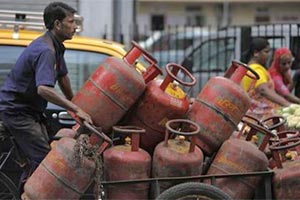
Cooking gas price hiked by Rs 26.50 to Rs 922 per cylinder

November 1, 2012
cooking_gas

New Delhi, November 1: The price of non-subsidised cooking gas (LPG), which consumers buy beyond the cheaper quota of six cylinders, was today hiked by Rs 26.50 to Rs 922 per unit on firming international rates.

The 14.2-kg cooking gas cylinder that consumers buy beyond their entitled six bottles at subsidised rates, will now cost Rs 922, up from Rs 895.50 in Delhi, according to Indian Oil Corp, the nation's largest fuel retailer.

The government had in September restricted the supply of subsidised domestic LPG cylinders to six per household in a year.

Any requirement above this will have to be bought at market rate, which is more than double the subsidised price of Rs 410.42 per cylinder in Delhi.

State-owned oil firms revise rates of non-subsidised LPG on 1st of every month based on the average imported cost and rupee-US dollar rate during the previous month.

There is no restriction on the number of non-subsidised cylinders that a consumer buys beyond the six subsidised bottles.

The price of commercial 14.2-kg LPG cylinder in Delhi will be Rs 1,105.5, while that of a 19-kg bottle would be Rs 1,551.

A commercial or non-domestic cylinder was previously priced at Rs 1,075 per 14.2-kg bottle. Similarly, the 19-kg cylinder was priced at Rs 1,536.5.

Rates of non-subsidised 14.2-kg cylinder and those of commercial bottles of the same size differ because the government has granted exemption from customs and excise duty on non-subsidised LPG cylinders only for domestic consumption to reduce the price burden on the common man.


Comments

Add new comment

  • Coastaldigest.com reserves the right to delete or block any comments.
  • Coastaldigset.com is not responsible for its readers’ comments.
  • Comments that are abusive, incendiary or irrelevant are strictly prohibited.
  • Please use a genuine email ID and provide your name to avoid reject.
News Network
March 3,2020

Chennai, Mar 3: The Madras High Court has ruled that if a working woman gives birth to a child in the second delivery after twins in the first, she is not entitled to maternity benefits as it should be treated as third child.

"As per existing rules, a woman can avail such benefits only for her first two deliveries. Even otherwise it is debatable as to whether the delivery is not a second delivery but a third one, in as much as ordinarily when twins are born they are delivered one after another, and their age and their inter-se elderly status is also determined by virtue of the gap of time between their arrivals, which amounts to two deliveries and not one simultaneous act," the court said.

The first bench, comprising Chief Justice A P Sahi and Justice Subramonium Prasad stated this while allowing the appeal from Ministry of Home Affairs.

It set aside the order June 18 2019 order of a single Judge, who extended 180 days of maternity leave and other benefits to a woman member of the Central Industrial Security Force (CISF) under the rules governing the Tamil Nadu government servants.

The issue pertains to an appeal moved by the ministry, which contended that the leave claim is by a member of CISF to whom the maternity rules of Tamil Nadu would not apply.

She would be covered by the maternity benefits as provided under the Central Civil Services (Leave) Rules, the ministry said.

When the appeal came up for hearing, the bench said it found that a second delivery, which, in the present case, resulted in a third child, cannot be interpreted so as to add to the mathematical precision that is defined in the rules.

The admissibility of benefits would be limited if the claimant has not more than two children, the bench said "This fact therefore changes the entire nature of the relief which is sought for by the woman petitioner, which aspect has been completely overlooked by the single judge", the bench said.

Comments

Add new comment

  • Coastaldigest.com reserves the right to delete or block any comments.
  • Coastaldigset.com is not responsible for its readers’ comments.
  • Comments that are abusive, incendiary or irrelevant are strictly prohibited.
  • Please use a genuine email ID and provide your name to avoid reject.
Agencies
May 21,2020

More than 50 million people in India do not have access to effective handwashing, putting them at a greater risk of acquiring and transmitting the novel coronavirus, according to a study.

Researchers from the Institute for Health Metrics and Evaluation (IHME) at the University of Washington in the US found that without access to soap and clean water, over 2 billion people in low- and middle-income nations -- a quarter of the world's population -- have a greater likelihood of transmitting the coronavirus than those in wealthy countries.

According to the study, published in the journal Environmental Health Perspectives, more than 50 per cent of the people in sub-Saharan Africa and Oceania lacked access to effective handwashing.

"Handwashing is one of the key measures to prevent COVID transmission, yet it is distressing that access is unavailable in many countries that also have limited health care capacity," said Michael Brauer, a professor at IHME.

The study found that in 46 countries, more than half of people lacked access to soap and clean water.

In India, Pakistan, China, Bangladesh, Nigeria, Ethiopia, Democratic Republic of the Congo, and Indonesia, more than 50 million persons in each country were estimated to be without handwashing access, according to the study.

"Temporary fixes, such as hand sanitizer or water trucks, are just that -- temporary fixes," Brauer said.

"But implementing long-term solutions is needed to protect against COVID and the more than 700,000 deaths each year due to poor handwashing access," Brauer said.

He noted that even with 25 per cent of the world's population lacking access to effective handwashing facilities, there have been "substantial improvements in many countries" between 1990 and 2019.

Those countries include Saudi Arabia, Morocco, Nepal, and Tanzania, which have improved their nations' sanitation, the researchers said.

The study does not estimate access to handwashing facilities in non-household settings such as schools, workplaces, health care facilities, and other public locations such as markets.

Earlier this month, the World Health Organization predicted 190,000 people in Africa could die of COVID-19 in the first year of the pandemic, and that upward of 44 million of the continent's 1.3 billion people could be infected with the coronavirus, the researchers said. 

Comments

Add new comment

  • Coastaldigest.com reserves the right to delete or block any comments.
  • Coastaldigset.com is not responsible for its readers’ comments.
  • Comments that are abusive, incendiary or irrelevant are strictly prohibited.
  • Please use a genuine email ID and provide your name to avoid reject.
News Network
June 13,2020

Visakhapatnam, Jun 13: A four-month-old baby who was on ventilator treatment for 18 days for COVID-19 was on Friday evening discharged from hospital after testing negative.

"A tribal woman of East Godavari named Laxmi was infected with COVID-19 in May, later the doctors confirmed that her four-month-old baby was also infected," said District Collector, Vinay Chand.

"The baby was shifted to Visakhapatnam VIMS hospital on May 25. She was treated for 18 days on a ventilator. Doctors again conducted baby's COVID-19 test recently, following which the reports came negative. After a health check-up, VIMS doctors discharged the baby on Friday evening," he added.

Meanwhile, 14 new COVID-19 positive cases have been reported in Visakhapatnam district on Friday, taking the total number of cases to 252 including one fatality due to the virus.

Comments

Add new comment

  • Coastaldigest.com reserves the right to delete or block any comments.
  • Coastaldigset.com is not responsible for its readers’ comments.
  • Comments that are abusive, incendiary or irrelevant are strictly prohibited.
  • Please use a genuine email ID and provide your name to avoid reject.