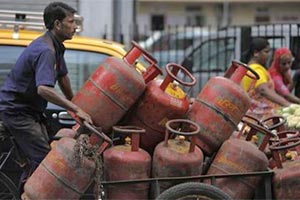
Cooking gas price hiked by Rs 26.50 to Rs 922 per cylinder

November 1, 2012
cooking_gas

New Delhi, November 1: The price of non-subsidised cooking gas (LPG), which consumers buy beyond the cheaper quota of six cylinders, was today hiked by Rs 26.50 to Rs 922 per unit on firming international rates.

The 14.2-kg cooking gas cylinder that consumers buy beyond their entitled six bottles at subsidised rates, will now cost Rs 922, up from Rs 895.50 in Delhi, according to Indian Oil Corp, the nation's largest fuel retailer.

The government had in September restricted the supply of subsidised domestic LPG cylinders to six per household in a year.

Any requirement above this will have to be bought at market rate, which is more than double the subsidised price of Rs 410.42 per cylinder in Delhi.

State-owned oil firms revise rates of non-subsidised LPG on 1st of every month based on the average imported cost and rupee-US dollar rate during the previous month.

There is no restriction on the number of non-subsidised cylinders that a consumer buys beyond the six subsidised bottles.

The price of commercial 14.2-kg LPG cylinder in Delhi will be Rs 1,105.5, while that of a 19-kg bottle would be Rs 1,551.

A commercial or non-domestic cylinder was previously priced at Rs 1,075 per 14.2-kg bottle. Similarly, the 19-kg cylinder was priced at Rs 1,536.5.

Rates of non-subsidised 14.2-kg cylinder and those of commercial bottles of the same size differ because the government has granted exemption from customs and excise duty on non-subsidised LPG cylinders only for domestic consumption to reduce the price burden on the common man.


Comments

Add new comment

  • Coastaldigest.com reserves the right to delete or block any comments.
  • Coastaldigset.com is not responsible for its readers’ comments.
  • Comments that are abusive, incendiary or irrelevant are strictly prohibited.
  • Please use a genuine email ID and provide your name to avoid reject.
News Network
March 5,2020

New Delhi, Mar 5: Retirement fund body EPFO on Thursday lowered interest rate on provident fund deposits to 8.5 per cent for the current financial year, said Labour Minister Santosh Gangwar on Thursday.

The EPFO had provided 8.65 per cent rate of interest on EPF for 2018-19 to its around six crore subscribers. The decision was taken at a meeting of the the Employees' Provident Fund Organisation's (EPFO) apex decision making body -- the Central Board of Trustee.

"The EPFO has decided to provide 8.5 per cent interest rate on EPF deposits for 2019-20 in the Central Board of Trustees (CBT) meeting today," Gangwar told reporters after the meeting here.

Now, the labour ministry requires the finance ministry's concurrence on the matter. Since the Government of India is the guarantor, the finance ministry has to vet the proposal for EPF interest rate to avoid any liability on account of shortfall in the EPFO income for a fiscal.

The finance ministry has been nudging the labour ministry for aligning the EPF interest rate with other small saving schemes run by the government like the public provident fund and post office saving schemes.

The EPFO had provided 8.65 per cent rate of interest to its subscribers for 2016-17 and 8.55 per cent in 2017-18. The rate of interest was slightly higher at 8.8 per cent in 2015-16.

It had given 8.75 per cent rate of interest in 2013-14 as well as 2014-15, higher than 8.5 per cent for 2012-13.

Comments

Add new comment

  • Coastaldigest.com reserves the right to delete or block any comments.
  • Coastaldigset.com is not responsible for its readers’ comments.
  • Comments that are abusive, incendiary or irrelevant are strictly prohibited.
  • Please use a genuine email ID and provide your name to avoid reject.
Agencies
July 23,2020

Jerusalem, Jul 23: Merging Israel's technological expertise with India's mass production capabilities, experts from the two countries have joined hands to develop rapid testing for Covid-19 in under 30 seconds.

Israel will soon send a high-level research delegation to India to conduct a series of "final stages of testing" as part of the joint effort to develop the rapid testing kits for Covid-19 .

A high ranking team from the Directorate of Defence Research and Development (DDR&D), in the Ministry of Defense, which has been working with India's DRDO to develop rapid testing for Covid-19 in under 30 seconds, is to leave from Tel Aviv to New Delhi on a special flight in a few days, Israel's Ministry of Defence said in a statement on Thursday.

Israel's Ministry of Foreign Affairs (MFA) and Ministry of Health are also involved in this unprecedented cooperation between the two countries which aims at "merging Israeli technology with Indian development and production capabilities to allow a swift resumption of normal life alongside the virus".

The DDR&D team will conduct a series of "final stages of testing" to determine the effectiveness of a number of rapid diagnostic solutions with their Indian counterparts.

Since the start of the pandemic, the DDR&D has tested dozens of diagnostic technologies. Some of them have matured and passed initial trials in Israel, however in order to complete testing and prove their effectiveness, these must be tested on a wide range of patients, IMoD said.

The four tech systems that will be tested are - voice test, breathalyzer test based on terra-hertz waves, isothermal test, and polyamino acids test.

"What they all have in common is the ability to detect the presence of the virus in the body quickly- usually within minutes. Developing diagnostic capabilities is a goal for the State of Israel and of many additional countries around the world. It is the most effective way to cut off 'chains of infection', prevent prolonged quarantine and enable the reopening of the global economy," the statement said.

"We hope that the research and development led by the DDR&D together with our excellent industries and academic institutions, will lead to a breakthrough that will change the way we diagnose and fight the virus, while giving the boost necessary to 'restart' our economy," Defense Minister Benny Gantz said.

Foreign Minister Gabi Ashkenazi noted that this cooperation provides a unique opportunity for scientific and technological cooperation that can assist Israel, India and the world in coping both with the pandemic and with the economic crisis that came with it.

The cooperation between Israel and India will enable the delegation and its Indian counterparts, to collect tens of thousands of samples in just ten days, and analyze them using computer systems based on artificial intelligence. This massive sampling will shorten processes and advance the approval of effective technology. All tests will be validated using PCR tests.

"The cooperation between India and Israel on Covid-19 is a good example of harnessing the scientific and technological strengths that the two countries have for larger, common good. It will also further deepen our strategic ties,” India's Ambassador Sanjeev Singla told PTI.

The flight will be carrying some breakthrough emerging Israeli technologies for combatting Covid-19, which have been donated by the Israeli foreign ministry and the private sector, in order to bolster India’s response to the virus outbreak.

The plane will also deliver mechanical ventilators which were given special permission by Israel for export to India.

Prime Minister Narendra Modi and his Israeli counterpart Benjamin Netanyahu have held three telephonic conversations since the outbreak of the pandemic and promised mutual assistance in dealing with the virus, committing to joint technological and scientific research between the countries.

The Israeli media widely reported that Modi lifted a ban on the export of Hydroxychloroquine at Netanyahu's request.

"The past few years have cemented the strategic relations between India and Israel and have included two historical visits of the Prime Ministers in Israel and in India," a press statement from the ministry of defence said.

"India seeks to integrate advanced technologies in its hospitals as they prepare to treat massive waves of Covid-19 patients on an Indian scale. The Israeli companies chosen by the MFA, MOD and Israel Defence Forces to be sent to India are potentially given unique access to one of the largest economies in the world to provide monitoring and treatment technologies while significantly reducing contact between the patients and the medical staff," it said.

"By opening the door to India’s market with its development and production capabilities, these Israeli technologies can be mass produced at a lower cost and could in future be jointly exported to third countries," it said.

"The COVID-19 pandemic is a global challenge, so it is only right that the solution be a global scientific cooperation between countries. India and Israel’s military R&D cooperation is well known for its success. I have no doubt the same will be seen in the private sector joined by brilliant scientific minds from both countries to introduce a breakthrough in swift and simple testing procedures,” said Prof. Nati Keller, an infectious diseases specialist from Sheba Medical Center, who is leading the medical side of the delegation.


Comments

Add new comment

  • Coastaldigest.com reserves the right to delete or block any comments.
  • Coastaldigset.com is not responsible for its readers’ comments.
  • Comments that are abusive, incendiary or irrelevant are strictly prohibited.
  • Please use a genuine email ID and provide your name to avoid reject.
News Network
January 30,2020

New Delhi, Jan 30: In a major shift of strategy ahead of the Delhi assembly polls, the Bharatiya Janata Party (BJP) has decided to rope in its senior leaders for massive public rallies.

Its star campaigners like Prime Minister Narendra Modi, Union Home Minister Amit Shah, BJP chief JP Nadda, Uttar Pradesh Chief Minister Yogi Adityanath, and other union ministers would now be addressing massive public rallies in addition to ongoing neighbourhood meetings.

"The big rallies would begin from February 1. While 'Nukkad' meetings will take place till the last day of campaigning, there would be big rallies of the top leadership of the party, " informed a senior party leader.

Sources said the BJP has changed its strategy after the success of its grassroots contact programme as the party wants to consolidate its gains.

"As part of the reworked strategy the BJP has asked its various Mandals to organise public meetings of 10,000-15,000 people in each assembly segment to reach out to the masses," sources added.

While there are two planned for Prime Minister Modi, two have been planned for JDU chief and Bihar Chief Minister Nitish Kumar along with Nadda and Amit Shah. Yogi Aadityanath too would be addressing 12 rallies.

The party is leaving no stone unturned to secure massive gains, which it feels can be converted to victory in the forthcoming polls.

Party sources feel that the relentless campaigning under the guidance of Amit Shah and Nadda has ensured that the morale of party cadre is at an all-time high.

"The neighbourhood meetings have ensured that we have been able to make the people of Delhi aware of the lack of work under the Arvind Kejriwal led Aam Aadmi Party government. They have also been apprised about the anti-national views of the opponents and we think that this is expected to turn the polls into our favour," sources added.

Delhi is scheduled for assembly polls on February 8 and the results for the 70 constituencies will be declared on February 11.

As part of the new strategy, senior leaders like JP Nadda, Amit Shah, Uttar Pradesh chief minister Yogi Adityanath, ministers like Rajnath Singh and Smriti Irani would be holding public rallies in various parts of the city. Several other chief ministers from various BJP ruled states are also expected to be roped in for the campaign.

The strategy for reach out to the masses is an attempt at weakening the hold of AAP on Delhi. With positive feedback coming after the success of the neighbourhood meetings in the past week, the BJP is now looking to increase its potential reach with polls just days away.

Till now the party had deployed 70 union ministers to hold at least one public meeting and one 'padayatra' each as part of the campaign.

Comments

Add new comment

  • Coastaldigest.com reserves the right to delete or block any comments.
  • Coastaldigset.com is not responsible for its readers’ comments.
  • Comments that are abusive, incendiary or irrelevant are strictly prohibited.
  • Please use a genuine email ID and provide your name to avoid reject.