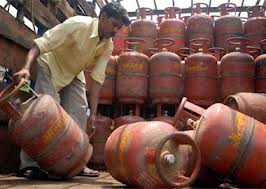
Non-subsidised LPG costlier by Rs. 26.50

November 1, 2012

lpg

New Delhi, November 1: Domestic LPG consumers buying beyond their limit will now have to shell out more for the fuel as oil marketing companies have hiked the price of a non-subsidised cylinder by Rs. 26.50 to Rs. 922 on firming international rates.

In September, the government restricted the supply of subsidised domestic LPG cylinders to six per household in a year. Any requirement above this will have to be bought at market rate, which is more than double the subsidised price of Rs. 410.42 a cylinder in Delhi.

The state-owned OMCs revise rates of non-subsidised LPG on the first of every month based on the average import cost and rupee-dollar rate during the previous month. There is no restriction on purchase of non-subsidised cylinders.

Commercial rates

In Delhi, the price of a commercial or non-domestic 14.2-kg LPG cylinder will be Rs. 1,105.50 and that of a 19-kg bottle, Rs. 1,551. Previously the prices were Rs. 1,075 and Rs. 1,536.50.

Rates of non-subsidised 14.2-kg cylinder and commercial bottles of the same size differ because the government has granted exemption from customs and excise duty only for domestic consumption to reduce the burden on the common man.

Subsidised cylinders will continue to be available at Rs. 410.42 (in Delhi). The price of non-subsidised, domestic LPG cylinders will go up and down every month based on the price of LPG in the international market, which in turn is determined by global demand-supply situations,” according to the Indian Oil Corporation.

Comments

Add new comment

  • Coastaldigest.com reserves the right to delete or block any comments.
  • Coastaldigset.com is not responsible for its readers’ comments.
  • Comments that are abusive, incendiary or irrelevant are strictly prohibited.
  • Please use a genuine email ID and provide your name to avoid reject.
News Network
June 24,2020

Kolkata, Jun 24: Trinamool Congress (TMC) MLA Tamonash Ghosh, who had tested positive for Covid-19 in May, died at a hospital here on Wednesday, party sources said.

He was 60.

The three-time MLA from the Falta assembly constituency in South 24 Parganas district was admitted to a hospital after he tested positive for the disease, they said.

He had several complications related to the heart and the kidney, the sources said.

"Very, very sad. Tamonash Ghosh, 3-time MLA from Falta & party treasurer since 1998 had to leave us today. Been with us for over 35 years, he was dedicated to the cause of the people & party. He contributed much through his social work," West Bengal Chief Minister and TMC supremo Mamata Banerjee tweeted.

"He has left a void that will be difficult to fill. On behalf of all of us, heartfelt condolences to his wife Jharna, his two daughters, friends and well-wishers," she added.

Comments

Add new comment

  • Coastaldigest.com reserves the right to delete or block any comments.
  • Coastaldigset.com is not responsible for its readers’ comments.
  • Comments that are abusive, incendiary or irrelevant are strictly prohibited.
  • Please use a genuine email ID and provide your name to avoid reject.
Agencies
March 6,2020

New Delhi, Mar 6: After Yes Bank was placed under moratorium, digital payments were impacted as PhonePe, which depends on the cash-strapped lender for its transactions, could not operate.

It can be noted that the bank's own net banking facilities have not been operational since last evening. Other fintech operators who rely on Yes Bank to settle their transactions are also down.  “We sincerely regret the long outage. Our partner bank (Yes Bank) was placed under moratorium by RBI. Entire team's been working all night to get services back up asap (as soon as possible),” the app's chief executive Sameer Nigam tweeted early in the morning.

PhonePe, one of the country's largest digital payment platforms, is dependent on Yes Bank to process its transactions.

He added that the app hopes to be live in a “few hours”.

Yes Bank placed under a moratorium Thursday evening, with the RBI capping deposit withdrawals at Rs 50,000 per account for a month and superseding its board.

Yes Bank will not be able to grant or renew any loan or advance, make any investment, incur any liability or agree to disburse any payment.

For the next month, Yes Bank will led by the RBI-appointed administrator Prashant Kumar, an ex-chief financial officer of SBI.

He added that the app - one of the most popular interfaces for UPI transactions - hopes to be live in a “few hours”.

Comments

Add new comment

  • Coastaldigest.com reserves the right to delete or block any comments.
  • Coastaldigset.com is not responsible for its readers’ comments.
  • Comments that are abusive, incendiary or irrelevant are strictly prohibited.
  • Please use a genuine email ID and provide your name to avoid reject.
News Network
June 25,2020

India has jumped past 4.5 lakh coronavirus cases and 14,476 people have succumbed to the viral infection so far. In this backdrop, speaking to IANS in an exclusive interview, AIIMS Director Randeep Guleria said India is also vulnerable to second wave of coronavirus and people should continue to follow social distancing, wearing mask and other precautions, after cases begin to decline.

He added that in order to contain the outbreak of Covid-19, a limited lockdown in hotspots, where volume of cases is very high, may be considered along with a micro-plan to prevent leakage of cases from these areas to other non-containment areas. Excerpts of the interview are below:

Q: Reports say China and South Korea are witnessing a second wave of coronavirus infection, what is this second wave, is India also vulnerable to this?

A: When cases come down significantly, people tend to drop their guard against the viral infection, and this leads to the second wave (which means a sudden increase in the number of cases). After cases begin to decline, people should continue to follow the precautions -- continue to maintain social distancing and wear masks regularly. See what happened in Singapore, it was struck by a second wave of coronavirus. Look, what happened in the 1918 pandemic, people dropped their guard and the second wave of viral infection struck back. If people do not follow social distancing then the spike in cases is apparent. We need to take these precautions at least for one year. India is also vulnerable to this second wave.

Q: If Covid-19 cases continue to rise rapidly, do you think we need another lockdown in areas where volume of cases are very high?

A: A large volume of cases is concentrated in specific areas like hotspots, and in order to maintain things in order, we may need a limited lockdown in these areas. This should be followed by a micro-plan which entails extensive testing of people and also extensive contact tracing of people who have got in touch with positive people. Need to ensure there is no leakage of cases from these areas. People from these areas should not mix with others in non-containment areas. This will aid in containing the outbreak of the virus. People who have developed symptoms should get themselves tested, especially in the containment areas.

Q: With more than 4.5 lakh cases and close to 14,500 deaths, do you think India has reached its peak and a decline in cases is prominent?

A: The cases will continue to increase for some time. The doubling time of cases has also increased. But, the cases will also begin to flatten. Though, it is difficult to give an exact time period in this viral infection, it seems, the growth in cases will flatten in the end of July or beginning of August. A decline will come to this viral infection, but it does not mean that people should drop their guard. As a measure, we need to decrease community participation and citizens should continue to follow social distancing. People should get themselves tested. All these efforts will help in preventing people from contracting this virus. These precautions will also prevent us from the second wave, and we must continue to take precautions. The virus has not gone away, it is still lurking.

Q: India has crossed the 4.5 lakh coronavirus cases so far, although our recovery rate is good, but still 10,000 to 15,000 cases are reported daily. Why do cases continue to spiral, what is the reason?

A: We have to remember a few things -- the bulk of cases are in 10 cities, nearly 70 per cent, and if we take into account cases per million population, the number is not very high, as compared with countries including countries in Europe. Many European countries put together still do not add up to the Indian population. Do not compare India to countries like Italy, Spain etc. We need to focus on hotspots, which contribute to between 70 -80 per cent of cases, and we have to identify cases in these areas at an early stage. The population density is very high in these cities. People in lower socio-economic status are highly vulnerable to the viral infection, as many live together in small spaces and there is a lot of mixing of people happening there. Look at the market places, people are not following social distancing and not wearing masks. In fact, many are in close vicinity of each other.


Comments

Add new comment

  • Coastaldigest.com reserves the right to delete or block any comments.
  • Coastaldigset.com is not responsible for its readers’ comments.
  • Comments that are abusive, incendiary or irrelevant are strictly prohibited.
  • Please use a genuine email ID and provide your name to avoid reject.