



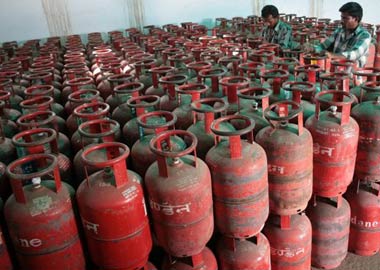
LPG cap may be raised to 9 subsidized cylinders per household

November 3, 2012

cylinders

New Delhi, November 3: The annual cap on the number of subsidized cooking gas cylinders per household is likely to be raised from six to nine - if not completely scrapped - after the poll code gets over with Himachal Pradesh and Gujarat elections, sources in state-run fuel retailing companies said.

Widespread consumer complaints over the ongoing customer verification - KYC or know-your-customer - drive as well as pressure from within the Congress and opposition parties appear to have prompted a relook. Though nothing has been put on paper yet, oil minister M Veerappa Moily himself gave an indication that the government was not fixated on the cap and was sensitive to aam aadmi's travails.

"They (state-run fuel retailers) have gone by some arithmetic that on an average six cylinders are enough (for a household). This is arithmetic, (but) there is also a chemistry, which they have not done," news agencies quoted Moily as saying in Bangalore on Friday. Though the cap was decided by the Cabinet, Moily said the fuel retailers were free to raise the cap.

But it may be difficult for the fuel retailers to do. If oil companies raise the cap on their own - obviously under verbal diktat from the parent ministry - they may have to bear the loss since thefinance ministry would not give them the subsidy amount on additional cylinders supplied at government rate beyond the six-cylinder cap. This would run foul of independent directors on company boards and the federal auditor for causing loss to company.

Indeed, a senior oil ministry official said any decision on changing the cap would have to be taken by the "government as a whole". "The decision was taken by the government... The prime minster and finance minister were involved (in the decision). So the oil ministry may not be able to make any change on its own. The matter has to be taken to the Cabinet."

"We have received complaints regarding the problems being faced by consumers from various quarters. It is a fact that the plan has put consumers to a great deal of hardships. But any raising of cap officially or even scrapping it would ultimately depend on the stand taken by the FM and PM," he said.

That the government is losing nerve on the issue was amply evident when it blocked a hike in the price of non-subsidised cooking gas on Thursday. On Friday, Congress spokesman P C Chacko reinforced this by saying the government would review the policy at the first possible opportunity.

"We said the reduction of subsidised cylinders would burden the common man. So our party president Sonia Gandhi wrote to the party's chief ministers that the cap on subsidised cylinders should be higher. But we understand that government's hands were tied, it was facing a fiscal crisis and oil companies would have collapsed. It would have led to fuel rationing."


Comments

Add new comment

  • Coastaldigest.com reserves the right to delete or block any comments.
  • Coastaldigset.com is not responsible for its readers’ comments.
  • Comments that are abusive, incendiary or irrelevant are strictly prohibited.
  • Please use a genuine email ID and provide your name to avoid reject.
News Network
June 18,2020

New Delhi, Jun 18: The border clash between Indian and Chinese soldiers in Ladakh broke the brittle quiet – and also the sense of security for anxious Chinese nationals in India who fear a backlash with anti-Chinese sentiment spiralling in the country.

With the high altitude violent face-off in eastern Ladakh’s Galwan Valley spurring hashtags such as “Boycott China” and “Teach Lesson to China” and leading to street protests, the undercurrents of tension were evident.

Wary of being identified, some said they had been reassured by their friends but were still apprehensive for themselves and their families.

"They (Chinese families) don''t want to speak to the media. They are not going out and are worried about their security and well being. Their families are also worried back home," Mohammed Saqib, secretary general of the India China Economic & Cultural Council, told PTI.

He added that his Chinese friends in India been calling him since they heard news about Monday night’s clashes in which 20 Indian soldiers were killed -- the worst military confrontation in five decades -- and expressed concern over growing anti-China sentiments.

A Chinese national from Beijing working in Gurgaon for a Chinese mobile firm initially refused to talk, saying he did not want to speak to the media and later shared his thoughts only on condition of anonymity.

"There is talk of border standoff and tensions, but we know Indians are very warm people and that is why I have told my family that all is fine here and they should not worry," he said.

Another Chinese national working in Gurgaon said he and his family are feeling the stress amid the spiralling conflict between India and China, but many friends have been reassuring him.

"They (Chinese in India) are under a lot of stress naturally. Such a conflict puts a lot of stress as they could bear the brunt and the same applies to Indians in China," B R Deepak, professor at the Centre for Chinese and South East Asian Studies of the Jawaharlal Nehru University said.

He said it was unfortunate that the border standoff derailed the commemorative programmes aimed at strengthening ties at a time the two countries were gearing to celebrate 70 years of establishment of diplomatic ties.

Experts also feel the border clash is likely to have a significant negative impact on the economic and people to people ties.

There are scores of Chinese in India working in various Chinese firms and also those who are studying in universities like JNU.

About 3,000 Chinese people, doing business or studying in big cities in India, were stranded in India at the start of the COVID-19 crisis, and about half of them returned to China before the lockdown began on March 25.

The Chinese Embassy in New Delhi announced on May 25 that they will arrange for flights to take back students, tourists and businesspersons to five Chinese cities, including Shanghai and Guangzhou.

"It will impact the psychology of the Chinese here. There are 2,000 Chinese firms in various sectors in India which are going to be impacted," Deepak said.

Future investments from the Chinese side could also be impacted, he said.

Moreover, as far as people-to-people contacts are concerned, the number of Chinese students choosing India as a preferred destination is likely to go down, Deepak said.

Alka Acharya, another China expert, said there are two kinds of impacts of such an incident -- short term and medium term.

Usually after the initial nationalistic reaction in the short term things tend to normalise in the medium term, but with such a border clash happening for the first time in decades clearly the resonance would be much more in both India and China, said Acharya, professor at the Centre for East Asian Studies, School of International Studies, in JNU.

“Due to the impact of the COVID-19 crisis on the economy, whether India can take a hardline in terms of economics towards China, is a tricky question,” she said.

In the immediate context, there may be a dip in economic ties with calls for boycott of Chinese goods and services, Acharya said.

The manner in which this crisis is resolved will affect how ties will be affected in the medium term, she said.

The headlines have added to the anxiety.

A group of ex-armymen gathered near the Chinese embassy to protest the killing of 20 Indian Army personnel in Ladakh’s Galwan Valley. And another group of around 10 protesters belonging to the Swadeshi Jagaran Manch protested near the Teen Murti roundabout in Central Delhi.

The anti-China sentiment prevalent among the common public is also finding a reflection in government policy with sources saying the Department of Telecom (DoT) is set to ask state-owned Bharat Sanchar Nigam Ltd (BSNL) not to use Chinese telecom gear in its 4G upgradation.

Trade bodies like CAIT are also calling for a boycott of Chinese products.

And Chinese handset maker Oppo cancelled the livestream launch of its flagship 5G smartphone in the country amid protests.

Monday night’s clashes between the Chinese and Indian troops in Galwan Valley significantly escalated the already volatile border standoff between the two countries.

The casualties on the Chinese side are not yet known. However, government sources, citing an American intelligence report, claimed the total number of soldiers killed and seriously wounded could be 35.

Comments

Add new comment

  • Coastaldigest.com reserves the right to delete or block any comments.
  • Coastaldigset.com is not responsible for its readers’ comments.
  • Comments that are abusive, incendiary or irrelevant are strictly prohibited.
  • Please use a genuine email ID and provide your name to avoid reject.
News Network
April 3,2020

New Delhi, Apr 3: Prime Minister Narendra Modi on Friday urged people to gather together for a unique exercise on April 5 at 9 pm to show they were together in the fight against coronavirus.

"On this Sunday, April 5, we will challenge the darkness of coronavirus threat together. On April 5, at 9 pm, I need your 9 minutes. At 9 pm, turn off all the lights in your houses and light a Diya, candle, torch or flashlight for 9 minutes at your doors, or balcony," Modi said.

The Prime Minister further said that this will send out a message that nobody among the 130 crore Indians is alone in this fight against the deadly infection.

"I have one more prayer to all of you, nobody has to gather at any place during this event. Everyone will light a Diya only at their doors, windows or balconies. The Laxman Rekha of social distancing must be followed," Modi said.
Earlier, the Prime Minister had said that 130 crore Indians are together in this fight against coronavirus and praised the countrymen for following the lockdown.

"Today when crores of people are inside homes, then some of us may think how will they fight this battle against COVID-19 alone. Such questions might come up in your mind? But please remember, none of us is alone. The strength of 130 crores of Indians is with each one of us," he said.

He also expressed gratitude towards countrymen for participating in 'Janata curfew' on March 22 and said it has become "an example for all countries" today as they are following it.

In his address to the nation on March 24, the Prime Minister had announced a 21-day lockdown in the country to contain the spread of novel coronavirus, which has infected over 2,000 people in the country.

During the last "Mann Ki Baat" on COVID-19 related issue, the Prime Minister had apologised to the countrymen for taking the tough decision of enforcing complete lockdown in the nation. "My conscience says you will forgive me," he had said.

Comments

Add new comment

  • Coastaldigest.com reserves the right to delete or block any comments.
  • Coastaldigset.com is not responsible for its readers’ comments.
  • Comments that are abusive, incendiary or irrelevant are strictly prohibited.
  • Please use a genuine email ID and provide your name to avoid reject.
News Network
June 29,2020

Kolkata, Jun 29: Sweet-loving Bengalis have something to cheer about in COVID-19 time as the West Bengal government decided to come out with a "sandesh" which will contain honey from Sundarbans and increase immunity, an official said on Sunday.

Cotton cheese made from cow milk will be mixed with pure honey from the Sunderbans to prepare the "Arogya Sandesh" which will also have extracts of tulsi leaves, an official of the Animal Resources Development Department said.

No artificial flavours would be added to the sweetmeat which will be available in the department's outlets in the city and neighbouring districts, he said.

The sandesh will boost the immune system as a whole but it is not a COVID-19 antidote, the official said.

Sunderbans Affairs Minister Manturam Pakhira said the honey for making Arogya Sandesh will be collected from beehives in places such as Pirkhali, Jharkhali and other parts of the Sunderbans and it will be stored in a scientific manner.

The sandesh is expected to hit the shelves in another two months and the pricing will be within the reach of the common man, the animal resources development department official said.

Earlier this month, a reputed sweetmeat chain of Kolkata came out with an "Immunity Sandesh" claiming that it contains various herbs and spices such as haldi (turmeric), tulsi, saffron, and cardamom and Himalayan honey, which will boost immunity to fight novel coronavirus.

Comments

Add new comment

  • Coastaldigest.com reserves the right to delete or block any comments.
  • Coastaldigset.com is not responsible for its readers’ comments.
  • Comments that are abusive, incendiary or irrelevant are strictly prohibited.
  • Please use a genuine email ID and provide your name to avoid reject.