


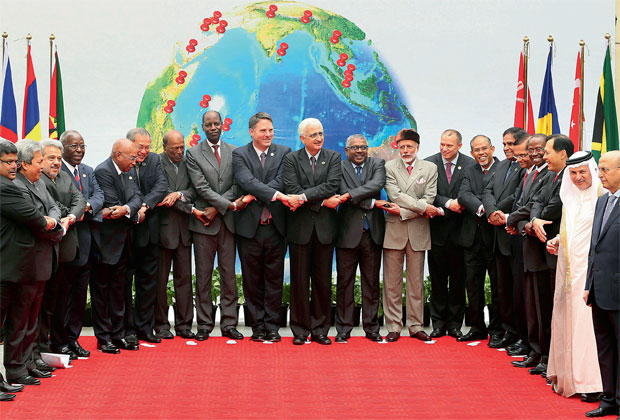
UAE ups profile at Indian Ocean group

[email protected] (Khaleej Times)
November 3, 2012

indianocean

New Delhi, November 3: The UAE is taking its green responsibility seriously and has offered to host the Indian Ocean Rim renewable energy forum next year. Minister of State for Foreign Affairs Dr Anwar Mohammed Gargash, speaking at the 12th ministerial meeting of the association in Gurgaon on Friday, said UAE officials will discuss with the IOR-ARC secretariat on how to take the proposal forward.

The UAE is home to the International Energy Agency and much can be gained by the group in developing and promoting alternative forms of energy.

Dr Gargash also announced the UAE’s contribution of $500,000 to a special fund of the association. He said the country is committed to the group of 20 nations, with Comoros joining as a full member on Friday. “The IOR-ARC must show will and determination for tangible results,” said the minister. He said the organisation needs to be energised through improved coordination, and new projects in member countries.

He warned of the dangers of the eurozone financial crisis spreading to the region and said the group must shield itself with further investments and press ahead through sustainable growth. He mentioned the Abu Dhabi Sustainable Energy Week in January next year and said the UAE is taking the lead in tapping environment-friendly, sustainable sources of energy.

“We must promote cultural understanding and tolerance in this association with its diverse interests and rates of growth,” Dr Gargash said, and added the UAE’s efforts to host Expo 2020 will bring people and businesses together. He said the Indian Ocean Rim group of countries must interact more to grow and expand.

On maritime security, he said the UAE would continue to combat piracy and has been instrumental in bringing warring factions in Somalia together to tackle the problem at source. Pirate attacks off the coast of Somalia have fallen by 50 per cent since that meeting in June and with the formation of a new Somali government.

“There’s a lot more we can do. We must invest time and effort to further the interests of the group,’’ he said.

Growing together

Earlier, the meeting of ministers was inaugurated by Indian External Affairs Minister Salman Khurshid, who echoed Dr Gargash’s call for the 15-year-old grouping to show tangible benefits for the two billion people of these countries.

“There must be greater structure for people in the IOR-ARC countries to grow together,” said Khurshid. Job creation and security are important for the region to prosper, he said. He laid emphasis on economic cooperation, technology exchange, education and development of fisheries in the region. The minister even mooted a university for the Indian Ocean Rim.

India has contributed $1 million for projects being carried out by the association. China, which is a dialogue partner, chipped in with $100,000.

The Indian External Affairs minister said he is committed to maintaining the momentum of the grouping, but suggested a pragmatic approach for holistic development.

The IOR-ARC, which was formed in 1997, is an apolitical body with interests in maritime security, trade and investment, fisheries management, disaster risk reduction, academics, science and tourism. It has three projects in Iran and Oman on fisheries, science and technology and maritime transport.


Comments

Add new comment

  • Coastaldigest.com reserves the right to delete or block any comments.
  • Coastaldigset.com is not responsible for its readers’ comments.
  • Comments that are abusive, incendiary or irrelevant are strictly prohibited.
  • Please use a genuine email ID and provide your name to avoid reject.
News Network
February 21,2020

Washington, Feb 21: Days ahead of his India visit, US President Donald Trump on Thursday said the two countries could make a "tremendous" trade deal.

"We're going to India, and we may make a tremendous deal there," Trump said in his commencement address at the Hope for Prisoners Graduation Ceremony in Las Vegas.

Trump, accompanied by First Lady Melania Trump, is scheduled to travel to Ahmedabad, Agra and New Delhi on February 24 and 25.

Ahead of the visit, there have been talks about India and the United States agreeing on a trade package as a precursor to a major trade deal.

During his commencement address, Trump indicated that the talks on this might slowdown if he did not get a good deal.

"Maybe we'll slow down. We'll do it after the election. I think that could happen too. So, we'll see what happens," he said.

"But we're only making deals if they're good deals because we're putting America first. Whether people like it or not, we're putting America first," Trump said.

Bilateral India-US trade in goods and services is about three per cent of the US' world trade.

In a recent report, the Congressional Research Service (CRS) said the trading relationship is more consequential for India -- in 2018 the United States was its second largest goods export market (16.0 per cent share) after the European Union (EU, 17.8 per cent), and third largest goods import supplier (6.3 per cent) after China (14.6 per cent) and the EU 28 (10.2 per cent).

"The Trump Administration takes issue with the US trade deficit with India, and has criticised India for a range of 'unfair' trading practices," the CRS said.

"Indian Prime Minister Modi's first term fell short of many observers' expectations, as India did not move forward with anticipated market opening reforms, and instead increased tariffs and trade restrictions," it said.

"Modi's strong electoral mandate may embolden the Indian government to press ahead with its reform agenda with greater vigour. Slowing economic growth in India raises concerns about its business environment," CRS said.

As per a fact sheet issued by the Council on Foreign Relations (CFR), trade in goods and services between the two countries from 1999 to 2018 surged from $16 billion to $142 billion.

India is now the United States' eighth-largest trading partner in goods and services and is among the world's largest economies.

India's trade with the United States now resembles, in terms of volume, the US' trade with South Korea ($167 billion in 2018) or France ($129 billion), said Alyssa Ayres from CFR.

"The United States for two years now has set out in stone pretty clearly the things that they wanted to see to try to get an agreement, and it's basically then on India's doorstep on whether they want to take those steps," Rick Rossow, Wadhwani Chair in US-India Policy Studies at the Center for Strategic and International Studies think-tank told reporters during a conference call.

"The list of US asks has been pretty static all throughout. Not to say that any of these things are easy for India to do, but the United States to my knowledge didn't change the goalposts just because we now consider India to be a middle-income country. The things that we wanted to see happen to get this trade agreement have been pretty static all throughout, no matter how difficult they are," he said in response to a question.

Comments

Add new comment

  • Coastaldigest.com reserves the right to delete or block any comments.
  • Coastaldigset.com is not responsible for its readers’ comments.
  • Comments that are abusive, incendiary or irrelevant are strictly prohibited.
  • Please use a genuine email ID and provide your name to avoid reject.
Agencies
June 6,2020

United Nations, Jun 6: The coronavirus disease has not "exploded" in India, but the risk of that happening remains as the country moves towards unlocking its nationwide lockdown that was imposed in March to contain the Covid-19, according to a top WHO expert.

WHO Health Emergencies Programme Executive Director Michael Ryan on Friday said the doubling time of the coronavirus cases in India is about three weeks at this stage.

“So the direction of travel of the epidemic is not exponential but it is still growing,” he said, adding that the impact of the pandemic is different in different parts of India and varies between urban and rural settings.

“In South Asia, not just in India but in Bangladesh and...in Pakistan, other countries in South Asia, with large dense populations, the disease has not exploded. But there is always the risk of that happening,” Ryan said in Geneva.

He stressed that as the disease generates and creates a foothold in communities, it can accelerate at any time as has been seen in a number of settings.

Ryan noted that measures taken in India such as the nationwide lockdown have had an impact in slowing transmission but the risk of an increase in cases looms as the country opens up.

“The measures taken in India certainly had an impact in dampening transmission and as India, as in other large countries, open up and as people begin to move again, there's always a risk of the disease bouncing back up,” he said.

He added that there are specific issues in India regarding the large amount of migration, the dense populations in the urban environment and the fact that many workers have no choice but to go to work every day.

India went past Italy to become the sixth worst-hit nation by the COVID-19 pandemic.

India saw a record single-day jump of 9,887 coronavirus cases and 294 deaths on Saturday, pushing the nationwide infection tally to 2,36,657 and the death toll to 6,642, according to the health ministry.

The lockdown in India, was first clamped on March 25 and spanned for 21 days, while the second phase of the curbs began on April 15 and stretched for 19 days till May 3. The third phase of the lockdown was in effect for 14 days and ended on May 17. The fourth phase ended on May 31.

The country had registered 512 coronavirus infection cases till March 24.

The nation-wide lockdown in containment zones will continue till June 30 in India but extensive relaxations in a phased manner from June 8 are listed in the Union home ministry's fresh guidelines on tackling the Covid-19 pandemic issued last week.

WHO Chief Scientist Soumya Swaminathan said the over 200,000 current coronavirus cases in India, a country of over 1.3 billion people, "look big but for a country of this size, it's still modest.”

She stressed that it is important for India to keep track of the growth rate, the doubling time of the virus and to make sure that that number doesn't get worse.

She said that India is a “heterogeneous and huge country” with very densely populated cities and much lower density in some rural areas and varying health systems in different states and these offer challenges to the control of Covid-19.

Swaminathan added that as the lockdown and restrictions are lifted, it must be ensured that all precautions are taken by people.

“We've been making this point repeatedly that really if you want behaviour change at a large level, people need to understand the rationale for asking them to do certain things (such as) wearing masks,” she said.

In many urban areas in India, it's impossible to maintain physical distancing, she said adding that it then becomes very important for people to wear appropriate face coverings when they are out, in office settings, in public transport and educational institutions.

“As some states are thinking about opening, every institution, organisation, industry and sector needs to think about what are the measures that need to be put in place before you can allow a functioning and it may never be back to normal.”

She said that in many professions working from home can be encouraged but in several jobs, people have to go to work and in such cases measures must be put in place that allow people to protect themselves and others.

“I think communication and behaviour change is a very large part of this whole exercise,” she added.

Comments

Add new comment

  • Coastaldigest.com reserves the right to delete or block any comments.
  • Coastaldigset.com is not responsible for its readers’ comments.
  • Comments that are abusive, incendiary or irrelevant are strictly prohibited.
  • Please use a genuine email ID and provide your name to avoid reject.
News Network
January 6,2020

Jammu, Jan 6: Union Minister Jitendra Singh on Sunday said India is the only shelter for religiously persecuted Hindus, Sikhs and other minorities who come from Pakistan, Bangladesh or Afghanistan, for the safety of their life and honour.

"India owes responsibility towards the minorities living in these countries which proclaim Islam as their state religion," Singh said here while launching the BJP's countrywide 10-day mass contact drive to spread awareness about the Citizenship Amendment Act (CAA).

Accompanied by senior party colleagues, including former deputy chief minister Kavinder Gupta and former minister Sat Sharma, he began by visiting the house of veteran columnist, writer and Padmashri awardee K L Pandita, where he spent time with them discussing the Act.

Later, he visited prominent social activist Amjad Mirza, eminent Sikh religious leader Baba Swaranjit Singh, retired High Court judge Justice G D Sharma, veteran journalist and former bureau head of Hind Samachar group Gopal Sachar, retired principal of Jammu government medical college Subhash Gupta, social activist and president of Peoples' Forum Ramesh Sabharwal, among others.

During his interaction with them, the Minister of State in the Prime Minister's Office claimed that Congress leaders and their allies protesting against the Act are doing so without "conviction".

He opined that if a "survey" was conducted among the family members of these Congress leaders, then, even they would not support their "anti-CAA stand".

"The tragedy of Congress party and contemporary leaders of Congress is that either they do not read their own history or are blissfully ignorant of the statements made by their own party patriarchs and former prime ministers," he said.

The minister recalled that the Nehru-Liaquat Pact of 1950 was inspired by the realisation on the part of the then Congress government headed by prime minister Jawaharlal Nehru that minorities, particularly Hindus, were not getting a fair deal in Pakistan.

"In 1949, Nehru had written a letter expressing concern about people coming in from then East Pakistan, which is now Bangladesh, and while doing so, he had referred to Hindus coming from there as 'refugees' and Muslims arriving here as 'immigrants'," Singh said.

Further, Nehru had stated that India owed a "responsibility" to these refugees, the minister said.

Referring to the opposition of senior Congress leaders Rahul Gandhi and Priyanka Gandhi to the amended legislation, the minister said someone should show them records of proceedings of the winter session of Parliament in 1950 when their great-grandfather (Nehru) had himself said that they deserved to be given citizenship and if the law was inadequate for it, then, the law should be changed.

"PM Modi should actually be given credit for showing courage and conviction to carry forward the task, which the Congress government lacked, to accomplish this," the minister opined.

Singh reiterated that a false fear psychosis against Muslims is being sought to be manufactured when there is no place as safe and comfortable to live for the community as India.

Turning the tables on the opposition to the National Population Register(NPR) and proposed National Register of Citizens (NRC), Singh pointed out that PM Modi and Union Home Minister Amit Shah have been stating that the exercise on NRC is yet to begin.

He also said that it was then Union home minister P Chidambaram, who had stated in Parliament in 2010 that NPR could be a basis for NRC.

Comments

Add new comment

  • Coastaldigest.com reserves the right to delete or block any comments.
  • Coastaldigset.com is not responsible for its readers’ comments.
  • Comments that are abusive, incendiary or irrelevant are strictly prohibited.
  • Please use a genuine email ID and provide your name to avoid reject.