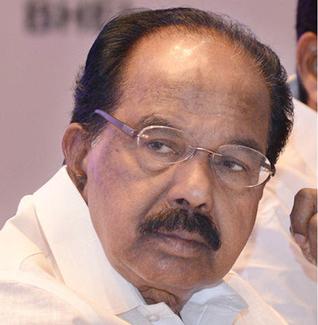
Audit a contractual obligation; RIL will abide by it: Moily

November 5, 2012

Moily_RIL

New Delhi, November 5: Amidst a row over CAG audit of Reliance Industries' KG-D6 gas field spendings, Petroleum Minister M Veerappa Moily today said audit is a contractual obligation and the company will abide by it.

"I have already gone on record to say that it is a contractual relationship between the government and the respective contracting parties... Audit (of spending on oil and gas fields) is part of this (contractual obligation)," he told reporters here.

RIL had on Saturday stated that it had never contested the government's right to get spendings on the flagging KG-D6 gas fields audited by the Comptroller and Auditor General of India (CAG) but added that the consent must not lead to a performance audit of a private firm.

"Let us not get into immediate on this. Allow them (RIL) to make a business," Moily said. "They (RIL) will abide by that (contractual obligations). We need not create problems for either for them (RIL) or for the government and CAG."

The row over CAG's second round of audit of KG-D6 field erupted after the Petroleum Ministry last week postponed a kick-off or 'Entry Conference' called to commence the scrutiny of spendings in 2008-09 to 2011-12.

The meeting was called-off due to differences over the nature and scope of audit to be conducted by CAG, with RIL saying it was open to a financial audit but not a performance scrutiny wherein complex technical decisions like hiring of a particular technology may come in for questioning.

In a Saturday evening statement, RIL said it "has at no time contested the government's right to conduct an audit by any agency, including the CAG, as provided in Section 1.9 of the Accounting Procedure of the Production Sharing Contract".

RIL said it "appreciates" CAG's reported statement that it does not conduct performance audit of private firms.


Comments

Add new comment

  • Coastaldigest.com reserves the right to delete or block any comments.
  • Coastaldigset.com is not responsible for its readers’ comments.
  • Comments that are abusive, incendiary or irrelevant are strictly prohibited.
  • Please use a genuine email ID and provide your name to avoid reject.
News Network
May 25,2020

New Delhi, May 25: Realtors' apex body CREDAI has written a letter to Prime Minister Narendra Modi, seeking immediate relief measures to tide over the crisis caused by the COVID-19 pandemic.

The association, which has around 15,000 developer members, has sought one-time debt restructuring, lower interest rate on home loans and tax sops to boost liquidity and demand in the sector.

In an open letter to the prime minister, the Confederation of Real Estate Developers' Associations of India (CREDAI) said, "In this distressful situation arising out of the COVID-19 calamity, we in the real estate sector seek immediate relief for our survival."

Stating that the sector contributes substantially to the country's GDP and has backward and forward linkages with almost 250 industries, CREDAI said, "Our survival, therefore, is not just desirable, it is rather crucial for the economy."

Liquidity crunch, stagnant demand and cartelization of raw materials are major impediments for the industry to kickstart, it added.

CREDAI made seven recommendations to revive the sector and sought immediate intervention from the prime minister.

Pointing out that the situation is "much worse" than global financial crisis in 2008, CREDAI said "a one-time restructuring scheme as was permitted by RBI in 2008 may be quickly instituted by all lending institutions."

Since real estate was already reeling under a cyclical downturn before COVID-19, debt restructuring needs to be allowed for all accounts which were standard as on December 31, 2019, it added.

CREDAI demanded that all banks, non-banking financial companies (NBFCs) and housing finance companies (HFCs) should be directed to provide additional credit equal to 20 per cent of the existing real estate project related advances with no additional security and without the classification of project as NPA.

The penal interest charged by banks and financial institutions should be suspended for a period of one year or until such time as it takes for the pandemic to abate.

To revive housing demand, CREDAI suggested that "government should reduce the maximum rate of interest on new home loans to 5 per cent by subsidizing the interest component of EMIs for next five years."

The limit of principal deduction on housing loan under Section 80C should be increased to 2.5 lakh.

Interest deduction under Section 24 on housing loan for homebuyers may be increased to Rs 10 lakh, it said.

There should be no capital gains for residential properties held for a period longer than one year.

CREDAI also demanded that the subvention scheme be allowed again by National Housing Bank (NHB) and the Reserve Bank.

Under the scheme, builders used to pay EMIs on behalf of homebuyers during construction of projects.

"The economic uncertainty and job insecurity at the moment would not allow purchase of residential property at this time. A scheme whereby a homebuyer would need to pay only margin money with no EMI for 24 months will address this insecurity," the letter said.

The association pointed out that prices of cement and steel have been increased during the lockdown period, and asked for crackdown on cartelisation by manufacturers.

On the GST front, CREDAI said that the current regime of GST provides a rate of 1 per cent  for affordable housing.

"The limit of Rs 45 lakh serves as a criterion of affordability for the purpose of GST. On all other housing, GST is applied at the rate of 5 per cent without input tax credit. It has been felt that the criterion of Rs 45 lakh is too low an index of affordability anywhere across the country, and especially so in the metros," the letter said.

It will serve as an inducement to buyers in the metros if the benefit of GST at the rate of 1 per cent is extended to units costing up to Rs 75 lakh, the association said.

CREDAI pointed out that the flat rate of 5 per cent GST for under construction residential housing is causing cost build up and is acting as a deterrent for sale of under construction projects since there is no GST on completed units.

It suggested that GST rate of 1 per cent and 5 per cent, without input tax credit, should continue.

"However, an option of GST @12 per cent for normal housing/ 8 per cent for affordable housing (with 1/3rd deduction for land i.e. effective GST rate of 8 per cent for normal housing and effective GST rate of 5 per cent for affordable housing) with input tax credit (ITC) benefits in line with the scheme applicable for the works contracts for government may be revived and made applicable to the real estate," the letter said.

Lastly, CREDAI demanded that a Rs 25,000 crore stress fund for completing stalled housing projects should be deployed at the earliest.

"We shall be grateful for your much-needed intervention for the above mentioned measures required to revive the real estate sector," CREDAI said in the letter to the PM.


Comments

Add new comment

  • Coastaldigest.com reserves the right to delete or block any comments.
  • Coastaldigset.com is not responsible for its readers’ comments.
  • Comments that are abusive, incendiary or irrelevant are strictly prohibited.
  • Please use a genuine email ID and provide your name to avoid reject.
Agencies
January 11,2020

New Delhi, Jan 11: The Supreme Court is scheduled to hear the curative petition of two death row convicts in 2012 Nirbhaya gang-rape case on January 14.

A five-judge Bench of Justices N V Ramana, Arun Mishra, R F Nariman, R Banumathi and Ashok Bhushan will hear the petition filed by Vinay Sharma and Mukesh.

The duo had moved a curative petition in the top court after a Delhi court issued a death warrant in their name and announced January 22 as the date of their execution.

Besides them, two other convicts named Pawan and Akshay are also slated to be executed on the same day at 7 am in Delhi's Tihar Jail premises.

They were convicted and sentenced to death for raping a 23-year-old woman on a moving bus in the national capital on the night of December 16, 2012.

The victim, who was later given the name Nirbhaya, died at a hospital in Singapore where she had been airlifted for medical treatment.

A curative petition is the last judicial resort available for redressal of grievances. It is decided by the judges in-chamber.

If it is rejected, they are legally bound to move a mercy petition. It is filed before the President who has the power to commute it to life imprisonment.

The court after issuing a black warrant in their name gave them two weeks' time to file both the curative and mercy petition.

Comments

Add new comment

  • Coastaldigest.com reserves the right to delete or block any comments.
  • Coastaldigset.com is not responsible for its readers’ comments.
  • Comments that are abusive, incendiary or irrelevant are strictly prohibited.
  • Please use a genuine email ID and provide your name to avoid reject.
News Network
May 11,2020

Kolkata, May 11: Murshidabad district, one of the biggest contributors to the army of migrant workers from West Bengal, received news of unnatural deaths of three of these people since Saturday. While two died in Kerala, one was found dead in a rented house in Odisha.

Residents of Baliaghati village in Murshidabad’s Suti police station area said Safikul Sheikh (31) was killed in a road accident in Kerala. Sheikh’s associates called up his family on Sunday morning and said he had gone to a local market, violating lockdown orders, when the accident took place. Sheikh wanted to return home before Eid but got stranded.

Mohammad Hafijul, one of Sheikh’s relatives, said, “A few days ago a special train from Kerala carried migrant workers to Murshidabad but Safikul did not have the money to buy a ticket. We do not know how his body will be brought back.”

In another incident, a 24-year-old resident of Domkal allegedly hanged himself in Kerala on Saturday. He used to work in a brick kiln. His mother said, “My son was depressed as he could not buy a ticket to board the special train that came to Murshidabad. We have appealed to the local administration to bring back his body.”

In the third incident, Bakul Sheikh (24) died under mysterious circumstances at Sonepur in Odisha where he went five months ago to work as a mason. Sheikh hails from Kohetpur village in Shamserganj. His relatives told the local police that his associates called up and said he was found dead inside the toilet of the house where he was living with other migrant workers.

Comments

Add new comment

  • Coastaldigest.com reserves the right to delete or block any comments.
  • Coastaldigset.com is not responsible for its readers’ comments.
  • Comments that are abusive, incendiary or irrelevant are strictly prohibited.
  • Please use a genuine email ID and provide your name to avoid reject.