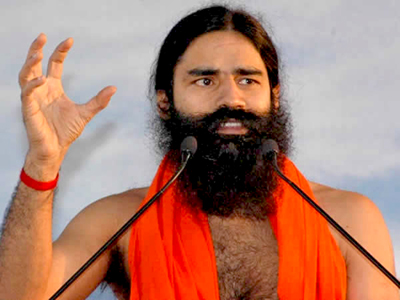
Baba Ramdev trusts asked to pay Rs.5 crore for alleged tax evasion

November 11, 2012

baba_ramdev

New Delhi, November 11: The Government has slapped a notice of Rs.five crore demand on trusts run by Baba Ramdev in connection with alleged service tax evasion while organising their yoga camps.

Claiming that shivirs (camps) undertaken by Patanjali Yoga Peeth and Divya Yoga Trust in Haridwar were commercial activity, the Revenue department has raised a demand of Rs.5.14 crore payable on fees collected from individuals for learning Yoga, officials said.

"The Directorate General of Central Excise Intelligence has sent notices for alleged service tax evasion to the tune ofRs.5.14 crore late last month. The demands have been raised for its assessment for period between 2007-08 and 2011-12," a Finance Ministry official said.

When contacted,Ramdev's spokesperson S K Tijarawala said the trusts and its activities like conducting yoga shivirs are exempted from service tax net as they are doing charitable activities for medical relief.

"Trusts' activities are barred from service tax as it is for the purpose for providing medical relief to poor. We do not have any thing to hide," he contended.

According to the Finance Ministry official, the notices were issued late last month after it found substantial documentary evidence that the trusts were avoiding service tax by conducting semi and fully residential yoga camps and calling them charitable in nature and thus claiming exemption.

"The trusts were taking donations from participants of yoga shivirs. They were also conducting a residential yoga camps through Swami Shankardev Vanprastha Asharam scheme," the official said.

The notices, issued to the trusts, also mentioned that the Finance Ministry is in the process of cancelling the Income Tax exemption status given to Ramdev trusts.

Thousands of people participate in the yoga camps conducted across the country by Swami Ramdev and trusts managed by him.

Ramdev, who is leading a campaign against black money in the country, also manages trusts which manufactures and sells ayurvedic medicines in India and abroad.

The yoga guru has declared capital ofRs.426.19 crore involving four trusts run by him-- Divya Yoga Mandir trust (Rs.249.63 crore), Patanjali Yoga Peeth trust (Rs.164.80 crore), Bharat Swabhiman trust (Rs.9.97 crore) and Acharyakul Shiksha Sansthan (Rs.1.79 crore).


Comments

Add new comment

  • Coastaldigest.com reserves the right to delete or block any comments.
  • Coastaldigset.com is not responsible for its readers’ comments.
  • Comments that are abusive, incendiary or irrelevant are strictly prohibited.
  • Please use a genuine email ID and provide your name to avoid reject.
News Network
February 19,2020

New Delhi, Feb 19: India will switch to the world's cleanest petrol and diesel from April 1 as it leapfrogs straight to Euro-VI emission compliant fuels from Euro-IV grades now - a feat achieved in just three years and not seen in any of the large economies around the globe.

India will join the select league of nations using petrol and diesel containing just 10 parts per million of sulphur as it looks to cut vehicular emissions that are said to be one of the reasons for the choking pollution in major cities.

Sanjiv Singh, Chairman of Indian Oil Corp (IOC) - the firm that controls roughly half of the country's fuel market, said almost all refineries began producing ultra-low sulphur BS-VI (equivalent to Euro-VI grade) petrol and diesel by the end of 2019 and oil companies have now undertaken the tedious task of replacing every drop of fuel in the country with the new one.

"We are absolutely on track for supplying BS-VI fuel from April 1. Almost all refineries have begun supplying BS-VI fuel and the same has reached storage depots across the country," he said.

From storage depots, the fuel has started travelling to petrol pumps and in the next few weeks all of them will only have BS-VI grade petrol and diesel, he said. "We are 100 per cent confident that fuel that will flow from nozzles at all the petrol pumps in the country on April 1 will be BS-VI emission compliant fuel."

India adopted Euro-III equivalent (or Bharat Stage-III) fuel with a sulphur content of 350 ppm in 2010 and then took seven years to move to BS-IV that had a sulphur content of 50 ppm. From BS-IV to BS-VI it took just three years.

"It was a conscious decision to leapfrog to BS-VI as first upgrading to BS-V and then shifting to BS-VI would have prolonged the journey to 4 to 6 years. Besides, oil refineries, as well as automobile manufacturers, would have had to make investments twice - first to producing BS-V grade fuel and engines and then BS-VI ones," he said.

State-owned oil refineries spent about Rs 35,000 crore to upgrade plants that could produce ultra-low sulphur fuel. This investment is on top of Rs 60,000 crore they spent on refinery upgrades in the previous switchovers.

BS-VI has a sulphur content of just 10 ppm and emission standards are as good as CNG.

Originally, Delhi and its adjoining towns were to have BS-VI fuel supplies by April 2019 and the rest of the country was to get same supplies from April 2020.

But oil marketing companies switched over to supply of BS-VI grade fuels in the national capital territory of Delhi on April 1, 2018.

The supply of BS-VI fuels was further extended to four contiguous districts of Rajasthan and eight of Uttar Pradesh in the National Capital Region (NCR) on April 1, 2019, together with the city of Agra.

BS-VI grade fuels were made available in 7 districts of Haryana from October 1, 2019.

Singh said the new fuel will result in a reduction in NOx in BS-VI compliant vehicles by 25 per cent in petrol cars and by 70 per cent in diesel cars.

The switchover, he said, is a tedious task as every drop of old, higher-sulphur content fuel has to be flushed out in depots, pipelines and tanks before being replaced by BS-VI.

"We are confident of disruption-free switchover to BS-VI supplies across the country," he said. "What we will be supplying is the best quality available anywhere in the world. You don't have any better fuel that is supplied in any part of the world. Perhaps our BS-VI fuel will be better than equivalent fuel in some parts of the US and Europe."

India adopted a fuel upgradation programme in the early 1990s. Low lead gasoline (petrol) was introduced in 1994 in Delhi, Mumbai, Kolkata and Chennai. On February 1, 2000, unleaded gasoline was mandated nationwide.

Similarly, BS-2000 (Euro-I equivalent, BS-1) vehicle emission norms were introduced for new vehicles from April 2000. BS-II (Euro-II equivalent) emission norms for new cars were introduced in Delhi from 2000 and extended to the other metro cities in 2001.

Benzene limits have been reduced progressively from 5 per cent in 2000 to 1 per cent nationwide. Lead content in gasoline was removed in phases and only unleaded gasoline is being produced and sold from February 1, 2000.

The octane number of gasoline signifies the improved performance of the engine. Loss in octane number due to phasing out of lead was made up by installing new facilities in the refinery and changes in refinery operation. RON (Research Octane Number) of gasoline for BS-2000 spec was increased to 88. This has over time been increased to 91.

Singh said sulphur reduction will reduce Particulate Matter (PM) emissions even in the in-use older generation diesel vehicles.


Comments

Add new comment

  • Coastaldigest.com reserves the right to delete or block any comments.
  • Coastaldigset.com is not responsible for its readers’ comments.
  • Comments that are abusive, incendiary or irrelevant are strictly prohibited.
  • Please use a genuine email ID and provide your name to avoid reject.
News Network
April 4,2020

Kochi, Apr 4: France on Saturday evacuated 112

French citizens stranded in Kerala and Tamil Nadu in a special Air India flight, official sources said here.

The Embassy of France had made a request to the Kerala government to facilitate the journey of the French citizens stranded due to the lockdown announced by the central government to prevent the spread of novel coronavirus.

The French citizens, mostly tourists and those who came for Ayurvedic treatment, were brought here by the state tourism department 24 days ahead of their trip.

They underwent a medical examination before boarding the flight for Paris from Cochin International Airport at 08.13 am on Saturday, officials said.

The Air India flight was chartered by the French government for evacuating its citizens in various cities in India including Kochi, Bengaluru and Mumbai.

On Friday, Gulf nation Oman had evacuated its 46 citizens stranded in Kochi in an Oman Air flight.

Comments

Add new comment

  • Coastaldigest.com reserves the right to delete or block any comments.
  • Coastaldigset.com is not responsible for its readers’ comments.
  • Comments that are abusive, incendiary or irrelevant are strictly prohibited.
  • Please use a genuine email ID and provide your name to avoid reject.
News Network
June 19,2020

New Delhi, Jun 19: RJD and AAP were not invited to the all-party meeting called by Prime Minister Narendra Modi on Friday to discuss the situation at the India-China border after 20 Indian soldiers were killed in a "violent face-off," leaving the parties fuming.

Top RJD leader Tejashwi Yadav criticised the government for not inviting the party to the meeting, asking on Twitter late Thursday night, "Just wish to know the criteria for inviting political parties for tomorrow's (Friday's) all-party meet on Galwan Valley. I mean the grounds of inclusion/exclusion. Because our party hasn't received any message so far."

AAP's Rajya Sabha leader Sanjay Singh joined the chorus, "there is a strange ego-driven government at the centre. AAP has a government in Delhi and is the main opposition in Punjab. We have four MPs. But on a vital subject, AAP's views are not needed? The country is waiting for what the Prime Minister will say at the meeting."

Sources said the government has set a criteria to invite only parties with five or more MPs in Parliament for the digital meet, where the Prime Minister will brief the top leaders of parties and hear their views on the way ahead. There are at least 27 parties in the Parliament, which have less than five members, while 17 have more than five members or more than five MPs.

Interestingly, RJD has five MPs in Rajya Sabha and its senior MP Manoj K Jha shared the Rajya Sabha website link on Twitter, which showed the party has five MPs. "We have not been invited and the government's bogus argument has been exposed," Jha said.

CPI leaders said General Secretary D Raja received a call from Defence Minister Rajnath Singh inviting him to the meeting and with a message that the Prime Minister's Office would coordinate but there was no follow-up after that.

"Exclusion of AAP and RJD in the all-party meet on a National debate does not augment well. AAP is ruling Delhi and has its CM. Why should people of Delhi be kept out in such an important debate on National integrity and Sovereignty?" former NCP MP Majeed Memon tweeted.

During the all-party meeting on COVID-19 too, the government had not called all parties with representation in Parliament to the all-party meeting in April and had set five MPs as a benchmark to be invited.

Raja had then written a letter to Modi demanding that the government should not get into "technicalities" and discuss the issue with all parties in Parliament.

Comments

Add new comment

  • Coastaldigest.com reserves the right to delete or block any comments.
  • Coastaldigset.com is not responsible for its readers’ comments.
  • Comments that are abusive, incendiary or irrelevant are strictly prohibited.
  • Please use a genuine email ID and provide your name to avoid reject.