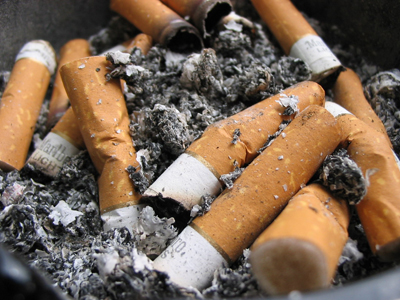
100 million deaths due to smoking in last 100 years in India

November 12, 2012

cig_sm

New Delhi, November 12: A new study has estimated that 100 million people have died due to smoking in India over the last 100 years, and the worst apparently is yet to come. Nearly 4.52 trillion cigarettes and 40.3 trillion beedis have been produced in 100 years, between 1910 and 2010 in India, according to a new study published in the journal Current Science. And in an even more shocking revelation, the study has estimated nearly a 100 million premature deaths in India, as a result of smoking in the last 100 years.

The study found that in the first 50 years between 1910 and 1960, more than 5.5 trillion beedis and 52.7 billion cigarettes were manufactured and smoked. Researchers believe these smokers mostly died in a span of the next 40-50 years.

But researchers have warned that the larger part of the epidemic is yet to occur. That is because in the last 50 years, from 1960 to 2010, smoking rates went up four times - and these are estimated to cause a large number of deaths in the next 50 years.

Study Author Dr Nevin Wilson said, "Smoking is estimated to cause 78.8 million deaths till 2050." Another study author Dr PC Gupta said that if this continues, we will see more than 200 million deaths within this century.

Presently, India has 111 million smokers, but public health experts warn of a larger health epidemic in the 164 million Indian smokeless tobacco users. Gutka is known is causing 90 per cent of all oral cancers and is responsible for the maximum number of young heart attacks, Gupta said.


Comments

Add new comment

  • Coastaldigest.com reserves the right to delete or block any comments.
  • Coastaldigset.com is not responsible for its readers’ comments.
  • Comments that are abusive, incendiary or irrelevant are strictly prohibited.
  • Please use a genuine email ID and provide your name to avoid reject.
News Network
June 30,2020

Mumbai, Jun 30: Senior Congress leader and former Union minister Prithviraj Chavan on Tuesday demanded a ban on NaMo app alleging that it was violating privacy of Indians.

The former Maharashtra chief minister also alleged that the NaMo app, the official mobile phone application of Prime Minister Narendra Modi, surreptitiously changes the privacy settings and sends data to third party companies in the US.

"Its good that Modi government is protecting privacy of 130 crore Indians by banning 59 Chinese apps. The NaMo app also violates privacy of Indians by accessing 22 data points, surreptitiously changing the privacy settings and sending data to third party companies in the US," Chavan tweeted.

India on Monday banned 59 apps with Chinese links, including hugely popular TikTok and UC Browser, saying they were prejudicial to sovereignty, integrity and security of the country.

The move came against the backdrop of the border stand-off with China and recent clash in Galwan Valley in which 20 Indian soldiers were killed.

Comments

Add new comment

  • Coastaldigest.com reserves the right to delete or block any comments.
  • Coastaldigset.com is not responsible for its readers’ comments.
  • Comments that are abusive, incendiary or irrelevant are strictly prohibited.
  • Please use a genuine email ID and provide your name to avoid reject.
Agencies
May 14,2020

New Delhi, May 14: India may witness the death of additional 1.2-6 lakh children over the next one year from preventable causes as a consequence to the disruption in regular health services due to the COVID-19 pandemic, UNICEF has warned.

The warning comes from a new study that brackets India with nine other nations from Asia and Africa that could potentially have the largest number of additional child deaths as a consequence to the pandemic.

These potential child deaths will be in addition to the 2.5 million children who already die before their fifth birthday every six months in the 118 countries included in the study.

The estimate is based on an analysis by researchers from the Johns Hopkins Bloomberg School of Public Health published in the Lancet.  

This means the global mortality rate of children dying before their fifth birthday, one of the key progress indicators in all of the global development, could potentially increase for the first time since 1960 when the data was first collected.

There were 1.04 million under-5 deaths in India in 2017, of which nearly 50% (0.57 million) were neonatal deaths. The highest number of under-5 deaths was in Uttar Pradesh (312,800 which included 165,800 neonatal deaths) and Bihar (141,500 which included 75,300 neonatal deaths).

The researchers looked at three scenarios, factoring in parameters like reduction in workforce, supplies and access to healthcare for services like family planning, antenatal care, childbirth care, postnatal care, vaccination and preventive care for early childhood. The effects are modelled for a period of three months, six months and 12 months.  

In scenario-1 marked by 10-18% reduction of coverage of all the services, the number of additional children deaths could be in the range of 30,000 plus over three months, more than 60,000 over six months and above 120,000 over the next 12 months.

Coronavirus India update: State-wise total number of confirmed cases, deaths on May 13

The numbers sharply rose to nearly 55,000; 109,000 and 219,000 respectively for scenario-2, which was associated with an 18-28% drop in all the regular services.

But in the worst-case scenario in which 40-50% of the services are not available, the number of additional deaths ballooned to 1.5 lakhs in the three months in the short-range to nearly six lakhs over a year.

The ten countries that could potentially have the largest number of additional child deaths are Bangladesh, Brazil, Congo, Ethiopia, India, Indonesia, Nigeria, Pakistan, Uganda and Tanzania.

In countries with already weak health systems, COVID-19 is causing disruptions in medical supply chains and straining financial and human resources.

Visits to health care centres are declining due to lockdowns, curfews and transport disruptions, and due to the fear of infection among the communities. Such disruptions could result in potentially devastating increases in maternal and child deaths, the UN agency warned.

Comments

Add new comment

  • Coastaldigest.com reserves the right to delete or block any comments.
  • Coastaldigset.com is not responsible for its readers’ comments.
  • Comments that are abusive, incendiary or irrelevant are strictly prohibited.
  • Please use a genuine email ID and provide your name to avoid reject.
Agencies
May 19,2020

Ahmedabad, Nay 19: Over 2,200 Indian nationals stranded in the UK due to the coronavirus related international travel restrictions have been flown back home during the first phase of India's biggest ever repatriation exercise, according to official figures.

Since the first special Air India flight took off from London’s Heathrow Airport for Mumbai on May 8, there have been eight routes to different Indian cities from the UK for Indian students and tourists.

Indian nationals were flown home to the cities of Mumbai, New Delhi, Bengaluru, Chennai and Ahmedabad.

“We have facilitated repatriation of 2,288 Indians stranded in the UK through eight Air India flights till 17 May. Vande Bharat Mission continues to get Indians home,” said the Indian High Commission in London.

The Vande Bharat Mission is India’s biggest ever repatriation exercise to bring back Indians from abroad who are unable to travel home due to COVID-19 related international travel restrictions.

As the second phase of the repatriation process gets underway, retired Indian High Commissioner to the UK Ruchi Ghanashyam will be among the Indians flying back to New Delhi on Thursday.

“It has been such a hectic period, but I hope to return to the UK to say goodbyes in person sometime in the future,” Ghanashyam said during a virtual farewell organised by the Indian Journalists’ Association (IJA UK) on Monday.

As the packed flights take off daily, there are some still desperately waiting their turn, including those wanting to fly to some cities that are yet to be scheduled, including Kolkata.

“I have two young daughters, elderly parents, and a wife back at home. There is no way to return to Kolkata. I am worried for my parents,” says Suvendu, who came to the UK for work but recently lost his job.

“I am really surprised there are no Kolkata flights yet, but I am hoping they will be announced in the future,” adds Dr Arpita Ray, whose father needs to fly back home.

Another group waiting their turn to return home to their families in India includes students in the Overseas Citizen of India (OCI) category, which remains suspended in India’s extended COVID-19 lockdown.

According to the regulations issued by the Indian government last month and updated last week, visas of foreign nationals and OCI cards, that provide visa-free travel privileges to the people of Indian-origin, have been suspended as part of the new international travel restrictions following the COVID-19 pandemic.

“Our plight is no different from the struggles being faced by Indian students who hold Indian passports – India is home for all us,” says Tridip, an undergraduate at SOAS University of London.

“Yes, air travel at this point of time may be a risk but we are of course ready to take all precautionary measures and undergo the mandatory quarantine period upon arrival in India," adds the 18-year-old.

“Having lived in India for the greater part of my life, India is home to me as much as it is to an Indian citizen, and just as any Indian citizen wishes for the comfort of home and family, so do I. I can only hope that the government reviews its policy on OCI holders and appeal to them to include us in their repatriation plans," says Atulit, an under-graduate student at Imperial College London.

Bianta, a student at Bangor University in Wales, adds: “Along with all of the mental stress, financially the UK is too expensive. In the coming weeks my rental agreement will expire, after which I will have nowhere to go.

“I cannot continue funding myself here in the UK as I only planned to be here till May marking the end of my course. Please help us get home. The colour of my passport does not define where my home is."

As all commercial international flights continue to be grounded, the second phase of the Vande Bharat Mission with a total of 149 flights is aimed at bringing back Indians from 40 countries. On landing in India, these travellers have a 14-day quarantine requirement at venues organised by the respective state governments. 

Comments

Add new comment

  • Coastaldigest.com reserves the right to delete or block any comments.
  • Coastaldigset.com is not responsible for its readers’ comments.
  • Comments that are abusive, incendiary or irrelevant are strictly prohibited.
  • Please use a genuine email ID and provide your name to avoid reject.