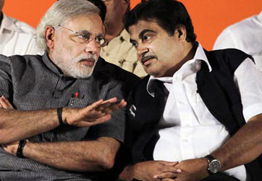
Gadkari rejects ‘insinuation’ made by RSS member, says party united behind Modi

[email protected] (The Hindu)
November 13, 2012

modi_gadkeri

New Delhi, November 13: The controversy over the propriety of Nitin Gadkari continuing as the Bharatiya Janata Party (BJP) president continuing in office refuses to die down and now the Rashtriya Swayamsevak Sangh (RSS) has been dragged into it directly.

Stunned by veteran RSS member M.G. Vaidya’s blog entry that Gujarat Chief Minister Narendra Modi could be behind the campaign within the BJP for ousting Mr. Gadkari, the BJP president issued a statement that his party rejected ‘insinuation’ made by the senior RSS member.

“The writer has tried to link recent comments by one of the party MPs with Mr. Modi. The BJP completely rejects such insinuation, as it is totally unfounded. All Central leaders of the party and its Chief Ministers have been working cohesively and unitedly for the party’s cause. We are fighting Gujarat Assembly elections with complete unity of purpose and total mutual confidence. The BJP is firmly and unitedly behind Mr. Modi and we are confident that the party will win decisively in the ensuing assembly elections,” Mr. Gadkari said in a written statement.

However, RSS propaganda chief Manmohan Vaidya sought to play down Mr. Vaidya’s comments, saying the article only expressed Mr. Vaidya’s “personal views” and it was not the Sangh’s official view.

Ever since anti-corruption activist-turned-politician Arvind Kejriwal trained his guns on Mr. Gadkari for the alleged wrongdoings by a company owned by him, there have been murmurs within the BJP that an influential section within is targeting Mr. Gadkari. However, it is for the first time that any one has pointed fingers at Mr. Modi.

The rumblings within the BJP surfaced after BJP Rajya Sabha MP Ram Jethmalani and his son Mahesh Jethmalani went public saying Mr. Gadkari should immediately step down from his post as the charges against him were damaging to the party.

The senior Jethmalani claimed the backing of other party leaders like Jaswant Singh, Yashwant Sinha and Shatrughan Sinha. The campaign within the BJP against Mr. Gadkari is widely perceived as a power struggle among senior leaders with an eye on the 2014 elections.

Last week, a prominent RSS face and BJP National Executive member Jagadish Shettigar joined the ranks of those demanding the resignation of Mr. Gadkari. The growing chorus within the party makes it very difficult for Mr. Gadkari to even consider bidding for a second term.

The discomfort within the party over the allegations against Mr. Gadkari is evident from the fact that the BJP’s top brass had to meet twice in a span of less than three weeks to affirm their support for him.


Comments

Add new comment

  • Coastaldigest.com reserves the right to delete or block any comments.
  • Coastaldigset.com is not responsible for its readers’ comments.
  • Comments that are abusive, incendiary or irrelevant are strictly prohibited.
  • Please use a genuine email ID and provide your name to avoid reject.
News Network
February 14,2020

London, Feb 14: Liquor tycoon Vijay Mallya once again asked the Indian banks to take back 100 per cent of the principal amount owed to them at the end of his three-day British High Court appeal on Thursday against an extradition order to India.

The 64-year-old former Kingfisher Airlines boss, wanted in India on charges of fraud and money laundering amounting to an alleged Rs 9,000 crores in unpaid bank loans, said the Enforcement Directorate (ED) and the Central Bureau of Investigation (CBI) are fighting over the same assets and not treating him reasonably in the process.

“I request the banks with folded hands, take 100 per cent of your principal back, immediately,” he said outside the Royal Courts of Justice in London.

“The Enforcement Directorate attached the assets on the complaint by the banks that I was not paying them. I have not committed any offenses under the PMLA (Prevention of Money Laundering Act) that the Enforcement Directorate should suo moto attach my assets," he said.

"I am saying, please banks take your money. The ED is saying no, we have a claim over these assets. So, the ED on the one side and the banks on the other are fighting over the same assets,” he added.

Asked about heading back to India, he noted: “I should be where my family is, where my interests are.

"If the CBI and the ED are going to be reasonable, it’s a different story. What all they are doing to me for the last four years is totally unreasonable.”

Lord Justice Stephen Irwin and Justice Elisabeth Laing, the two-member bench presiding over the appeal, concluded hearing the arguments in the case and said they will be handing down their verdict at a later date after considering the oral as well as written submissions in the “very dense” case over the next few weeks.

On a day of heated arguments between Mallya’s barrister, Clare Montgomery, and Crown Prosecution Service (CPS) counsel Mark Summers, arguing on behalf of the Indian government, both sides clashed over the prima facie case of fraud and deception against Mallya.

“We submit that he lied to get the loans, then did something with the money he wasn’t supposed to and then refused to give back the money. All this could be perceived by a jury as patently dishonest conduct,” said Summers.

“What they [Kingfisher Airlines] were saying [to the banks] about profitability going forward was knowingly wrong,” he said, as he took the High Court through evidence to counter Mallya’s lawyers’ claims that Westminster Magistrates Court Judge Emma Arbuthnot had fallen into error when she found a case to answer in the Indian courts against Mallya.

Mallya, who remains on bail on an extradition warrant, is not required to attend the hearings but has been in court to observe the proceedings since the three-day appeal opened on Tuesday. A key defence to disprove a prima facie case of fraud and misrepresentation on his part has revolved around the fact that Kingfisher Airlines was the victim of economic misfortune alongside other Indian airlines.

However, the CPS has argued that “there is enough in the 32,000 pages of overall evidence to fulfil the [extradition] treaty obligations that there is a case to answer”. “There is not just a prima facie case but overwhelming evidence of dishonesty… and given the volume and depth of evidence the District Judge [Arbuthnot] had before her, the judgment is comprehensive and detailed with the odd error but nothing that impacts the prima facie case,” said Summers.

At the start of the appeal, Mallya’s counsel claimed Arbuthnot did not look at all of the evidence because if she had, she would not have fallen into the multiple errors that permeate her judgment. The High Court must establish if the magistrates’ court had in fact fallen short on a point of law in its verdict in favour of extradition.

Representatives from the Enforcement Directorate (ED) and Central Bureau of Investigation (CBI), as well as the Indian High Commission in London, have been present in court to take notes during the course of the appeal hearing.

Mallya had received permission to appeal against his extradition order signed off by former UK home secretary Sajid Javid last February only on one ground, which challenges the Indian government's prima facie case against him of fraudulent intentions in acquiring bank loans.

At the end of a year-long extradition trial at Westminster Magistrates’ Court in London in December 2018, Judge Arbuthnot had found “clear evidence of dispersal and misapplication of the loan funds” and accepted a prima facie case of fraud and a conspiracy to launder money against Mallya, as presented by the CPS on behalf of the Indian government.

Mallya remains on bail since his arrest on an extradition warrant in April 2017 involving a bond worth 650,000 pounds and other restrictions on his travel while he contests that ruling.

Comments

Add new comment

  • Coastaldigest.com reserves the right to delete or block any comments.
  • Coastaldigset.com is not responsible for its readers’ comments.
  • Comments that are abusive, incendiary or irrelevant are strictly prohibited.
  • Please use a genuine email ID and provide your name to avoid reject.
Agencies
July 20,2020

Mumbai, Jul 20: The Bombay High Court on Monday asked the NIA and the Maharashtra government to inform it about the health condition of poet Varavara Rao, an accused in the Elgar Parishad-Maoists links case, and if his family could be allowed to see him "from a reasonable distance".

The directions came after Rao's lawyer told the court that the activist was "almost on his deathbed".

Rao, 81, is currently admitted in the Nanavati Hospital here. He tested positive for coronavirus earlier this month and is also suffering from several other ailments.

A division bench of Justices S S Shinde and S P Tavade asked the National Investigation Agency (NIA) and the state to inform the court about Rao's health condition and clarify by July 22 whether his family members could be permitted to see him.

Rao's lawyer Sudeep Pasbola told the court that the activist was "almost on his deathbed" and that if he were to die, it should be in the presence of his family.

"His condition is very serious. He hit his head against the hospital bed while he was at the J J hospital and sustained severe injuries. Besides COVID-19, he suffers from several ailments, he is hallucinating and is delirious," Pasbola said.

"His days are numbered and if he is to die, at least let him die in the presence of his family members," the lawyer said while seeking that Rao be granted bail. Pasbola said Rao was in no condition to cause any prejudice to the probe in the case and even the NIA could not dispute this fact.

The bench, however, asked if Rao was in such a critical condition, wouldn't it be counterproductive to move him out of the hospital, and take him to any other place? "Also, if he has COVID-19, then how can he meet his family?" the court asked.

To this, Pasbola said if permitted, Rao's family could take precautions, and see him from a distance. The state's counsel, Deepak Thakare, told the high court that it could arrange for video-conferencing facilities for Rao's family.

Additional Solicitor General Anil Singh, who appeared for the NIA, said as far as he knew, "COVID-19 patients could not be permitted to meet anyone". He also said Rao had been admitted to "one of the best multi-speciality hospitals in the city," and that he was being taken care of in accordance with guidelines of the Indian Council of Medical Research (ICMR).

"We are providing the best treatment to him, all his medical needs are being attended to and we are following ICMR guidelines in treating him for COVID-19," Singh said. The court, while seeking details from the NIA and the state, said, "Can his family members see him from a reasonable distance in the hospital?"

Rao earlier filed two pleas in HC through his lawyer. One was to direct the state to produce all his medical reports from the state-run J J Hospital, where he was admitted in May but discharged hurriedly on June 2 and sent back to Taloja jail in neighbouring Navi Mumbai.

The other plea sought bail on health grounds.

The same bench also heard a petition filed by Rao's co-accused in the case, activists Vernon Gonsalves and Anand Teltumbde, seeking that they be tested for COVID-19 as they had been in close contact with Rao in the jail.

The court directed the prison authorities and the NIA to respond to the plea by July 23. "The prayer in the petition is limited. You (authorities) carry out the test for COVID-19 and see. If they are negative then good," the court said.

It noted that they (Gonsalves and Teltumbde) are lodged in the Taloja jail where there have been cases of inmates testing positive for coronavirus. Besides, the hearing on the plea of activist Sudha Bharadwaj, also an accused in the case, seeking bail on health grounds was adjourned after the court found the Byculla women prison superintendent's report on her health to be "illegible".

Her plea will also be heard on July 23.

Bharadwaj has been in jail since September 2018. She applied for bail on health grounds after an inmate at the Byculla prison tested positive for coronavirus last month.

Rao and nine other activists were arrested in the Elgar Parishad-Maoist links case, which was initially probed by the Pune Police and later transferred to the NIA.

Comments

Add new comment

  • Coastaldigest.com reserves the right to delete or block any comments.
  • Coastaldigset.com is not responsible for its readers’ comments.
  • Comments that are abusive, incendiary or irrelevant are strictly prohibited.
  • Please use a genuine email ID and provide your name to avoid reject.
Agencies
May 27,2020

New Delhi, May 27: India’s fourth recession since Independence, first since liberalisation, and perhaps the worst to date is here, according to rating agency, Crisil.

CRISIL sees the Indian economy shrinking 5 per cent in fiscal 2021 (on-year), because of the Covid-19 pandemic. The first quarter will suffer a staggering 25 per cent contraction.

About 10 per cent of gross domestic product (GDP) in real terms could be permanently lost. "So going back to the growth rates seen before the pandemic is unlikely in the next three fiscals", Crisil said.

Crisil has revised its earlier forecast downwards. "Earlier, on April 28, we had slashed our prediction to 1.8 per cent growth from 3.5 per cent growth. Things have only gone downhill since", it said.

While we expect non-agricultural GDP to contract 6 per cent, agriculture could cushion the blow by growing at 2.5 per cent.

In the past 69 years, India has seen a recession only thrice as per available data in fiscals 1958, 1966 and 1980. The reason was the same each time a monsoon shock that hit agriculture, then a sizeable part of the economy.

"The recession staring at us today is different," it added. For one, agriculture could soften the blow this time by growing near its trend rate, assuming a normal monsoon. Two, the pandemic-induced lockdowns have affected most non-agriculture sectors. And three, the global disruption has upended whatever opportunities India had on the exports front.

Economic conditions have slid precipitously since the April-end forecast of 1.8 per cent GDP growth for fiscal 2021 (baseline), Crisil said.

On the lockdown extension, it said that the government has extended the lockdown four times to deal with the rising number of cases, curtailing economic activity severely (lockdown 4.0 is ending on May 31).

The first quarter of this fiscal will be the worst affected. June is unlikely to see major relaxations as the Covid-19 affliction curve is yet to flatten in India.

"Not only will the first quarter be a washout for the non-agricultural economy, services such as education, and travel and tourism among others, could continue to see a big hit in the quarters to come. Jobs and incomes will see extended losses as these sectors are large employers," Crisil said.

CRISIL also foresees economic activity in states with high Covid-19 cases to suffer prolonged disruption as restrictions could continue longer.

A rough estimate based on a sample of eight states, which contribute over half of India's GDP, shows that their 'red zones' (as per lockdown 3.0) contributed 42 per cent to the state GDP on average regardless of the share of such red zones.

On average, the orange zones contribute 46 per cent, while the green zones where activity is allowed to be close to normal contribute only 12 per cent to state GDP.

The economic costs are higher than earlier expectations, according to Crisil. The economic costs now beginning to show up in the hard numbers are far worse than initial expectations.

Industrial production for March fell by over 16%. The purchasing managers indices for the manufacturing and services sectors were at 27.4 and 5.4, respectively, in April, implying extraordinary contraction. That compares with 51.8 and 49.3, respectively, in March.

Exports contracted 60.3 per cent in April, and new telecom subscribers declined 35 per cent, while railway freight movement plunged 35 per cent on-year.

"Indeed, given one of the most stringent lockdowns in the world, April could well be the worst performing month for India this fiscal," it said.

Added to that is the economic package without enough muscle. The government recently announced a Rs 20.9 lakh crore economic relief package to support the economy. The package has some short-term measures to cushion the economy, but sets its sights majorly on reforms, most of which will have payoffs only over the medium term.

"We estimate the fiscal cost of this package at 1.2 per cent of GDP, which is lower than what we had assumed in our earlier estimate (when we foresaw a growth in GDP)," it said.

"We believe a catch-up to the pre-crisis trend level of GDP growth will not be possible in the next three fiscals despite policy support. Under the base case, we estimate a 10 per cent permanent loss to real GDP (from the decadal-trend level), assuming average growth of about 7 per cent between fiscals 2022 and 2024," Crisil said.

Interestingly, after the Global Financial Crisis (GFC), a sharp growth spurt helped catch up with the trend within two years. GDP grew 8.2 per cent on average in the two fiscals following the GFC. Massive fiscal spending, monetary easing and swift global recovery played a role in a V-shaped recovery.

To catch-up would require average GDP growth to surge to 11 per cent over the next three fiscals, something that has never happened before.

The research said that successive lockdowns have a non-linear and multiplicative effect on the economy a two-month lockdown will be more than twice as debilitating as a one-month imposition, as buffers keep eroding.

Partial relaxations continue to be a hindrance to supply chains, transportation and logistics. Hence, unless the entire supply chain is unlocked, the impact of improved economic activity will be subdued.

Therefore, despite the stringency of lockdown easing a tad in the third and the fourth phases, their negative impact on GDP is expected to massively outweigh the benefits from mild fiscal support and low crude oil prices, especially in the April-June quarter. "Consequently, we expect the current quarter's GDP to shrink 25 per cent on-year," it said.

Counting lockdown 4.0, Indians have had 68 days of confinement. S&P Global estimates that one month of lockdown shaves 3 per cent off annual GDP on average across Asia-Pacific.

Since India's lockdown has been the most stringent in Asia, the impact on economic growth will be correspondingly larger.

Google's Community Mobility Reports show a sharp fall in movement of people to places of recreation, retail shops, public transport and workplace travel. While data for May shows some improvement in India, mobility trends are much below the average or baseline, and lower compared with countries such as the US, South Korea, Brazil and Indonesia.


Comments

Add new comment

  • Coastaldigest.com reserves the right to delete or block any comments.
  • Coastaldigset.com is not responsible for its readers’ comments.
  • Comments that are abusive, incendiary or irrelevant are strictly prohibited.
  • Please use a genuine email ID and provide your name to avoid reject.