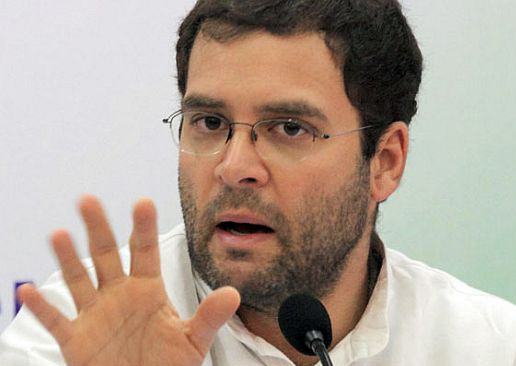
EC orders probe into Subramanian Swamy's charges against Rahul Gandhi

November 17, 2012

Rahul

New Delhi, November 17: The Election Commission has asked the returning officer of Amethi Lok Sabha constituency to probe allegations by Subramanian Swamy that Rahul Gandhi gave "wrong information" regarding his assets while filing nomination papers in the 2009 polls.

In a letter to chief electoral officer on November 15, the commission said Swamy has alleged that Gandhi had given "wrong information" relating to his assets and cited a June 2004 letter which said the returning officer is the competent authority to look into such complaints.

"Since the affidavit is filed before the Returning Officer, in view of the provisions of Section 195 of CrPC, it is the Returning Officer concerned, who is the competent authority to consider any complaint regarding false statement in the affidavit...," the EC letter said.

The letter written by principal secretary R K Srivastava also said if the returning officer is satisfied that the affidavit contained false statement, he can take appropriate follow up action.

The commission directed the CEO to forward Swamy's complaint to the returning officer for appropriate action.

"The commission may be kept informed of the action taken in the matter," the letter said.

Swamy had earlier this month alleged that Gandhi did not show shares owned by him in Associated Journals which ran the now-defunct National Herald newspaper in the affidavit he filed during Lok Sabha elections in 2009.


Comments

Add new comment

  • Coastaldigest.com reserves the right to delete or block any comments.
  • Coastaldigset.com is not responsible for its readers’ comments.
  • Comments that are abusive, incendiary or irrelevant are strictly prohibited.
  • Please use a genuine email ID and provide your name to avoid reject.
News Network
January 13,2020

Jan 13: For the first time in years, the government of India’s Prime Minister Narendra Modi is playing defense. Protests have sprung up across the country against an amendment to India’s laws — which came into effect on Friday — that makes it easier for members of some religions to become citizens of India. The government claims this is simply an attempt to protect religious minorities in the Muslim-majority countries that border India; but protesters see it as the first step toward a formal repudiation of India’s constitutionally guaranteed secularism — and one that must be resisted.

Modi was re-elected prime minister last year with an enhanced majority; his hold over the country’s politics is absolute. The formal opposition is weak, discredited and disorganized. Yet, somehow, the anti-Citizenship Act protests have taken hold. No political party is behind them; they are generally arranged by student unions, neighborhood associations and the like.

Yet this aspect of their character is precisely what will worry Modi and his right-hand man, Home Minister Amit Shah. They know how to mock and delegitimize opposition parties with ruthless efficiency. Yet creating a narrative that paints large, flag-waving crowds as traitors is not quite that easy.

For that is how these protests look: large groups of young people, many carrying witty signs and the national flag. They meet and read the preamble to India’s Constitution, into which the promise of secularism was written in the 1970’s.

They carry photographs of the Constitution’s drafter, the Columbia University-trained economist and lawyer B. R. Ambedkar. These are not the mobs the government wanted. They hoped for angry Muslims rampaging through the streets of India’s cities, whom they could point to and say: “See? We must protect you from them.” But, in spite of sometimes brutal repression, the protests have largely been nonviolent.

One, in Shaheen Bagh in a Muslim-dominated sector of New Delhi, began simply as a set of local women in a square, armed with hot tea and blankets against the chill Delhi winter. It has now become the focal point of a very different sort of resistance than what the government expected. Nothing could cure the delusions of India’s Hindu middle class, trained to see India’s Muslims as dangerous threats, as effectively as a group of otherwise clearly apolitical women sipping sweet tea and sharing their fears and food with anyone who will listen.

Modi was re-elected less than a year ago; what could have changed in India since then? Not much, I suspect, in most places that voted for him and his party — particularly the vast rural hinterland of northern India. But urban India was also possibly never quite as content as electoral results suggested. India’s growth dipped below 5% in recent quarters; demand has crashed, and uncertainty about the future is widespread. Worse, the government’s response to the protests was clearly ill-judged. University campuses were attacked, in one case by the police and later by masked men almost certainly connected to the ruling party.

Protesters were harassed and detained with little cause. The courts seemed uninterested. And, slowly, anger began to grow on social media — not just on Twitter, but also on Instagram, previously the preserve of pretty bowls of salad. Instagram is the one social medium over which Modi’s party does not have a stranglehold; and it is where these protests, with their photogenic signs and flags, have found a natural home. As a result, people across urban India who would never previously have gone to a demonstration or a political rally have been slowly politicized.

India is, in fact, becoming more like a normal democracy. “Normal,” that is, for the 2020’s. Liberal democracies across the world are politically divided, often between more liberal urban centers and coasts, and angrier, “left-behind” hinterlands. Modi’s political secret was that he was that rare populist who could unite both the hopeful cities and the resentful countryside. Yet this once magic formula seems to have become ineffective. Five of India’s six largest cities are not ruled by Modi’s Bharatiya Janata Party in any case — the financial hub of Mumbai changed hands recently. The BJP has set its sights on winning state elections in Delhi in a few weeks. Which way the capital’s voters will go is uncertain. But that itself is revealing — last year, Modi swept all seven parliamentary seats in Delhi.

In the end, the Citizenship Amendment Act is now law, the BJP might manage to win Delhi, and the protests might die down as the days get unmanageably hot and state repression increases. But urban India has put Modi on notice. His days of being India’s unifier are over: From now on, like all the other populists, he will have to keep one eye on the streets of his country’s cities.


Comments

Add new comment

  • Coastaldigest.com reserves the right to delete or block any comments.
  • Coastaldigset.com is not responsible for its readers’ comments.
  • Comments that are abusive, incendiary or irrelevant are strictly prohibited.
  • Please use a genuine email ID and provide your name to avoid reject.
News Network
March 20,2020

New Delhi, Mar 20: Bodies of the four Nirbhaya convicts who were hanged on Friday morning at Tihar Jail have been sent to hospital for a post-mortem, following which it will be handed over to the families, according to an official.

After the hanging at 5:30 am today, the bodies were taken from Tihar Jail to Deen Dayal Upadhyay (DDU) Hospital for post mortem at around 8:20 am.

Tihar jail Director-General Sandeep Goel said that the bodies will be handed over to the families after the post mortem.

The families, however, will have to give a written undertaking that they will not make a public demonstration of the cremation or burial of the executed person.

The superintendent will also consult the District Magistrate and the Deputy Commissioner of Police for arrangements for the disposal of the body.

The post mortem comes in line with the Supreme Court's order in Shatrughan Chauhan's case in January 2014, which had mandated the same observing that there is a dearth of experienced hangman in the country.

"By making the performance of post mortem obligatory, the cause of the death of the convict can be found out, which will reveal whether the person died as a result of the dislocation of the cervical vertebrate or by strangulation which results on account of too long a drop," the apex court had said in its order.

"Our constitution permits the execution of death sentence only through the procedure established by law and this procedure must be just, fair and reasonable," the order added.

All four convicts in the 2012 Nirbhaya gang-rape and murder case -- Akshay Singh Thakur, Pawan Gupta, Vinay Sharma, and Mukesh Singh -- were hanged till death at 5:30 am this morning.

The case pertains to the brutal gang-rape and killing of a 23-year-old paramedical student in a moving bus on the night of December 16, 2012, by six people including a juvenile in the national capital. The woman had died at a Singapore hospital a few days later.

One of the adults accused had allegedly committed suicide in the prison during the trial, while the juvenile was released from a correction home after a period of three years.

Comments

Add new comment

  • Coastaldigest.com reserves the right to delete or block any comments.
  • Coastaldigset.com is not responsible for its readers’ comments.
  • Comments that are abusive, incendiary or irrelevant are strictly prohibited.
  • Please use a genuine email ID and provide your name to avoid reject.
News Network
March 26,2020

Panaji, Mar 26: Three persons, all with travel history abroad, tested positive for coronavirus in Goa on Wednesday, health department officials said, as the tourist haven joined the states which have reported COVID-19 cases.

This is the first time the tourist state has reported coronavirus positive cases.

The Directorate of Health Services, in a late night press statement here, said three suspected cases of COVID-19 from Goa, whose test results were awaited, have turned out positive.

All three are male patients of ages 25, 29 and 55 years. They have travel history of returning to Goa from Spain, Australia and the USA, respectively, the officials said.

The condition of the trio, admitted in Goa Medical College and Hospital near here, is stable, the officials added.

Chief Minister Pramod Sawant said the state is providing the best healthcare facility to the diagnosed patients.

I have been informed by the state Directorate of Health services that three individuals have been tested positive for #COVID19 in Goa.

"We are providing the best healthcare facility to the diagnosed patients, he said.

Their condition is stable at present. e have also traced their contacts and are quarantining them, Sawant added.

Health Minister Vishwajit Rane said the government is taking all precautions and following guidelines related to the viral infection.

In view of the three positive coronavirus cases in Goa, we are following all guidelines laid down by the central government and taking all precautions with the support of chief minister Pramod Sawant, he said.

Our testing facility will be up and running in the next two days. Our team of doctors is doing its est to make sure we contain the spread of virus in the state, Rane added.

Comments

Add new comment

  • Coastaldigest.com reserves the right to delete or block any comments.
  • Coastaldigset.com is not responsible for its readers’ comments.
  • Comments that are abusive, incendiary or irrelevant are strictly prohibited.
  • Please use a genuine email ID and provide your name to avoid reject.