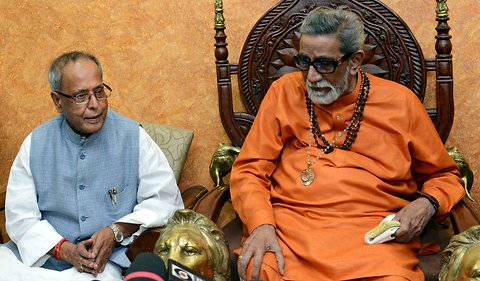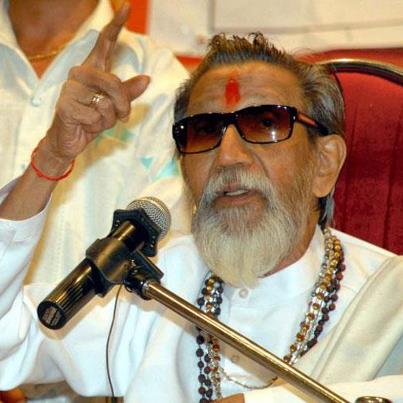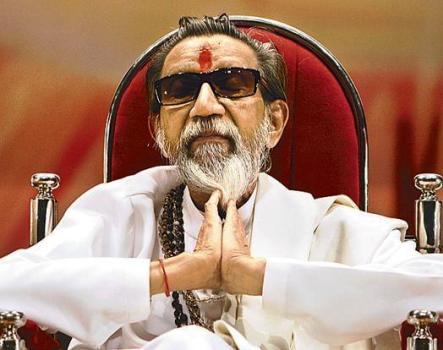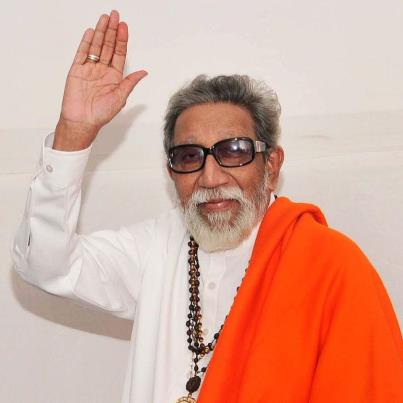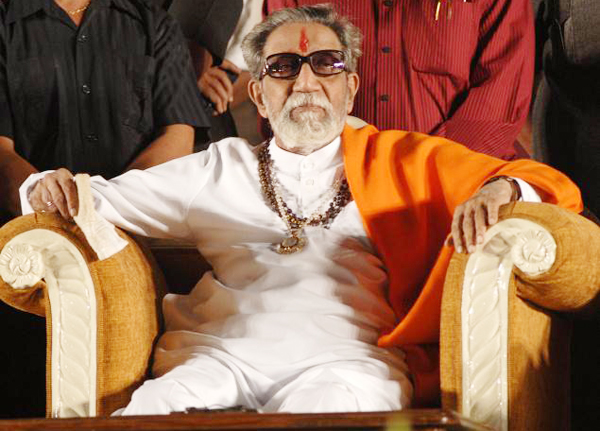
Bal Thackeray, Shiv Sena founder, dies at 86 in Mumbai

November 17, 2012
tackre

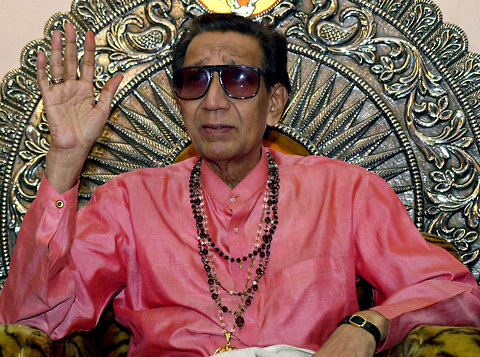
Mumbai, November 17: Bal Thackeray, a maverick politician who roused emotions on Marathi pride and catapulted Shiv Sena to power in Maharashtra in the 1990s, died today after having been critically ill for the past few days.

The 86-year-old cartoonist turned politician, known for his strong views and speaking his mind, sometimes bordering on the offensive, breathed his last at 3.30 PM at his residence 'Matoshree' in suburban Bandra.

"He had suffered a cardiac arrest. We could not revive him despite our best efforts. He breathed his last at around 3:30 PM," Dr Jalil Parkar, who treated the Sena supremo, told reporters after emerging from Thackeray residence this evening.

Thackeray is survived by sons Jaidev and Uddhav, who is the Executive President of the party. His nephew Raj had split from the family and found his own Maharashtra Navnirman Sena over six years ago following a succession row.

A rabble rouser, who started out as a cartoonist alongside R K Laxman in the Free Press Journal in the 1950s, founded the Shiv Sena in 1966 on the plank of job security for the Marathi manoos (sons of the soil) which translated into attacks on South Indians whom he had blamed for taking away the opportunities from the locals.

Later, his politics also centred around Hindu identity and anti-Congressism and was also unrestrained in his Muslim bashing.

Known for paralysing Bombay, as Mumbai was called then, at any opportunity, Thackeray initially concentrated on the metropolis but later spread his politics throughout the state and tied up with the BJP to remain its longest ally till date, sharing the saffron agenda.

Always the kingmaker, Thackeray was largely instrumental in ending the Congress hegemony in Maharashtra when the two parties stormed to power in 1994 and they shared power even at the Centre between 1998 and 2004. He never occupied any office.

Thackeray, who had relegated himself to the background after anointing Uddhav as his successor, had been suffering from respiratory problems and pancreatic disease.

Senior party leaders, Raj Thackeray along with family members and other political leaders rushed to 'Matoshree'.

Meanwhile, security has been stepped up in the metropolis in the wake of Thackeray's death.

President Pranab Mukherjee and Prime Minister Manmohan Singh condoled the death of Thackeray. Singh cancelled a dinner for BJP leaders scheduled today ahead of Parliament session following Sushma Swaraj's request.

Interestingly, notwithstanding his strong anti-Congress stand, Thackeray extended his party's support to Pratibha Patil, also from Maharashtra, in the Presidential election in 2006 and later to Mukerjee in this year's election.

Despite the setback in his health in the last few days, Sena leaders and the party mouthpiece 'Saamna' kept maintaining that he was improving. Eminent personalities from politics, Bollywood and industry have been thronging his residence ever since.

Media persons and Sena workers stationed outside 'Matoshree' realised around 4 PM that there was some development as several senior leaders from Sena, BJP and other parties started arriving and police were seen to have become more alert.

As the speculation rose, Shiv Sena leaders Sanjay Raut, Diwakar Raote accompanied by Dr Jalil Parkar, who had been treating Thackeray for the last three years, came out around 5 pm to announce Thackeray's demise.

On hearing the news, a frenzied mob of Shiv sainiks tried to enter 'Matoshree' by raising slogans "Bal Thackeray Amar Rahe' while police tried to prevent them from going inside and enhanced security allover.

Many of them in the crowd broke down on hearing the news about their leader's death.

Thackeray's health kept fluctuating since last few days with his son Uddhav appealing to Sainiks "to maintain calm and pray for his father" on Thursday night.

Shiv Sena spokesperson Sanjay Raut appealed to people to maintain peace and harmony.

Thackeray was being treated by doctors from Lilavati Hospital. No medical bulletin was issued, but Sena leaders briefed the media daily.

The condition of Sena patriarch worsened on Wednesday night when he had to be put on life support. He was taken off life support later after showing signs of improvement. In the last three days there was a steady stream of visitors to Matoshree, including Bollywood personalities. Among them were Amitabh Bachchan and his family, Salman Khan along with father Salim and brother Arbaaz, filmmaker Madhur Bhandarkar, actress Hema Malini, yesteryear stars Manoj Kumar, Jitendra and Rakesh Roshan.

Political bigwigs like NCP chief and Union Agriculture Minister Sharad Pawar — Thackeray's old friend; BJP president Nitin Gadkari, and senior leader Gopinath Munde, Maharashtra chief minister Prithviraj Chavan, home minister R R Patil, finance minister Jayant Patil among others visited Matoshree.

Thackeray addressed Shiv Sainiks every year on Dussehra at Mumbai's Shivaji Park since Sena's inception. However, this year he could not attend the annual event, and his recorded address was telecast.

In this recorded speech, Thackeray, visibly very ill, appealed the workers to support his son and executive president Uddhav Thackeray, and grandson and Sena youth wing president Aditya Thackeray. "I have collapsed physically," he had said.

Related: Bal Thackeray: Leader who brought ethnic politics to Mumbai melting pot
BT1

BT2

BT3

BT4

BT5


Comments

Add new comment

  • Coastaldigest.com reserves the right to delete or block any comments.
  • Coastaldigset.com is not responsible for its readers’ comments.
  • Comments that are abusive, incendiary or irrelevant are strictly prohibited.
  • Please use a genuine email ID and provide your name to avoid reject.
News Network
June 27,2020

New Delhi, Jun 27: Delhi Environment Minister Gopal Rai on Saturday called an emergency meeting here to discuss the situation following a locust attack in neighbouring Gurugram.

The minister also directed the administration to be alert, an official said.

"After the emergency meeting, an advisory will be issued on steps to be taken to deal with the situation," Rai told PTI.

He asked the officials of the Agriculture department to make field visits to areas close to Gurugram.

The development secretary, divisional commissioner, director, Agriculture department, and the district magistrates of South Delhi and West Delhi will attend the meeting, the official said.

Earlier in the day, the skies over many parts of Gurugram turned dark as swarms of locusts descended on the town.

However, the migratory pests are likely to spare the national capital for now, officials said.

The swarms of locusts, spread across two kilometres, moved from west to east. They entered Gurugram around 11.30 am, K L Gurjar of the Locust Warning Organisation, Ministry of Agriculture, told PTI.

The pests, he said, were headed towards Faridabad and Palwal in Haryana.

Alarmed at the invasion of the locusts, which settled on trees, rooftops and plants, many residents of Gurugram shared videos from their high-rise perches.

In May, India battled a devastating desert locust outbreak. The crop-destroying swarms first attacked Rajasthan and then spread to Punjab, Gujarat, Maharashtra and Madhya Pradesh.

According to experts, broadly four species of locusts are found in India – desert locust, migratory locust, Bombay locust and tree locust. The desert locust is considered the most destructive.

It multiplies very rapidly and is capable of covering 150 kilometers in a day.

This insect, a type of a grasshopper, can eat more than its body weight. A one square kilometer of locust swarm containing around 40 million locusts can in a day eat as much food as 35,000 people.

Experts blame the growing menace of desert locusts on climate change. They say breeding of locusts is directly related to soil moisture and food availability.

Comments

Add new comment

  • Coastaldigest.com reserves the right to delete or block any comments.
  • Coastaldigset.com is not responsible for its readers’ comments.
  • Comments that are abusive, incendiary or irrelevant are strictly prohibited.
  • Please use a genuine email ID and provide your name to avoid reject.
News Network
January 28,2020

Panaji, Jan 28: Bureaucrat-turned-activist Kannan Gopinathan on Tuesday said even some "RSS people" are convinced the Citizenship Amendment Act is a bad law but are keeping quiet as the NDA government at the Centre is their own baby.

Speaking in Panaji, he further said the Narendra Modi government was behaving like a "drunken teenager" which needs to be questioned or else it will end up destroying homes.

"I was detained twice in UP, kept the whole day, because they (government) do not want the questioning (of CAA). I have met so many RSS people, they also understand this...if you have this conversation, they also understand the government has done something (wrong) and they have been asked to support it," he claimed.

He said the line of thought among these RSS people (he met) was "just support it (CAA)" as they don't want an altercation because the "government is their baby".

"He (government) is not a normal baby, he is a drunken teenager. He should be asked questions because when he starts destroying, he does not destroy somebody else's home but your own home," Gopinathan said.

He also hit out at those who have been claiming that the people protesting against the CAA are unaware about the law and have not even read it.

Gopinathan claimed if one had asked supportive MPs about the CAA on the day it was passed in Parliament, several of them would not have been able to speak on it as "they would not have known what was passed, because they were not given time (to go through the bill)".

He said, earlier, such legislation was passed after several rounds of consultation but "now, by night, it becomes an Act", adding (now) "everything is a surgical strike".

Gopinathan, in a possible reference to the National Register of Citizens exercise carried out in Assam, also claimed "thousands of people are in detention centres".

"It is your fundamental right to peacefully assemble without arms, Article 19 (1) (D) (of the Constitution)," he said at a function organised by a group opposed to CAA.

Gopinathan said people "always felt they were in a democracy" because they never tried to fly, when in reality "you are in a cage".

"The moment you want to fly you realise you are in a cage," he said, adding that "we have to question, we have to ask ourselves where are we going".

"When you don't allow a person to speak against an incorrect legislation, then what is democracy? What is freedom of expression?" Gopinathan questioned.

Gopinathan, a 2012 batch AGMUT cadre Indian Administrative Service officer, was the secretary, Power Department of the Union Territories of Daman and Diu, and Dadra and Nagar Haveli when he resigned on August 21 last year.

At the time, he had claimed the people of Jammu and Kashmir were being denied freedom of expression following abrogation of Article 370 by the Centre.

Comments

Add new comment

  • Coastaldigest.com reserves the right to delete or block any comments.
  • Coastaldigset.com is not responsible for its readers’ comments.
  • Comments that are abusive, incendiary or irrelevant are strictly prohibited.
  • Please use a genuine email ID and provide your name to avoid reject.
News Network
June 18,2020

New Delhi, Jun 18: The border clash between Indian and Chinese soldiers in Ladakh broke the brittle quiet – and also the sense of security for anxious Chinese nationals in India who fear a backlash with anti-Chinese sentiment spiralling in the country.

With the high altitude violent face-off in eastern Ladakh’s Galwan Valley spurring hashtags such as “Boycott China” and “Teach Lesson to China” and leading to street protests, the undercurrents of tension were evident.

Wary of being identified, some said they had been reassured by their friends but were still apprehensive for themselves and their families.

"They (Chinese families) don''t want to speak to the media. They are not going out and are worried about their security and well being. Their families are also worried back home," Mohammed Saqib, secretary general of the India China Economic & Cultural Council, told PTI.

He added that his Chinese friends in India been calling him since they heard news about Monday night’s clashes in which 20 Indian soldiers were killed -- the worst military confrontation in five decades -- and expressed concern over growing anti-China sentiments.

A Chinese national from Beijing working in Gurgaon for a Chinese mobile firm initially refused to talk, saying he did not want to speak to the media and later shared his thoughts only on condition of anonymity.

"There is talk of border standoff and tensions, but we know Indians are very warm people and that is why I have told my family that all is fine here and they should not worry," he said.

Another Chinese national working in Gurgaon said he and his family are feeling the stress amid the spiralling conflict between India and China, but many friends have been reassuring him.

"They (Chinese in India) are under a lot of stress naturally. Such a conflict puts a lot of stress as they could bear the brunt and the same applies to Indians in China," B R Deepak, professor at the Centre for Chinese and South East Asian Studies of the Jawaharlal Nehru University said.

He said it was unfortunate that the border standoff derailed the commemorative programmes aimed at strengthening ties at a time the two countries were gearing to celebrate 70 years of establishment of diplomatic ties.

Experts also feel the border clash is likely to have a significant negative impact on the economic and people to people ties.

There are scores of Chinese in India working in various Chinese firms and also those who are studying in universities like JNU.

About 3,000 Chinese people, doing business or studying in big cities in India, were stranded in India at the start of the COVID-19 crisis, and about half of them returned to China before the lockdown began on March 25.

The Chinese Embassy in New Delhi announced on May 25 that they will arrange for flights to take back students, tourists and businesspersons to five Chinese cities, including Shanghai and Guangzhou.

"It will impact the psychology of the Chinese here. There are 2,000 Chinese firms in various sectors in India which are going to be impacted," Deepak said.

Future investments from the Chinese side could also be impacted, he said.

Moreover, as far as people-to-people contacts are concerned, the number of Chinese students choosing India as a preferred destination is likely to go down, Deepak said.

Alka Acharya, another China expert, said there are two kinds of impacts of such an incident -- short term and medium term.

Usually after the initial nationalistic reaction in the short term things tend to normalise in the medium term, but with such a border clash happening for the first time in decades clearly the resonance would be much more in both India and China, said Acharya, professor at the Centre for East Asian Studies, School of International Studies, in JNU.

“Due to the impact of the COVID-19 crisis on the economy, whether India can take a hardline in terms of economics towards China, is a tricky question,” she said.

In the immediate context, there may be a dip in economic ties with calls for boycott of Chinese goods and services, Acharya said.

The manner in which this crisis is resolved will affect how ties will be affected in the medium term, she said.

The headlines have added to the anxiety.

A group of ex-armymen gathered near the Chinese embassy to protest the killing of 20 Indian Army personnel in Ladakh’s Galwan Valley. And another group of around 10 protesters belonging to the Swadeshi Jagaran Manch protested near the Teen Murti roundabout in Central Delhi.

The anti-China sentiment prevalent among the common public is also finding a reflection in government policy with sources saying the Department of Telecom (DoT) is set to ask state-owned Bharat Sanchar Nigam Ltd (BSNL) not to use Chinese telecom gear in its 4G upgradation.

Trade bodies like CAIT are also calling for a boycott of Chinese products.

And Chinese handset maker Oppo cancelled the livestream launch of its flagship 5G smartphone in the country amid protests.

Monday night’s clashes between the Chinese and Indian troops in Galwan Valley significantly escalated the already volatile border standoff between the two countries.

The casualties on the Chinese side are not yet known. However, government sources, citing an American intelligence report, claimed the total number of soldiers killed and seriously wounded could be 35.

Comments

Add new comment

  • Coastaldigest.com reserves the right to delete or block any comments.
  • Coastaldigset.com is not responsible for its readers’ comments.
  • Comments that are abusive, incendiary or irrelevant are strictly prohibited.
  • Please use a genuine email ID and provide your name to avoid reject.