


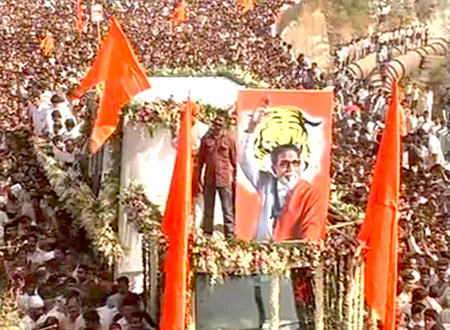
Bal Thackeray’s last journey begins

November 18, 2012

takreys_last_journey

Mumbai, November 18: The final journey of Shiv Sena patriarch Bal Thackeray began with his body being taken out for funeral procession from his residence in suburban Bandra on Sunday morning amid presence of thousands of grief-stricken Shiv Sainiks, who have come from across Maharashtra.

People were also seen showering flowers on their beloved leader, who breathed his last on Saturday, after battling prolonged illness.

Thackeray, who was critically ill since last Wednesday, was declared dead last afternoon by Dr Jaleel Parkar who was treating him. The Sena chief had been suffering from respiratory problems and pancreatic disease.

According to doctors, Thackeray passed away at 3.33 p.m. due to cardiac arrest.

Thackeray’s cortège will first go to Sena Bhavan, the party headquarters in Dadar, and the body would later be kept at Shivaji Park for people to pay their last respects.

People thronged the roadsides, flyovers, skywalks and balconies of their buildings to catch a glimpse of the Sena patriarch and pay homage to him.

In view of the legions of crowds pouring in to pay their last respects to Balasaheb, it is estimated that the funeral procession would take more than two hours to reach the Sena Bhavan (party headquarters) at Dadar.

Lakhs of Shiv Sainiks are walking along with the funeral procession, shouting slogans in memory of the Shiv Sena chief.

Scores of Shiv Sainiks arrived in the city from different parts of the State, largely from neighbouring Thane, Raigad, Pune, Aurangabad and Konkan region, which are the bastions of the saffron party, founded on June 19, 1966.

Lakhs of people were waiting since early morning to pay last respects to the leader, some even standing on the street poles.

Shiv Sainiks have also formed a human chain to enable the procession pass smoothly.

According to reports, hordes of people are arriving in the metropolis to attend the cremation of the Sena chief, to be held in the evening at 6 p.m. at the Shivaji Park, for which the Sena has taken special permission.

Thackeray addressed his first speech at the Shivaji Park ground and used to address the annual Dussehra rally there.

The body will be kept at Shiv Sena Bhavan for sometime to allow the party office-bearers to pay their last respects.

Extensive security arrangements have been put in place in the State, particularly in Mumbai, with over 20,000 police personnel deployed in the metropolis to keep a tight vigil.

Security has been beefed up at Matoshree and Shivaji Park with vehicular traffic prohibited in and around the area.

Meanwhile, a bandh-like situation prevailed in many parts of the city, Navi Mumbai and Thane in the wake of Balasaheb’s death.

“The State government has already announced that Thackeray will be accorded a State funeral,” State Protocol Minister Suresh Shetty said.

The bereaved Thackeray family is accompanied by several Sena leaders including Manohar Joshi, Diwakar Raote, party spokesperson Sanjay Raut, Neelam Gorhe, Vinayak Raut, Anil Desai, Subhash Desai, senior BJP Gopinath Munde, among others.


Comments

Add new comment

  • Coastaldigest.com reserves the right to delete or block any comments.
  • Coastaldigset.com is not responsible for its readers’ comments.
  • Comments that are abusive, incendiary or irrelevant are strictly prohibited.
  • Please use a genuine email ID and provide your name to avoid reject.
Agencies
June 6,2020

New Delhi, Jun 6: Bookings for select destinations in the USA, Canada, UK and Europe etc under Phase3 of Mission Vande Bharat opened at 5 pm on Friday, according to Air India.

"#FlyAI: Bookings for select destinations in USA, Canada, UK & Europe etc under Phase3 of #MissionVandeBharat opened at 5pm today. Around 60 million hits received till 7pm on our website & 1700 seats sold through website alone in 2 hrs. Bookings continue & tickets are being issued," the national carrier said in a tweet on Friday.

The third phase of the mission will begin from June 11 and continue till June 30.

Air India will operate five flights in the third phase of Vande Bharat Mission to evacuate almost 1,200 Indians nationals stranded in the United Kingdom between June 18 to June 23.

Air India will operate 70 flights in the third phase of Mission Vande Bharat to evacuate Indians stranded in the US and Canada between June 11 to June 30, Civil Aviation Minister Hardeep Singh Puri had said. 

Comments

Add new comment

  • Coastaldigest.com reserves the right to delete or block any comments.
  • Coastaldigset.com is not responsible for its readers’ comments.
  • Comments that are abusive, incendiary or irrelevant are strictly prohibited.
  • Please use a genuine email ID and provide your name to avoid reject.
News Network
June 18,2020

New Delhi, Jun 18: The border clash between Indian and Chinese soldiers in Ladakh broke the brittle quiet – and also the sense of security for anxious Chinese nationals in India who fear a backlash with anti-Chinese sentiment spiralling in the country.

With the high altitude violent face-off in eastern Ladakh’s Galwan Valley spurring hashtags such as “Boycott China” and “Teach Lesson to China” and leading to street protests, the undercurrents of tension were evident.

Wary of being identified, some said they had been reassured by their friends but were still apprehensive for themselves and their families.

"They (Chinese families) don''t want to speak to the media. They are not going out and are worried about their security and well being. Their families are also worried back home," Mohammed Saqib, secretary general of the India China Economic & Cultural Council, told PTI.

He added that his Chinese friends in India been calling him since they heard news about Monday night’s clashes in which 20 Indian soldiers were killed -- the worst military confrontation in five decades -- and expressed concern over growing anti-China sentiments.

A Chinese national from Beijing working in Gurgaon for a Chinese mobile firm initially refused to talk, saying he did not want to speak to the media and later shared his thoughts only on condition of anonymity.

"There is talk of border standoff and tensions, but we know Indians are very warm people and that is why I have told my family that all is fine here and they should not worry," he said.

Another Chinese national working in Gurgaon said he and his family are feeling the stress amid the spiralling conflict between India and China, but many friends have been reassuring him.

"They (Chinese in India) are under a lot of stress naturally. Such a conflict puts a lot of stress as they could bear the brunt and the same applies to Indians in China," B R Deepak, professor at the Centre for Chinese and South East Asian Studies of the Jawaharlal Nehru University said.

He said it was unfortunate that the border standoff derailed the commemorative programmes aimed at strengthening ties at a time the two countries were gearing to celebrate 70 years of establishment of diplomatic ties.

Experts also feel the border clash is likely to have a significant negative impact on the economic and people to people ties.

There are scores of Chinese in India working in various Chinese firms and also those who are studying in universities like JNU.

About 3,000 Chinese people, doing business or studying in big cities in India, were stranded in India at the start of the COVID-19 crisis, and about half of them returned to China before the lockdown began on March 25.

The Chinese Embassy in New Delhi announced on May 25 that they will arrange for flights to take back students, tourists and businesspersons to five Chinese cities, including Shanghai and Guangzhou.

"It will impact the psychology of the Chinese here. There are 2,000 Chinese firms in various sectors in India which are going to be impacted," Deepak said.

Future investments from the Chinese side could also be impacted, he said.

Moreover, as far as people-to-people contacts are concerned, the number of Chinese students choosing India as a preferred destination is likely to go down, Deepak said.

Alka Acharya, another China expert, said there are two kinds of impacts of such an incident -- short term and medium term.

Usually after the initial nationalistic reaction in the short term things tend to normalise in the medium term, but with such a border clash happening for the first time in decades clearly the resonance would be much more in both India and China, said Acharya, professor at the Centre for East Asian Studies, School of International Studies, in JNU.

“Due to the impact of the COVID-19 crisis on the economy, whether India can take a hardline in terms of economics towards China, is a tricky question,” she said.

In the immediate context, there may be a dip in economic ties with calls for boycott of Chinese goods and services, Acharya said.

The manner in which this crisis is resolved will affect how ties will be affected in the medium term, she said.

The headlines have added to the anxiety.

A group of ex-armymen gathered near the Chinese embassy to protest the killing of 20 Indian Army personnel in Ladakh’s Galwan Valley. And another group of around 10 protesters belonging to the Swadeshi Jagaran Manch protested near the Teen Murti roundabout in Central Delhi.

The anti-China sentiment prevalent among the common public is also finding a reflection in government policy with sources saying the Department of Telecom (DoT) is set to ask state-owned Bharat Sanchar Nigam Ltd (BSNL) not to use Chinese telecom gear in its 4G upgradation.

Trade bodies like CAIT are also calling for a boycott of Chinese products.

And Chinese handset maker Oppo cancelled the livestream launch of its flagship 5G smartphone in the country amid protests.

Monday night’s clashes between the Chinese and Indian troops in Galwan Valley significantly escalated the already volatile border standoff between the two countries.

The casualties on the Chinese side are not yet known. However, government sources, citing an American intelligence report, claimed the total number of soldiers killed and seriously wounded could be 35.

Comments

Add new comment

  • Coastaldigest.com reserves the right to delete or block any comments.
  • Coastaldigset.com is not responsible for its readers’ comments.
  • Comments that are abusive, incendiary or irrelevant are strictly prohibited.
  • Please use a genuine email ID and provide your name to avoid reject.
Agencies
June 30,2020

Seventy-seven per cent children below five years of age in Jammu and Kashmir were not able to access basic healthcare services like immunisation during the lockdown imposed to curb the spread of COVID-19, CRY said on Monday citing a study.

The 'Rapid Online Perception Study about the Effects of COVID-19 on Children' was conducted during the first and second phases of the lockdown based on responses of parents and primary caregivers from all across the country, including Jammu and Kashmir, the NGO said in a statement.

It said a total of 387 respondents from Jammu and Kashmir participated in the study.

"Seventy-seven per cent children of age 0-5 years were not able to access basic healthcare services such as immunisation during lockdown - necessarily imposed to curb the spread of COVID-19 pandemic in Jammu and Kashmir," Child Rights and You (CRY) said.

It said as immunisation programmes witnessed a major setback during the lockdown across the country, the results of the survey across 23 states and Union Territories found nearly 50 per cent of parents with children below five years of age unable to access immunisation services.

"Worryingly, the figure was considerably high in Jammu and Kashmir with 77.14 per cent children below five years unable to get immunisation services," it added.

According to the study, in Jammu and Kashmir, nearly 35 per cent of the respondents said their children did not receive medical help during the lockdown, resulting in difficulties to cope with their children's illnesses and health hazards.

The study also talks about more systemic arrangements and logistical preparedness to ensure that children with no or compromised digital reach are not deprived from their Right to Education.

With online classes introduced as a substitute of schools during the lockdown, access to education for children remained a major issue of concern, as many of them, especially the ones from marginalised and financially poorer backgrounds found it difficult without smartphones and internet access.

The survey's findings revealed that nationally only 41 per cent households with children of school-going age could access online classes on a regular basis.

"Almost 90 per cent parents and primary caregivers reported that the lockdown has increased the screen time of their child to great or some extent. About half of the households recorded an increase of children's exposure to online activities during lockdown," it said.

The NGO said around 76 per cent parents agreed that they could keep a watch of their children's online activity to some extent.

Comments

Add new comment

  • Coastaldigest.com reserves the right to delete or block any comments.
  • Coastaldigset.com is not responsible for its readers’ comments.
  • Comments that are abusive, incendiary or irrelevant are strictly prohibited.
  • Please use a genuine email ID and provide your name to avoid reject.