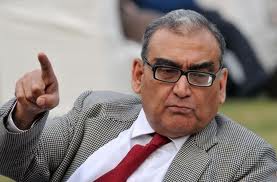
Rape isn't India's only problem, says Justice Markandey Katju

December 19, 2012

katju New Delhi, December 19: True to form, Press Council Chairman Justice Markandey Katju slammed the horrific Delhi gang rape but cautioned people against creating a hype around a single incident while unemployment, farmers' suicide and lack of healthcare remain pressing problems that need to be tackled immediately.

Katju, known for his astute and often acerbic take on current events, also stated that such an incident in rural India would not have resulted in the condemnation in media and Parliament that the Delhi rape has generated.

"I strongly condemn this crime, and am of the opinion that those who are found guilty by a court of law should be given harsh punishment. At the same time, I would like to know whether the same hue and cry which has been raised about it in the media and in Parliament would have been raised had this incident happened in some other part of India, particularly in rural India.

"I am sure it would not. But surely Delhi is not the whole of India," he said in a blog post. Katju went on to cite the case of farmers' suicide in Vidharba.

"There has been hardly any hue and cry to a similar extent about the 250,000 farmers suicide in Vidharbha, Andhra Pradesh and elsewhere over the last 10-15 years (an average of 47 farmers suicide per day, which is still continuing) which is a world record of farmers suicide," he said.

"I am not trying to justify rape but I only request people to maintain a balance and not hype the Delhi gangrape incident as if it is the only problem in the country. Section 376 Indian Penal Code already provides for a maximum of life sentence for rape, and I see no reason why capital punishment should also be provided for it," he said.

According to Katju, India needs to give equal importance to malnourished children, massive unemployment in India, the almost total lack of healthcare, education in India and skyrocketing prices.

Comments

Add new comment

  • Coastaldigest.com reserves the right to delete or block any comments.
  • Coastaldigset.com is not responsible for its readers’ comments.
  • Comments that are abusive, incendiary or irrelevant are strictly prohibited.
  • Please use a genuine email ID and provide your name to avoid reject.
News Network
March 27,2020

Mumbai, Mar 27: Reserve Bank of India (RBI) Governor Shaktikanta Das on Friday said that Monetary Policy Committee (MPC) has taken note of the global economic activity coming to a near standstill due to the coronavirus pandemic and added that large parts of the world could slip into recession in the coming days to the coronavirus crisis.
"The MPC noted that global economic activity has come to a near stand-still as COVID-19 related lockdowns and social distancing are imposed across a widening swath of affected countries. Expectations of a shallow recovery in 2020, from 2019's decade low in global growth, have been dashed," Das said.
"The outlook is now heavily contingent upon the intensity, spread and duration of the pandemic. There is a rising probability that large parts of the world will slip into recession," he added.
The RBI Governor further added that "the implied GDP growth of 4.7 per cent in Quarter 4 of 2019-20, in the second advance estimates of the National Statistics Office which was released in February 2020, within the annual estimate of 5 per cent for the year as a whole is now at risk."
As per the outlook for the year 2020-21, Das said, "Apart from continuing resilience of agriculture and allied activities most other sectors of the economy will be adversely impacted by the pandemic depending upon, its intensity, spread and duration."
Das also announced a reduction in the repo and reverse repo rates for banks.
"The repo rate has been reduced by 75 basis points to 4.4 per cent. The reserve repo rate has been reduced by 90 basis points to 4 per cent," Das said addressing the media.
The decision for "a sizeable reduction" in the policy repo rate, according to the RBI Governor was taken to "revive growth and mitigate the impact of COVID-19 and ensure financial stability." 

Comments

Add new comment

  • Coastaldigest.com reserves the right to delete or block any comments.
  • Coastaldigset.com is not responsible for its readers’ comments.
  • Comments that are abusive, incendiary or irrelevant are strictly prohibited.
  • Please use a genuine email ID and provide your name to avoid reject.
News Network
March 7,2020

Thiruvananthapuram, Mar 7: Kerala Chief Minister Pinarayi Vijayan on Saturday came down heavily on the BJP-led government at the Centre for imposing a ban on two Malayalam channels in connection with the Delhi violence reporting, saying an "undeclared emergency" was prevailing in the country.

Terming the ban as a "dangerous trend", the left leader said it was an indication of the coming dangers. "The Centre has made an infringement into the freedom of the press, crossing all limits. There is a threat that if anybody criticises RSS and Sangh Parivar, they will be taught a lesson," he said here in a statement.

The channels- Asianet News and MediaOne were suspended for 48 hours over their coverage of last month's riots in Delhi, with the official orders saying they covered events on February 25 in a manner that "highlighted the attack on places of worship and siding towards a particular community".

However, the ban was lifted on Saturday morning. Urging everyone to adopt a "democratic vigil" against such trends, the Chief Minister said the tactics of the Centre was to bring everyone under its control by instilling fear.

It was seen that such an approach had repeatedly been made on Parliament, constitutional bodies and judiciary in recent times, he said. Claiming that one of the reasons for the ban was criticism of RSS and the Delhi police by the channels, he said no one is beyond that. "How can it be illegal to criticise RSS? The Constitution guarantees the right of any citizen to express his opinion fearlessly," he said.

People have the right to know what is happening in the country and the media has the right and responsibility to report it, Vijayan said adding that the fourth estate should be allowed to act "freely and equitably". The ban on Asianet News was lifted at 1.30 am, while the ban on Media One was lifted at 9.30 am on Saturday, a source at the Ministry of Information and Broadcasting told PTI.

Sources said the two channels had written to the ministry seeking revocation of the bans, following which it was lifted. "Channel's reporting on Delhi violence seems to be biased as it is deliberately focusing on the vandalism of CAA supporters," the ministry order on Media One had said.

"It also questions RSS and alleges Delhi Police inaction. Channel seems to be critical towards Delhi Police and RSS." The ministry had ordered prohibition of transmission or re-transmission of Media One and Asianet News for 48 hours on any platform throughout India with effect from 7.30 pm on Friday to 7.30 pm on Sunday. The Congress and the CPI had flayed the government over the suspension of Media One and Asianet News, calling the clampdown as "stifling of media freedom".

Former chief minister Oommen Chandy said the ban on the two malayalam channels was an "affront" on the democratic rights of the media. The fourth estate is the pillar of democracy and attempts to suppress the media by the government is "extremely worrying", he said in a facebook post.

"I join all democratic minded citizens in strongly condemning such attempts to muzzle the media by the government," he said. Meanwhile, Press Club, Kerala Union of Working Jouranlists (KUWJ) and Kerala Newspaper Employees Federation (KNEF) took out a march to the General Post Office here against the Centre's action on the two channels.

Media personnel holding placards and raising slogans participated in the march against the centre's decision. Similar protests were held in various parts of the state.

Comments

Indian
 - 
Saturday, 7 Mar 2020

All these are happening in our nation only because of EVM tamper. Unless Ballot voting criminals will spoil our nations unity and image.


Jai Hind


Add new comment

  • Coastaldigest.com reserves the right to delete or block any comments.
  • Coastaldigset.com is not responsible for its readers’ comments.
  • Comments that are abusive, incendiary or irrelevant are strictly prohibited.
  • Please use a genuine email ID and provide your name to avoid reject.
Agencies
June 29,2020

From March through May, around 1 crore migrant workers fled India’s megacities, afraid to be unemployed, hungry and far from family during the world’s biggest anti-Covid-19 lockdown.

Now, as Asia’s third-largest economy slowly reopens, the effects of that massive relocation are rippling across the country. Urban industries don’t have enough workers to get back to capacity, and rural states worry that without the flow of remittances from the city, already poor families will be even worse off -- and a bigger strain on state coffers.

Meanwhile, migrant workers aren’t expected to return to the cities as long as the virus is spreading and work is uncertain. States are rolling out stimulus programs, but India’s economy is hurtling for its first contraction in more than 40 years, and without enough jobs, a volatile political climate gets more so.

“This will be a huge economic shock, especially for households of short-term, cyclical migrants, who tend to come from vulnerable, poor and low-caste and tribal backgrounds,” said Varun Aggarwal, a founder of India Migration Now, a research and advocacy group based in Mumbai.

In the first 15 days of India’s lockdown, domestic remittances dropped by 90%, according to Rishi Gupta, chief executive officer of Mumbai-based Fino Paytech Ltd., which operates the country’s biggest payments bank.

By the end of May, remittances were back to around 1750 rupees ($23), about half the pre-Covid average. Gupta’s not sure how soon it’ll fully recover. “Migrants are in no hurry to come back,” Gupta said. “They’re saying that they’re not thinking of going back at all.”

If workers stay in their home states long term, policymakers will have more than remittances to worry about. If consumption falls and the new surplus of labor drives wages down, Agarwal said, “there will also be a second-order shock to the local economy. Overall, not looking good.”

India announced a $277 billion stimulus package in May and followed it up with a $7 billion program aimed at creating jobs for 125 days for migrants in villages across 116 districts. Separately, local authorities are also looking for solutions.

Officials in Bihar have identified 2,500 acres of land that could be made available to investors, said Sushil Modi, deputy chief minister of Bihar, a state in east India. “We can use this crisis as an opportunity to speed up reforms,” he said.

The investors haven’t materialised yet, and in the meanwhile, state governments are relying on the national cash-for-work program that guarantees 100 days worth of wages per household.

Skilled workers don’t want to do manual labor offered through the program, and even if they did, says Amitabh Kundu of RIS, many think of it as beneath their station. “There will be an increase in social tensions,” he predicts. “Caste may again start playing a role. It’s absolute chaos.”

For skilled workers, initiatives vary:

* Uttar Pradesh, which received 3.2 million people, is compiling lists of skilled workers who need employment and trying to place them with local manufacturing and real estate industry associations. So far, the government says, it’s placed 300,000 people with construction and real estate firms.

* Bihar has placed returners in state-run infrastructure projects and hired others to stitch uniforms and make furniture for government-run schools, even as they waited in quarantine centres, said Pratyay Amrit, head of the state’s disaster management department.

* The eastern state of Odisha announced an urban wage employment program aimed at putting as many as 450,000 day labourers to work through September. Some 25,000 people have been employed, so far, under the scheme, G. Mathivathanan, principal secretary for housing and urban development said.

Attracting Investments

It’s not clear any of this will be enough to make a dent, says Ravi Srivastava, professor at New Delhi-based Institute of Human Development, adding that the states don’t have much of a track record on economic development.

“It was the failure of these states to improve governance and put development plans in place that led to the out-migration in the first place,” he said.

But officials and workers’ rights advocates see opportunity. Uttar Pradesh has established liaisons to encourage companies from the US, Japan and South Korea to establish manufacturing in the state. There and in Madhya Pradesh and Rajasthan, the government has made labour laws more friendly to employers, making it easier to hire and fire workers.

Modi, the minister from Bihar, said the migration may also give workers--historically a disenfranchised group--new power, particularly as urban centres struggle. “The way industries treated workers during the lockdown -- didn’t pay them, the living conditions were poor -- now these industries will realize the value of this force,” Modi said.

“In the days to come, labour will emerge as a force that can’t be ignored anymore,” he added. “That’s the new normal. We will work out how to ensure dignity, rights to our people who are going to work in other states.”

Bihar is due for elections by November, a vote that could be an early test of the mass migration’s political consequences. The state is currently governed by a coalition that includes Prime Minister Narendra Modi’s Bharatiya Janata Party. Amitabh Kundu, a fellow at the Research and Information System for Developing Countries, a New Delhi-based government think-tank, said migrant workers are likely to be angry voters.

“Chief ministers are telling these migrants that they will not have to go back for work,” he said. “But their capacity to do something miraculous in the next four to five months is doubtful. If they can retain even one-fourth of the migrants, I would call it a success.”


Comments

Add new comment

  • Coastaldigest.com reserves the right to delete or block any comments.
  • Coastaldigset.com is not responsible for its readers’ comments.
  • Comments that are abusive, incendiary or irrelevant are strictly prohibited.
  • Please use a genuine email ID and provide your name to avoid reject.