



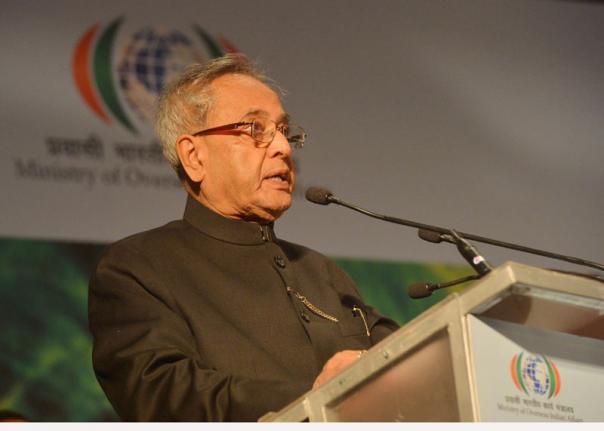
Indian diaspora should help build knowledge society: President

January 10, 2013

pranab_at_PBD

Kochi, Jan 10: President Pranab Mukherjee Wednesday said India sees its vast diaspora as a valuable contributor to its growth and is keen to expand the bonds further in building an inclusive and knowledge society.

The president said the record remittance of $67 billion from overseas Indians was a testimony to both the emotional attachment and the fulfillment in investing in India's strong economy.

"We should explore ways and means to encourage further participation by the diaspora to give additional impetus to India's growth story," Mukherjee said at the 11th Pravasi Bharatiya Divas here.

"I also wish to see the Indian diaspora as a stronger partner, not only in India's economic growth, but also in building India's knowledge society, while continuing to engage culturally and emotionally, and serving as the effective ambassadors that they have been for this country," the president said.

He said India was the world's third-largest economy on the basis of purchasing power parity and the second fastest growing economy after China.

"In six out of nine years, our country managed to grow at a rate above eight percent. Due to the slowdown in the global economy and other factors, the growth rates have declined -- from 8.4 percent in 2010-11 to 6.5 percent in 2011-12, and further to 5.4 percent in the first half of 2012-13," he said.

He said the diaspora could become partners in India's progress.

"For accelerated growth, investment level has to increase. You all can help in the process by investing in Indian companies and establishing new ventures. The yield of Indian equity markets is amongst the highest in the world and many of the most famous companies have established business here or seeking to do so," he said.

Mukherjee said that during his tenure as finance minister, he opened up the Indian capital market for qualified foreign investors (QFIs).

"Initially, we permitted QFIs to invest in Indian mutual funds and on January 1, 2012, in a far-reaching decision, we opened the doors for them to directly invest in Indian equities.

"Soon, the corporate bond market was opened to QFIs. You may, therefore, also like to look at the opportunity that India offers in this regard and take advantage of the high yield that you are likely to get by investing in the Indian capital markets," he said.

Pravasi Bharatiya Divas -- India's annual exposition to connect with its 130-million diaspora in 130 countries -- also saw the president confer the Pravasi Bharatiya Samman awards on 15 pre-eminent overseas Indians for their contributions.

In his address, the president lauded the contributions of the Indian diaspora in areas ranging from social service and polity to economy, science and culture.

"It is a matter of pride for every Indian that there are at least five heads of state or government, and over 70 senior political leaders such as deputy heads of state, speakers, ministers in various countries, who can trace their roots to India," Mukherjee said.

The chief guest at the event was Mauritius President Rajkeswur Purryag, who was also among the recipients of the Pravasi Bharatiya Samman.

Comments

Add new comment

  • Coastaldigest.com reserves the right to delete or block any comments.
  • Coastaldigset.com is not responsible for its readers’ comments.
  • Comments that are abusive, incendiary or irrelevant are strictly prohibited.
  • Please use a genuine email ID and provide your name to avoid reject.
News Network
January 20,2020

Davos, Jan 20: India's richest 1 per cent hold more than four-times the wealth held by 953 million people who make up for the bottom 70 per cent of the country's population, while the total wealth of all Indian billionaires is more than the full-year budget, a new study said on Monday.

Releasing the study 'Time to Care' here ahead of the 50th annual meeting of the World Economic Forum (WEF), rights group Oxfam also said the world's 2,153 billionaires have more wealth than the 4.6 billion people who make up 60 per cent of the planet's population.

The report flagged that global inequality is shockingly entrenched and vast and the number of billionaires has doubled in the last decade, despite their combined wealth having declined in the last year.

"The gap between rich and poor can't be resolved without deliberate inequality-busting policies, and too few governments are committed to these," said Oxfam India CEO Amitabh Behar, who is here to represent the Oxfam confederation this year.

The issues of income and gender inequality are expected to figure prominently in discussions at the five-day summit of the WEF, starting Monday. The WEF's annual global risks Report has also warned that the downward pressure on the global economy from macroeconomic fragilities and financial inequality continued to intensify in 2019.

Concern about inequality underlies recent social unrest in almost every continent, although it may be sparked by different tipping points such as corruption, constitutional breaches, or the rise in prices for basic goods and services, as per the WEF report.

Although global inequality has declined over the past three decades, domestic income inequality has risen in many countries, particularly in advanced economies and reached historic highs in some, the Global Risks Report flagged last week.

The Oxfam report further said "sexist" economies are fuelling the inequality crisis by enabling a wealthy elite to accumulate vast fortunes at the expense of ordinary people and particularly poor women and girls.

Regarding India, Oxfam said the combined total wealth of 63 Indian billionaires is higher than the total Union Budget of India for the fiscal year 2018-19 which was at Rs 24,42,200 crore.

"Our broken economies are lining the pockets of billionaires and big business at the expense of ordinary men and women. No wonder people are starting to question whether billionaires should even exist," Behar said.

As per the report, it would take a female domestic worker 22,277 years to earn what a top CEO of a technology company makes in one year.

With earnings pegged at Rs 106 per second, a tech CEO would make more in 10 minutes than what a domestic worker would make in one year.

It further said women and girls put in 3.26 billion hours of unpaid care work each and every day -- a contribution to the Indian economy of at least Rs 19 lakh crore a year, which is 20 times the entire education budget of India in 2019 (Rs 93,000 crore).

Besides, direct public investments in the care economy of 2 per cent of GDP would potentially create 11 million new jobs and make up for the 11 million jobs lost in 2018, the report said.

Behar said the gap between rich and poor cannot be resolved without deliberate inequality-busting policies, and too few governments are committed to these.

He said women and girls are among those who benefit the least from today's economic system.

"They spend billions of hours cooking, cleaning and caring for children and the elderly. Unpaid care work is the 'hidden engine' that keeps the wheels of our economies, businesses and societies moving.

"It is driven by women who often have little time to get an education, earn a decent living or have a say in how our societies are run, and who are therefore trapped at the bottom of the economy,” Behar added.

Oxfam said governments are massively under-taxing the wealthiest individuals and corporations and failing to collect revenues that could help lift the responsibility of care from women and tackle poverty and inequality.

Besides, the governments are also underfunding vital public services and infrastructure that could help reduce women and girls' workload, the report said.

As per the global survey, the 22 richest men in the world have more wealth than all the women in Africa.

Besides, women and girls put in 12.5 billion hours of unpaid care work each and every day -- a contribution to the global economy of at least USD 10.8 trillion a year, more than three times the size of the global tech industry.

Getting the richest one per cent to pay just 0.5 per cent extra tax on their wealth over the next 10 years would equal the investment needed to create 117 million jobs in sectors such as elderly and childcare, education and health.

Governments must prioritise care as being as important as all other sectors in order to build more human economies that work for everyone, not just a fortunate few, Behar said.

Oxfam said its calculations are based on the latest data sources available, including from the Credit Suisse Research Institute's Global Wealth Databook 2019 and Forbes' 2019 billionaires list.

Comments

Add new comment

  • Coastaldigest.com reserves the right to delete or block any comments.
  • Coastaldigset.com is not responsible for its readers’ comments.
  • Comments that are abusive, incendiary or irrelevant are strictly prohibited.
  • Please use a genuine email ID and provide your name to avoid reject.
News Network
April 3,2020

Washington, Apr 3: The World Bank has approved USD 1 billion emergency funding for India to help it tackle the coronavirus pandemic, which has claimed 76 lives and infected 2,500 people in the country.

The World Bank's first set of aid projects, amounting to USD 1.9 billion, will assist 25 countries, and new operations are moving forward in over 40 nations using the fast-track process, the bank said on Thursday.

The largest chunk of the emergency financial assistance has gone to India USD 1 billion.

"In India, USD 1 billion emergency financing will support better screening, contact tracing, and laboratory diagnostics; procure personal protective equipment; and set up new isolation wards," the World Bank said after its Board of Executive Directors approved the first set of emergency support operations for developing countries around the world, using a dedicated, fast-track facility for COVID-19 response.

In South Asia, the World Bank also approved USD 200 million for Pakistan, USD 100 million for Afghanistan, USD 7.3 million for the Maldives and USD 128.6 million for Sri Lanka.

The World Bank said it was now working to grant up to USD 160 billion over the next 15 months to support measures to tackle the pandemic which will focus on the immediate health consequences and bolster economic recovery.

The broader economic program will aim to shorten the time to recovery, create conditions for growth, support small and medium enterprises, and help protect the poor and vulnerable.

"The World Bank Group is taking broad, fast action to reduce the spread of COVID-19 and we already have health response operations moving forward in over 65 countries," said World Bank Group President David Malpass.

"We are working to strengthen (the) developing nations' ability to respond to the COVID-19 pandemic and shorten the time to economic and social recovery," Malpass said.

According to the bank, USD 100 million will support Afghanistan to slow and limit the spread of COVID-19 through enhanced detection, surveillance, and laboratory systems, as well as strengthen essential health care delivery and intensive care.

In Pakistan, USD 200 million will support preparedness and emergency response in the health sector and include social protection and education measures, the bank said.

A total of 1,002,159 COVID-19 cases have been reported across more than 175 countries and territories with 51,485 deaths reported so far, according to Johns Hopkins University data.

Comments

Add new comment

  • Coastaldigest.com reserves the right to delete or block any comments.
  • Coastaldigset.com is not responsible for its readers’ comments.
  • Comments that are abusive, incendiary or irrelevant are strictly prohibited.
  • Please use a genuine email ID and provide your name to avoid reject.
News Network
February 13,2020

New Delhi, Feb 13: Arvind Kejriwal wrote to Delhi Lieutenant Governor Anil Baijal on Wednesday, staking claim to form the government in the national capital, sources said, while hinting that the AAP might not invite senior leaders and chief ministers of other parties for the oath-taking ceremony.

The sources said it was the formal process by the AAP chief, who was elected as the legislature party leader earlier in the day, to stake claim for forming the new government.

Kejriwal, who returned to power in Delhi with a stunning poll victory on Tuesday, will take oath as chief minister for the third consecutive time on February 16.

While the oath-taking ceremony will be open to the public, the Aam Aadmi Party (AAP) was considering not inviting leaders and chief ministers of other parties as it did not wish to be seen as a "confrontationist" against the BJP-led Centre, the sources said.

They, however, added that the party was yet to take a decision on it.

The AAP has planned mobilisation of people for the mega event and all the newly-elected MLAs of the party have been asked to ensure huge participation from their constituencies.

"I request the people of Delhi to attend the oath-taking ceremony of the chief minister at the Ramlila Maidan in large numbers," senior AAP leader Manish Sisodia told reporters, adding that the ceremony will start at 10 am.

The AAP won 62 seats in the 70-member Delhi Assembly, while the Bharatiya Janata Party (BJP) bagged the remaining eight seats. The Congress drew a blank for the second consecutive time in the Delhi polls.

Comments

Add new comment

  • Coastaldigest.com reserves the right to delete or block any comments.
  • Coastaldigset.com is not responsible for its readers’ comments.
  • Comments that are abusive, incendiary or irrelevant are strictly prohibited.
  • Please use a genuine email ID and provide your name to avoid reject.